Use this tool when
Addressing holistic credit mobility priorities that cannot be solved by one office, institution, system, or sector alone and you need to determine who must act, what each partner must contribute and why, and how the collaboration will improve learner mobility.
What you should leave with
A specific learner problem statement; a prioritized partner coalition; clear roles and commitments; a partnership-health baseline; and a 90-day action plan.
Active collaboration is one of five necessary supports for holistic credit mobility. Beyond creating stronger relationships, active collaboration supports all core principles. Collaboration is critical as states, systems, and institutions work to count validated learning, prevent repeated learning, connect learning across siloed sectors, provide clear guidance, and design programs that accommodate diverse pathways. The strongest collaborations also coordinate the policy, practice, technology, and data that can enable students to carry forward what they have already learned and take the shortest viable route to the credential they seek.
Using this Tool
This tool, comprising five workshop activities, will guide you towards constructing a coalition aimed at addressing a key learner problem. The activities progress sequentially, but, depending on the status of your current credit mobility initiatives and collaboration, can be started at any point. We encourage all users to start with Step 1, which helps structure the learner mobility problem that you hope to address via collaboration.
| Section | Purpose |
|---|---|
| 1. Define the Learner Mobility Problem | Define the learner mobility friction, desired outcome, and relevant principles. |
| 2. Map What Must Change Across the Five Necessary Supports | Identify policy, practice, technology, collaboration, and data advanced via collaboration. |
| 3. Identify and Prioritize the Partners who can Change the Barrier | Scan internal and external partners and prioritize by ability to enact change and readiness to act. |
| 4. Design the Collaboration around a Shared Learner Outcome and Commit to the Next 90 Days | Create a one-page charter to center learner outcomes and stipulate roles, actions, decision rights, meeting cadence, and strategy. |
| 5. Complete a Targeted Partnership Health Assessment | Use a 14-item targeted assessment to maintain momentum. |
Step 1. Define the Learner Mobility Problem
Before identifying partners and collaborators, read the holistic credit mobility framework and review your self-assessment results. With these in mind, begin by stating the learner pain points you are working to address. These may include inconsistent validation of prior learning, knowledge gaps among advisors, repeating accomplished learning, anemic relationships with cross-sector partners, or other bottlenecks identified in the report.
From this initial brainstorming, this tool can help cumulatively scope the problem and design a strategy for collaboration. Be concrete so that you can observe whether the problem improves. Remember, it’s okay to start small. This activity can be completed multiple times to align with various initiatives.
Define a learner problem statement
Students with [type/source of learning] currently experience [barrier] because [root cause], resulting in [time, cost, momentum, or completion consequence].
_____________________________________________________________
Which learners are affected?
Which learners encounter this barrier most often?
_____________________________________________________________
What are the top desired learner outcomes?
What should become easier, faster, clearer, or more portable?
_____________________________________________________________
What evidence supports this conclusion or is lacking?
What data, student feedback, workflow evidence, or recurring cases show that this problem exists?
_____________________________________________________________
Next, select the principle(s) this work must advance
□ Principle I Count validated learning regardless of source
□ Principle II Avoid repeated learning of the same content
□ Principle III Link learning across K–12, higher education, and workforce
□ Principle IV Provide clear guidance on how learning will count towards a specific degree
□ Principle V Maximize program flexibility to accommodate diverse learning pathways

Quick check
If you cannot explain how collaboration will improve at least one principle for learners, the partnership goal is still too broad. Most high-value credit mobility efforts will touch more than one principle.
Step 2. Map What Must Change Across the Five Necessary Supports
Active collaboration is the primary support you will leverage. Use this scan to identify the conditions the partnership must create, sustain, or change. Complete only the rows that matter to your learner problem.
| Support | Key Questions | Current Successes | Existing Barriers | Potential Actions |
| Effective Policy | Which rules, requirements, agreements, standards, funding incentives, or decision authorities contribute to the barrier? | |||
| Responsive Practice | Which workflows must change: intake, evaluation, faculty review, transcript processing, advising, degree audit, exception handling, or handoff between offices? | |||
| Supportive Technology | Which system, tool, public resource, equivalency database, or degree-planning function must be aligned or improved? | |||
| Active Collaboration | Which relationships, governance structures, cross-office routines, or shared decisions are required? | |||
| Data & Measurement | What data must be shared or reviewed to understand the barrier and know whether the solution is working? |
Step 3. Identify and Prioritize the Partners who can Change the Barrier
For advancing holistic credit mobility, internal partners are often as important as external partners. These partners can range across sectors and functions, including actors who can authorize change, implement it, maintain the underlying data or technology, validate learning, guide learners, and represent learner experience.
Identify: Prospective Partners Sweep
The table below outlines common partners and the areas they often intersect with holistic credit mobility. This list, while not exhaustive, provides a starting off point for aligning partner roles.
| Holistic Credit Mobility Function | Potential Partners |
| Policy / decision authority | State boards or agencies; system offices; presidents/provosts; faculty governance; academic affairs; legal/policy leaders |
| Learning validation / curriculum | Faculty; department chairs; curriculum committees; CPL leaders; credential providers; military or workforce subject-matter experts |
| Student-facing practice | Admissions; advising; transfer centers; registrar; enrollment; financial aid; student success; K–12 counselors; workforce navigators, CBOs |
| Technology / data stewardship | IT; institutional research; data governance; SIS/degree audit owners; transfer-technology teams; vendors or data exchanges |
| Cross-sector pathway partners | K–12 districts; community colleges; universities; technical colleges; employers; workforce boards; industry associations; military organizations; community-based organizations, HEPs and Department of Corrections |
| Conveners / champions / resources | Consortia; intermediaries; foundations; chambers; trusted champions; funders; community leaders |
| Learner voice | Transfer students; adult learners; military-connected learners; dual-enrollment students; student organizations; alumni, justice-impacted students |
Begin to list partners in the table below, noting how they support your learner problem, what principles and supports they advance, and their authority or capacity to influence your initiative. Then, add in detail on your existing relationship (strong: work together regularly; moderate: have worked together before; emerging: have not worked together previously).
| Partner Name | Why Needed for This Learner Problem? | Principle(s) Addressed (I / II / III / IV / V) | Support(s) Unlocked (Policy / Practice / Tech / Collab / Data) | Authority / Capacity | Relationship (Strong / Moderate / Emerging) |
Prioritize: Map Holistic Credit Mobility Ability and Readiness
After identifying key existing and potential stakeholders, evaluate them relative to one another in order to understand who are the most engaged and important to your problem. One way to accomplish this is to map stakeholders within a “Boston Square” and visually capture the degree to which each stakeholder has resources and influence (ability to act) over the relevant issues against their level of interest or incentive to engage (readiness to engage). The goal is not to identify the “most powerful” stakeholder in the abstract; it is to identify who can materially remove this specific barrier and how ready they are to engage to address it today.
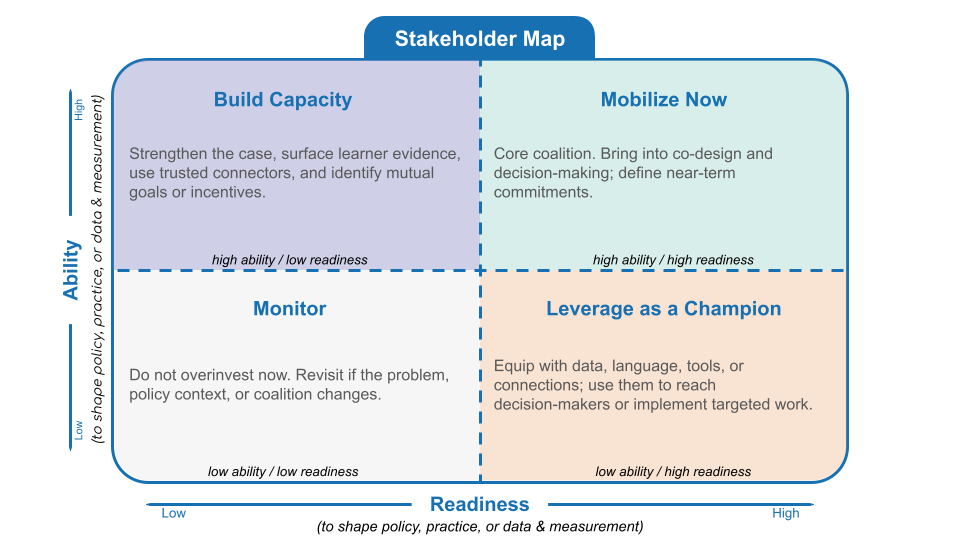
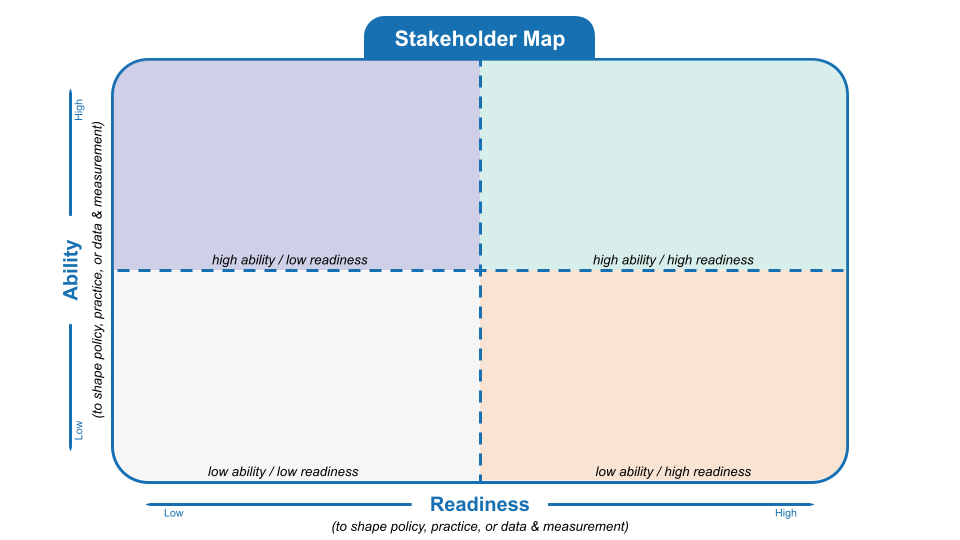 Ideal partners will be in the top right quadrant with strong ability and readiness. However, it is rarely so clear cut. There may be cases where: 1) significant awareness-raising is required to turn a highly-influential but low-interest stakeholder into an interested potential partner or 2) significant capacity development is necessary to turn a stakeholder with high interest but low influence into a stronger partner. In other words, the initial results of this mapping exercise are subject to change and can guide strategy around which partners you need to motivate or strengthen your casemaking to.
Define: Curate Your List of Necessary Partners
Now that you have enumerated potential partners and triaged them, as they pertain to your specific issue, take stock of the Boston Square results above. Who is in each quadrant? Are there collaborators you did not expect amongst the critical group of potential partners? How strong are your existing relationships with the key partners? The table below sets forth suggested strategies and actions for the partners you identified, based on their location within the grid.
Step 4. Design the Collaboration around a Shared Learner Outcome and Commit to the Next 90 Days
Identifying collaborators is only half the battle; now you need to leverage them. Use this two-page charter with the partners you have prioritized in Step 3. A durable collaboration makes the learner outcome explicit, assigns the supports, clarifies roles and responsibilities, and agrees on how progress will be reviewed. Take your learner problem statement from page [1] and refine it now. Invert the premise: instead of addressing this as a problem, reframe it as a desired outcome or set of outcomes. (For further treatment of structuring initiatives and increasing buy-in, see Making the Case for Holistic Credit Mobility.)
Shared Learner Outcome
Within [time period], learners with [type/source of learning] will be able to [observable mobility outcome].
____________________________________________________________
Establish: Partners in the Core Coalition
Now that you have solidified your learner problem statement, establish roles and responsibilities. Spend time early setting initial protocols around decision making, communication, expectations, and ongoing working relationships. The table below presents key considerations that feed into these more mundane yet essential elements of successful credit mobility partnerships.
| Primary Role | Key Considerations | Partner(s) | Owners(s) | Immediate Next Step |
| Decision rights | Which decisions can this group make? Which require faculty governance, executive, board, agency, or legislative action? | |||
| Communication rhythm | What routine meetings, working sessions, backchannels, and shared tools will keep implementation moving? | |||
| Contribution expectations | What staff time, data, technology, funding, subject-matter expertise, or convening capacity will each partner contribute? | |||
| Learner voice | How will affected learners inform design, test clarity, or surface implementation problems? | |||
| Escalation | How will the group address conflicts, stalled decisions, inconsistent implementation, or competing priorities? | |||
| Scale / maintenance | What will be piloted first? What evidence would justify expansion? Who will maintain the work when leaders, priorities, or resources change? |
Enhance: Choose Measures that Reveal Whether Mobility Improved
With the right actors in place, develop a list of measures to measure success. These can be shared in common or partner-specific. Improving each should address your learner problem statement. Refer to the Data Readiness and Prioritization Worksheet attached to the Key Performance Indicators to Track Learner Success tool and report here the top three metrics you will treat as goalposts.
| Priority KPI | Why This KPI Matters in Our Context | Partner(s) | Owners | Immediate Next Step |
| KPI 1 | ||||
| KPI 2 | ||||
| KPI 3 |
Enact: Commit to the Next 90 Days
At this point, you have clearly identified how you will leverage the necessary supports to advance the desired learner outcome and set forth the guardrails of your collaboration cadence and structure. It’s time to act. Choose no more than three priorities to take immediate action on to quickly build evidence, unblock implementation, or generate buy-in. These should be actionable, measurable steps; do not end with “let’s continue the conversation.” See Module A in Making the Case for Holistic Credit Mobility for additional steps in developing and communicating your plan.
This final table is the action component of your collaboration’s initial guiding charter. Though foundational, it is a living document: refine it over time through feedback with key stakeholders.
| Priority / Barrier | Action | Partner(s) | Support(s) Addressed | Owner / Target Date | Near-Term Output | Evidence of Progress |
| Priority 1 | ||||||
| Priority 2 | ||||||
| Priority 3 |
Next review date: ___________________
What would make us expand or scale? _____________________________________________________
What would make us change course or stop?_________________________________________________

Final check
Can every core partner explain (1) the learner problem, (2) their roles and responsibilities, (3) the evidence the group will use to judge progress, (4) the support(s) being advanced, and (5) their next action? If not, refocus the collaboration before adding more partners or activities.
Step 5: Complete a Targeted Partnership Health Assessment
Periodic assessments of partnership health can be a key tool for measuring alignment, mutual benefit, ability to meet goals, and sustainability. The assessment below, adapted from The Intersector Toolkit: Tools for Cross-Sector Collaboration,”[1] contains key considerations for quantifying the health of an individual partner relationship.
Choose one cross-sector partner that you have identified as critical to your holistic credit mobility project to focus on while completing the following assessment. This brief partner assessment probes fundamental aspects of cross-sector partnership design, structure, leadership, and administration. Using the scale below, reflect on the extent to which you agree or disagree that your partnership meets the following criteria before tallying your scores.
A strong relationship is necessary but not sufficient. This assessment asks whether the partnership is aligned to a learner outcome, has the authority and operating structure to act, coordinates the relevant supports, and uses evidence to improve.
Assessment Scale
- Completely Disagree
- Somewhat Disagree
- Somewhat Agree
- Completely Agree
| Partner Identified: ________________________________ | Response |
| Holistic Credit Mobility Principle Alignment | _______________ |
| Partners share a specific learner mobility problem and a clear, observable learner outcome. | _______________ |
| Partners can name the holistic credit mobility principle(s) this collaboration advances and how success would improve the learner journey. | _______________ |
| The collaboration is compatible with partner missions while keeping learner mobility as the common purpose. | _______________ |
| Governance & Roles | _______________ |
| The coalition includes the people or organizations with authority to make the policy, program, practice, technology, or data decisions the work requires. | _______________ |
| Roles are explicit across the needed holistic credit mobility functions: policy authority, validation/curriculum, practice, guidance/pathways, technology/data, convening, and learner voice. | _______________ |
| Faculty, staff, cross-sector partners, and learners are engaged at the points where their expertise or experience is necessary. | _______________ |
| Time, staff, data, technology, funding, and other contributions are clear and equitable enough for partners to meet their commitments. | _______________ |
| Operations & Trust | ______________ |
| Partners use reliable communication and working routines that support decisions and follow-through, not simply information sharing. | ______________ |
| Shared guidance, workflows, tools, and messages are consistent enough that learners receive reinforcing answers across partners. | ______________ |
| Partners have a trusted process for resolving tensions, escalating stalled issues, and adapting when constraints or priorities change. | ______________ |
| Evidence & Improvement | _______________ |
| Partners track measures that show whether validated learning is recognized, applied, visible, portable, and moving learners efficiently toward credentials. | _______________ |
| Partners share and review data on a regular cycle, including learner feedback, and use the evidence to change policies, practices, pathways, or tools. | _______________ |
| Sustainability | _______________ |
| Responsibilities are embedded in roles, agreements, plans, or routines so the work can survive leadership, staffing, resource, and priority changes. | _______________ |
| Partners have identified what should be piloted, maintained, expanded, or stopped based on evidence and changing learner needs. | _______________ |
| Tally Scores Here | _______________ |
Understanding Your Score
| Score | Interpretation | Action |
| 43–56 | Strong | Sustain momentum, document shared practices, maintain evidence routines, and plan for leadership transitions and scale. |
| 29–42 | Developing | Identify the two lowest-scoring areas. Select one concrete change for each and assign a 90-day owner and measure. |
| 14–28 | Emerging / Fragile | Revisit the learner problem, coalition membership, decision authority, roles, communication routines, and cross-support commitments before expanding the work. |
Acknowledgements
This report was made possible through generous support from Ascendium Education Group. The views expressed in this report do not necessarily reflect the positions or policies of the funder. In developing this resource, authors drew on expertise and insights shared by members of the Holistic Credit Mobility Acceleration Cohort, which included: EDWorks of Northeast Tennessee, Eastern Washington University on behalf of a regional group of education and training organizations, Idaho State Board of Education, Louisiana Board of Regents, Minnesota State Colleges & Universities, Missouri Department of Higher Education & Workforce Development, Nevada System of Higher Education, Ohio Department of Higher Education, Pennsylvania State System of Higher Education, South Carolina Commission on Higher Education, Shasta College/North State Together Partnership, and University System of Georgia. The authors are also grateful for excellent copyediting and design from Kimberly Lutz and Juni Ahari and thought partnership from Complete College America.
Endnotes
- “The Intersector Toolkit: Tools for Cross-Sector Collaboration,” The Intersector Project, https://intersector.com/wp-content/uploads/2017/08/The-Intersector-Project-Toolkit.pdf. ↑