The Benefits of Institutional Debt Relief for Adult Learners
Three Years of Evidence from Northeast Ohio
For the 37 million adults in the US who have completed some college but do not have a degree or credential (SCNC), financial costs are one of the biggest barriers to returning. Institutional debt—unpaid balances that a student owes to their college or university after stopping out—is a specific challenge that many students with SCNC face. In 2020, we estimated that as many as 6.6 million students were unable to re-enroll or transfer because of an unpaid institutional debt. With these balances preventing enrollment, individuals are unable to turn their credits into degrees and credentials, institutions are unable to benefit from re-enrolled students’ tuition and graduation, and regions and states miss out on a key opportunity to close workforce credential gaps. The Ohio College Comeback Compact (the Compact), which launched in Fall 2022 and concluded in Fall 2025, took an innovative approach to re-enrollment by canceling up to $5,000 in institutional debt as students re-enrolled and made progress toward their degrees, treating unpaid balances as a student engagement strategy rather than a collection effort.
For decades, colleges and universities leveraged registration and transcript holds as a means to compel payment of past due balances—a practice encouraged by the Department of Education at least as far back as a 1998 Dear Colleague letter and employed by 95 percent of institutions in 2020. While a standard business practice, the consequences for students were significant even as they flew under the radar. Learners with stranded credits were prevented from completing their credential, despite having the desire and aptitude to do so. The Compact, alongside similar programs in Detroit and Southwest Ohio, reimagined the status quo and tested a different approach. The results challenged the assumptions institutions held about this population of students, including their behaviors, the impact of institutional debt, and the risk assumed by re-engaging this population.
The Compact worked with the eight public colleges and universities in Northeast Ohio—Cleveland State University, Cuyahoga County Community College, Kent State University, Lakeland Community College, Lorain County Community College, Stark State College, The University of Akron, and Youngstown State University—to collaboratively address stranded credits by removing administrative holds and resolving past-due balances for qualified students. More than 15,000 students had the opportunity to re-enroll at any of the eight institutions, whether to return to their debt-holding institution or to transfer. With the barrier of stranded credits removed and supported by coordinated outreach and advising, 723 students opted to return. This 4.6 percent re-enrollment rate is more than double the re-enrollment rate of Ohio’s total population of adults with some college but no credential.
Students didn’t just return; they succeeded. Through Spring 2025, 52 percent of Compact-eligible returners enrolled for two or more terms, and 25 percent continued for three or more terms. Beyond persisting, students completed credentials. One hundred nine learners have completed a credential—some completing multiple—and we anticipate this number to increase as the Compact concludes in Spring 2026. When we developed the Compact, we expected student mobility across institutions to be a significant draw for learners. Interestingly, what we found was that the vast majority of students, more than 90 percent, chose to return to their debt-holding institution, even when given institution-neutral outreach and advising support by a third party provider.
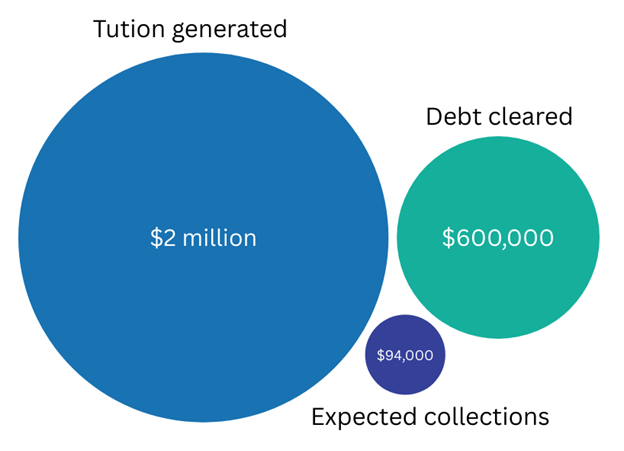
Enrollment, retention, and completion numbers demonstrate a successful intervention, but the dollars and cents tell a compelling story about what happens when institutions reimagine debt as an opportunity to intervene rather than an account to balance. Compact-eligible students generated more than $2 million dollars in new tuition revenue. This compares favorably to the nominal value of the debt resolved, $600,000. When considering that institutions would likely have collected around 15 percent of that debt, the equation becomes even more favorable for this approach—institutions generated new tuition revenue that was approximately 21 times that of the expected collections.
Tuition generation relative to debt cleared and expected collections
Several lessons from our facilitation of the Compact stand out:
Collaboration matters. Administrative holds and past due balances exist at the intersection of enrollment, finance, records, and advising. Partners in each of these functional areas had to work together to produce data for effective student outreach, provide incoming students with accurate information on re-enrollment next steps, and ensure accurate tracking of student outcomes and debt resolution. Moreover, the regional approach of the Compact amplified the effect that an individual institution could accomplish by sharing promising practices across institutions and expanding the pool of eligible students. The Compact was successful because of the intentional coordination within and across institutions.
Data is just as important as intervention design. Multiple offices across eight institutions meant data quality and availability could be inconsistent. This required collaborating with representatives who worked with academic, financial, and student support data to design data dictionaries and collection processes. Together, we iterated each year r to drop unnecessary data elements and adapt processes to unique institutional needs. Prioritizing this data collection allowed us to evaluate the Compact after its first year, and track student and institutional outcomes as the Compact continued.
Debt resolution works best when it is framed as a win-win for students and institutions. By reframing past due balances as a re-enrollment challenge, the Compact demonstrated that new tuition revenue from returning students far exceeded expected collections. Treating debt resolution as an enrollment, retention, and completion strategy better aligns institutional incentives with student success.
The Ohio College Comeback Compact demonstrates that when institutions eliminate barriers, reduce friction, and align incentives with student success, it’s a winning combination for everyone. Learners with SCNC return, credentials are earned, and institutions improve both their enrollment and revenue. This can be done without creating punitive policies that adversely affect both students and institutions. Instead, institutions can work together to implement creative solutions that improve student access and institutions’ finances. Although Fall 2025 was the last term new students could enroll in the Compact, many participating institutions are continuing to support students with institutional debt through their own programs.
The Compact was made possible through the generous financial support from Lumina Foundation, the Kresge Foundation, and the Joyce Foundation. While the Compact has now ended, if you would like to learn more about its implementation, please reach out to Liz Looker at Elizabeth.Looker@ithaka.org.