Library Partnership Development Framework
-
Table of Contents
- Acknowledgments
- Introduction
- What is a public-academic library partnership?
- Library Partnership Framework
- View the graphic
- How can libraries partner to support basic needs?
- View the graphic
- Challenges in developing and sustaining library partnerships
- Directions for the future
- Appendix A: Stakeholder definitions
- Appendix B: Key concept definitions
- Endnotes
- Acknowledgments
- Introduction
- What is a public-academic library partnership?
- Library Partnership Framework
- View the graphic
- How can libraries partner to support basic needs?
- View the graphic
- Challenges in developing and sustaining library partnerships
- Directions for the future
- Appendix A: Stakeholder definitions
- Appendix B: Key concept definitions
- Endnotes
Acknowledgments
The Library Partnership Development Framework is the result of three years of dedicated research and collaboration led by our core project team at Ithaka S+R. This work and framework would not have been possible without their substantial contributions, as both researchers and active participants in the Library Partnership Development Institute, where they helped shape, test, and strengthen the framework into its current form. The Ithaka S+R team that made this work possible is:
- Elmira Jangjou, Senior Analyst
- Sage Love, Analyst
- Grace Cope, User Experience Designer
- Christy McDaniel, Researcher
- Sindy Lopez, Senior Analyst
We would like to thank and highlight additional Ithaka S+R colleagues for their input and support: Elizabeth Looker, Daniel Braun, Juni Ahari, and Kimberly Lutz.
We would also like to thank all participants at the Library Partnership Development Institute for their input and engagement, including representatives from the following organizations: San José State University, San José Public Library, Waubonsee Community College, Messenger Public Library of North Aurora, Aurora Public Library District, and Bakersfield College.
We thank ECMC Foundation, in particular our program officer Ireri Rivas Mier y Teran, for supporting this project.
We also thank our external advising committee for their expert guidance and support throughout the project:
- Jorge Cárdenas, Head, Belzberg Library, Simon Fraser University
- Sarah Johnson, Adjunct Lecturer, University of Illinois Urbana-Champaign, School of Information Sciences
- Oscar Lanza-Galindo, Dean of Library Services, Holyoke Community College
- Paula Settoon, Dean of Libraries and Knowledge Management, Tulsa Community College
- Paula Talley, Executive Director of Holistic Student Supports and Workforce Alignment, Achieving the Dream
- Carrie Welton, Senior Policy Strategist, Trellis Strategies
- Lance Werner, Executive Director, Kent Library District
Introduction
Across the United States, public and academic libraries play a vital role in the educational and social infrastructure of their communities. They often serve overlapping populations: students balancing coursework, jobs, and family responsibilities; parents searching for early childhood learning opportunities; and community members seeking reliable internet access, workforce resources, or simply a quiet place to study and connect. Both sectors share a deep commitment to equity, access, and lifelong learning, and both have become essential entry points for individuals pursuing education and opportunity.
Despite these shared missions and intertwined audiences, there has been little formal guidance on how public and academic libraries can collaborate intentionally to advance their common goals. Many institutions recognize the potential of partnership, particularly in addressing challenges that extend beyond academic success to include issues of food and housing insecurity, digital access, and mental health, but lack a clear roadmap for making those collaborations effective and sustainable.
To address this gap, Ithaka S+R launched the Maximizing Public-Academic Library Partnerships (PALP) Project, a three-year research initiative funded by ECMC Foundation.[1] The project aims to equip libraries with the insights, tools, and evidence needed to develop, strengthen, and sustain partnerships that support the basic needs of students and the broader community.
This framework is designed to support libraries at all stages of partnership: exploring new opportunities, formalizing emerging collaborations, or enhancing and scaling established initiatives.
Drawing on a qualitative inventory of library websites, national case studies, and insights gathered through an in-person institute with participating library teams, the project has informed the development of the following Library Partnership Development Framework. This framework is designed to support libraries at all stages of partnership: exploring new opportunities, formalizing emerging collaborations, or enhancing and scaling established initiatives. It offers a flexible, iterative structure that libraries can enter at any point and revisit as their needs, goals, and contexts evolve. This framework also can apply to the partnerships libraries form with other stakeholders committed to advancing student and community wellbeing, including other departments on campus or community organizations.
This framework seeks to provide actionable guidance and real-world strategies to help libraries make the most of limited resources, coordinate services across sectors, and respond effectively to evolving community needs. By fostering a shared vision for collaboration, it seeks to empower library leaders and staff alike to build partnerships that are sustainable, impactful, and responsive to the people they serve.

This framework is intended for public and academic librarians—both leadership and staff—who are looking to start a partnership or scale their existing collaborations. Anyone, regardless of where they are in the process, can find value at different stages of the framework. The framework is also valuable for libraries considering partnerships outside of the library to help expand and strengthen the impact of their efforts.
What is a public-academic library partnership?
A public-academic library partnership brings together two or more distinct yet complementary library systems to serve shared audiences in coordinated and impactful ways. Public libraries offer open community spaces, broad programming, and connections to local services, whereas academic libraries tend to focus on supporting learning, research, and information literacy. When these missions intersect, libraries can expand their reach, providing pathways for student success that extend beyond campus walls, while also enriching community access to information, technology, and lifelong learning opportunities. These partnerships have the ability to be more than just cooperative agreements; they’re relationships built on trust, shared purpose, and a commitment to addressing the whole person—not just as a student or resident, but as a member of an interconnected community.
Over the course of the PALP project, we conducted three in-depth case studies informed by interviews with library and non-library faculty and staff members to better understand how partnerships between public and academic libraries develop, operate, and evolve over time:
- Waubonsee Community College Library’s collaboration with Messenger and Aurora Public Libraries: Public and Academic Libraries in Partnership: Advancing Digital Literacy in Illinois[2]
- The joint-use Chatham Community Library with Central Carolina Community College: Maximizing Impact Through Collaboration at Chatham Community Library: A Case Study of a Joint-Use Library Partnership[3]
- The joint-use Dr. Martin Luther King, Jr. Library (King Library) with San José State University (SJSU) and the San José Public Library (SJPL): Shared Space, Shared Mission: How the King Library Expands Access and Strengthens Community Impact[4]
Each of these partnerships represents a distinct model of collaboration, reflecting the varied ways libraries can align resources and missions to better serve students and communities. Some partnerships created joint-use facilities, enabling seamless service delivery to overlapping patron bases. Others function as programmatic partnerships, collaborating across institutions and systems to offer shared programming, outreach initiatives, and coordinated resource referrals without co-location. These variations demonstrate that there is no universal model for success. Effective public-academic partnerships are context dependent, shaped by local demographics, institutional capacity, leadership priorities, and community needs.
Figure 1. Types of Public-Academic Library Partnerships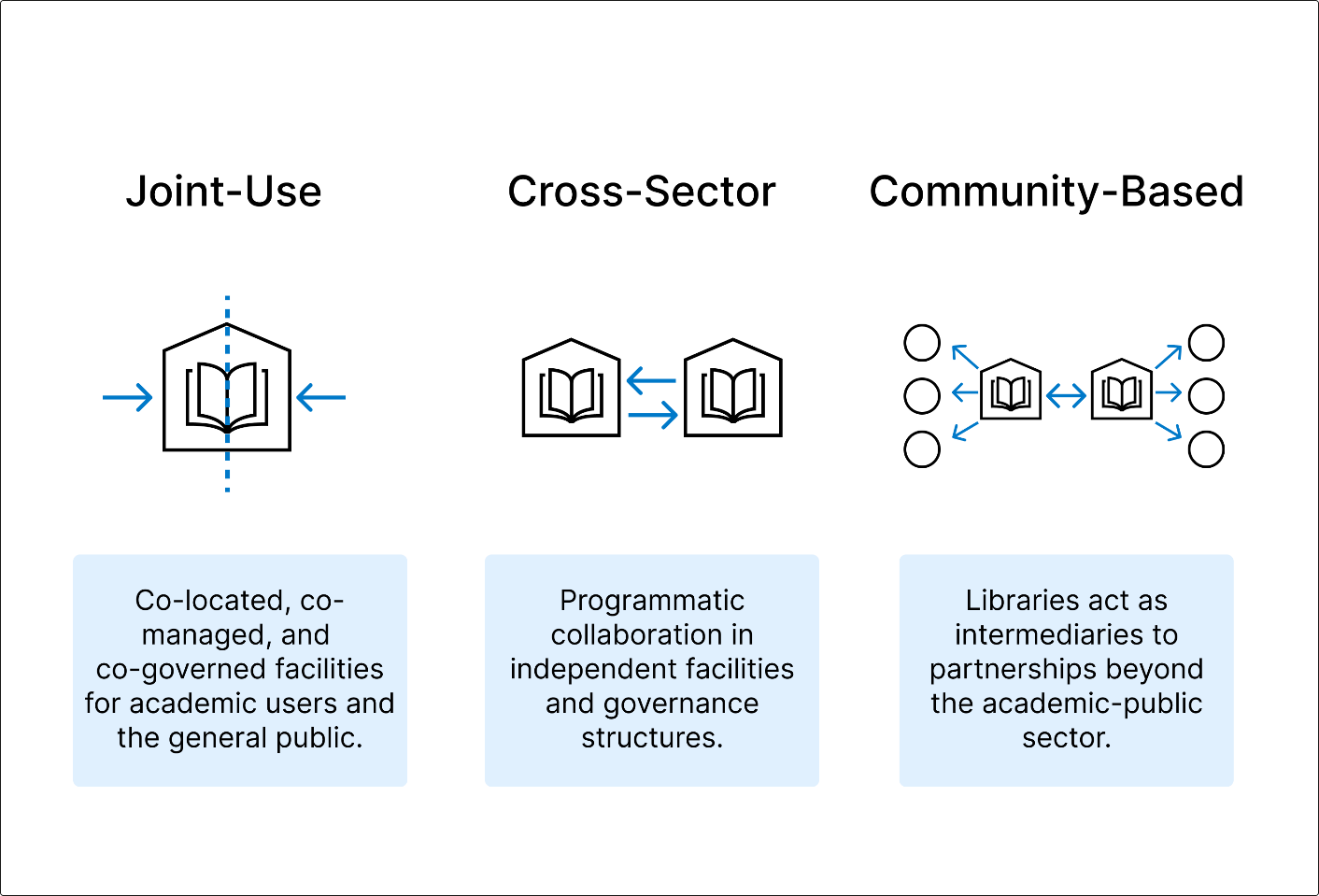
Joint-use library partnerships
The joint-use library model represents one of the most integrated forms of collaboration between public and academic libraries. These facilities are co-located, co-managed, and co-governed, designed to serve both academic users and the general public under a shared roof. By definition, a joint-use library refers to “two separate library service providers [that] use the same building to serve distinct clienteles.”[5] The PALP case studies at the King Library in San José, California and Chatham Community Library in North Carolina provide two distinct yet complementary examples of how this model can function successfully across different institutional and community contexts.
Each joint-use library operates under a formal Memorandum of Understanding (MOU) or Joint Ownership and Operations Agreement (JOOA) that outlines governance, cost-sharing, and staffing responsibilities. While their specific arrangements differ, both models rely on shared resources including physical space, collections, staff, and operational services such as maintenance, technology, and security. Despite their success, the case studies of King Library and Chatham Community Library highlight the complexity of sustaining long-term collaboration. Over time, operational systems and institutional priorities evolve. Joint-use partnerships are deeply collaborative and provide high levels of integration, but to remain successful over time they must share a commitment to ongoing communication and adaptive governance.
Cross-sector programmatic library partnerships
In contrast to the highly integrated nature of joint-use libraries, cross-sector partners emphasize programmatic collaboration while maintaining independent facilities and governance structures. These partnerships are typically driven by shared community needs and executed through joint initiatives, shared programming, and collective outreach.
A strong example of this model can be seen in Waubonsee Community College’s partnership with the Aurora and Messenger Public Libraries in Illinois. The partnership emerged from informal conversations among library staff who recognized a growing need for digital literacy and technology training across their service areas. Leveraging existing relationships and local expertise, the three institutions co-developed a program during Adult Education and Family Literacy Week to address these needs. The success of this initial effort led to ongoing collaboration, additional program rounds, and the establishment of a regional network of six participating libraries.
Community-based partnerships
Community-based partnerships represent another vital dimension of collaboration: one that extends beyond libraries to include nonprofits, social service organizations, and other civic institutions that seek to strengthen community well-being and basic needs support. These partnerships are often designed to address specific local challenges, such as housing instability, food insecurity, or mental health needs, and connect patrons to a network of support. Through these partnerships, libraries act as trusted intermediaries, linking community members to critical services and reinforcing their role as anchors within broader ecosystems of care. The case studies revealed that each library partnership, whether formalized through joint-use agreements or coordinated through programmatic collaboration, relied on community-based relationships—with local advocacy agencies focused on domestic violence and housing rights, local food banks and pantries, tax assistance clinics, and more—to broaden impact.
Public-academic library partnerships can take many forms depending on local needs, institutional goals, and community contexts, demonstrating there is no single structure or formula for effective collaboration.
Together, these examples illustrate the diversity of partnership models across the country. These variations highlight that public-academic library partnerships can take many forms depending on local needs, institutional goals, and community contexts, demonstrating there is no single structure or formula for effective collaboration.
Library Partnership Framework
The Library Partnership Framework was developed through a collaborative, participatory process that centered the expertise and lived experiences of library practitioners, students, and community partners. To ensure the framework reflected the realities of the field and the diversity of library contexts across the country, the research team at Ithaka S+R convened the Library Partnership Development Institute, a day-long, in-person co-designed event, on July 31, 2025.
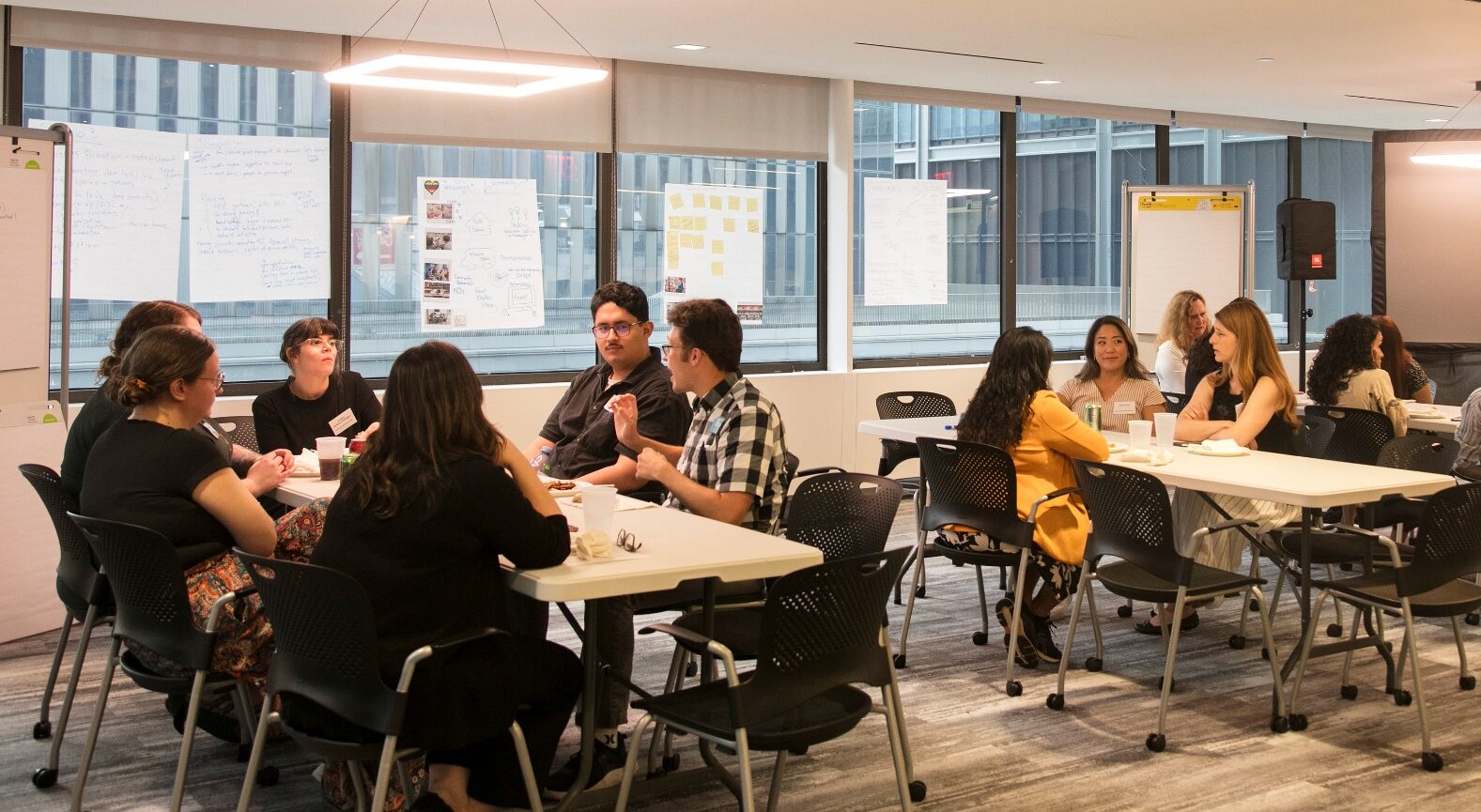
Groups of institute participants sit at tables and brainstorm ideas.
Developing the framework
The Institute brought together over 20 public and academic librarians, students, funders, and community stakeholders from across the United States. This event offered the opportunity to translate insights from the project’s research findings into actionable strategies through participatory design. After an interactive day of knowledge sharing and discussion, the group was led through an interactive co-designed activity structured around six stages of the partnership lifecycle:
- Partnership initiation
- Defining roles, goals, and expectations
- Designing partnerships
- Implementing partnerships
- Community engagement and outreach
- Sustaining collaboration
Participants rotated among six stations aligning with the stages of the partnership lifecycle, annotating posters with recommendations, identifying relevant stakeholders, promising practices, potential barriers, and policy and funding implications. The session culminated in a gallery walk and dot-voting exercise, allowing participants to collectively and visually identify the most promising ideas and strategies for inclusion in the framework below.

Participants place sticky notes on posters.
The Library Partnership Framework is not a prescriptive model, but rather a co-created guide shaped by the shared experiences and priorities of the library community itself. By embedding practitioner expertise into its design, the framework reflects a deep understanding of the realities of partnership work. It serves as a practical roadmap for libraries seeking to initiate, strengthen, or sustain collaborations that meet the holistic needs of their students and communities. Synthesis of the dot-voting results revealed that many of the same best practices and challenges, such as shared governance, establishing communication rhythms, or capturing the user perspective, consistently appeared across all phases of partnership development. This continuity underscores the need for core practices to be embedded and revisited throughout initiation, implementation, and sustainability, setting the stage for the co-created framework outlined below.
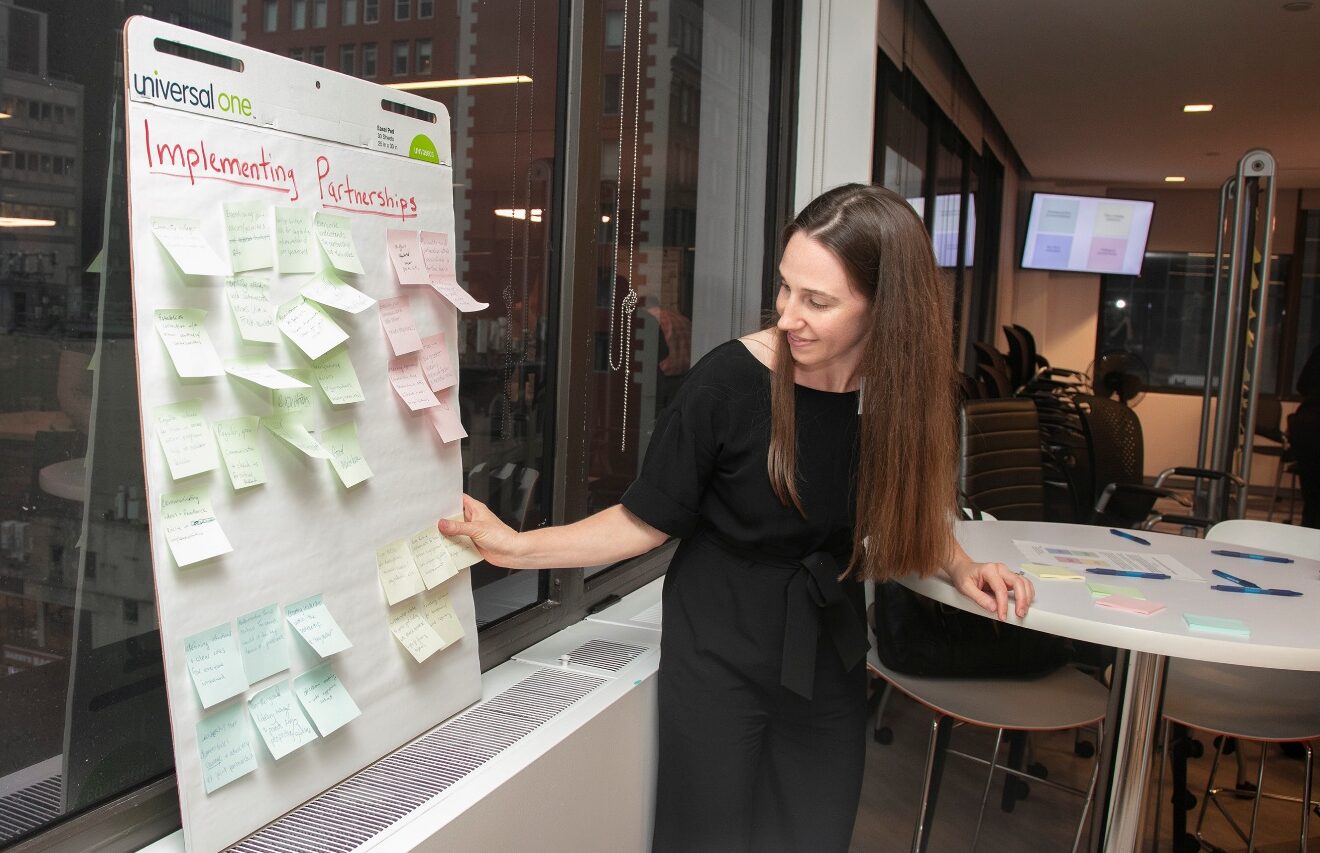
Ithaka S+R facilitator reviews sticky notes added to “Implementing Partnerships” board.
How to use the Library Partnership Framework
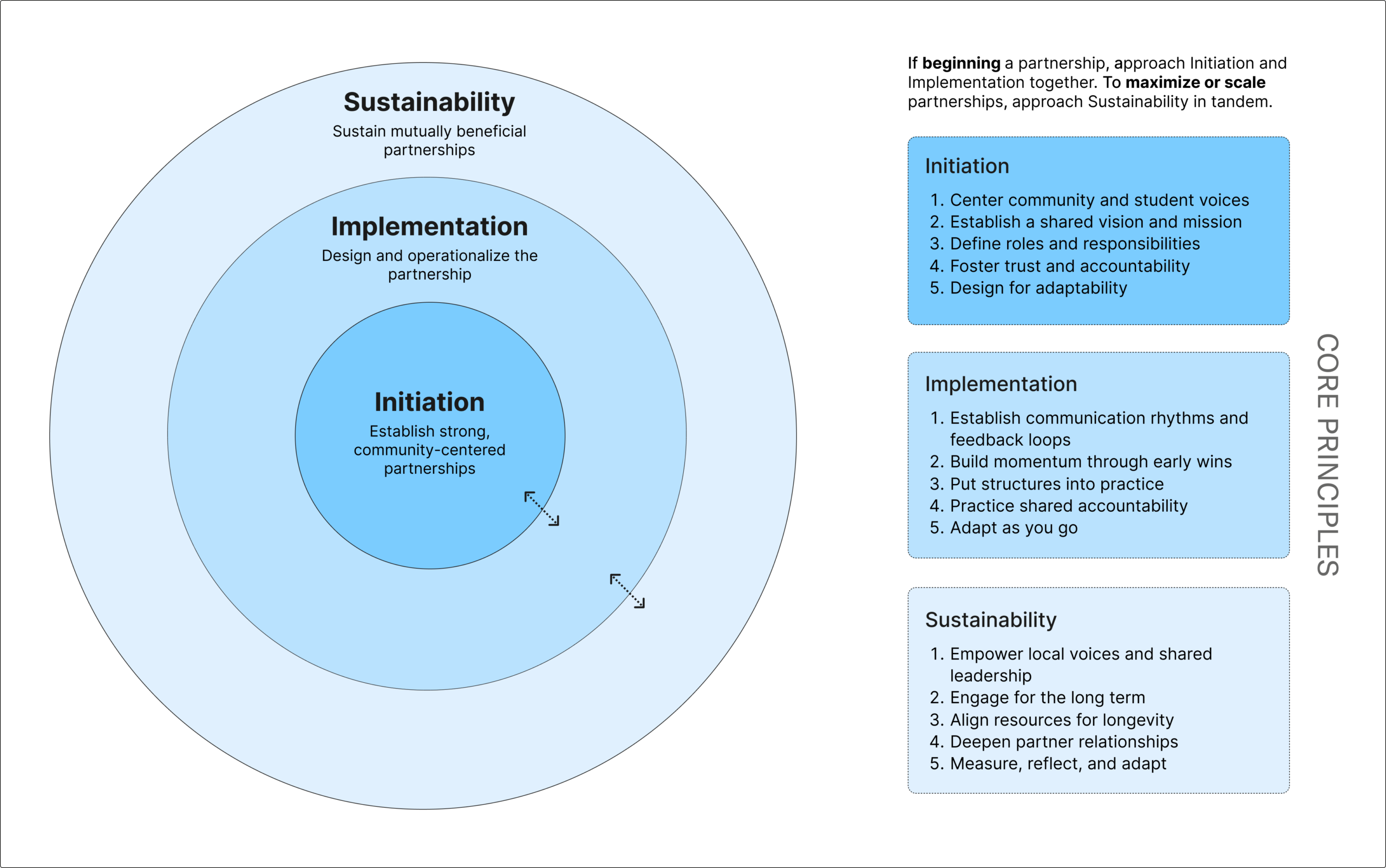
The Library Partnership Development Framework synthesizes the six stages of the partnership lifecycle into three overarching phases: initiation, implementation, and sustainability. Each phase reflects a critical stage in the evolution of a partnership and provides core principles and corresponding action items to guide libraries.
Depending on where libraries are in their partnership journey—whether they are actively seeking new partners, refreshing an existing collaboration, or revitalizing a partnership that has lost momentum—the framework offers practical entry points for reflection and action. Each phase includes a set of guiding questions that partners should ask and answer together to ensure clarity of purpose, alignment of goals, and shared accountability.
Each phase includes the following goals:
- Initiation focuses on establishing strong, community-centered partnerships that expand capacity to address student and community basic needs.
- Implementation centers on designing and operationalizing the partnership by putting agreed-upon structures into practice by executing shared practices, communication rhythms, and early collaborative efforts that translate defined roles, build momentum, demonstrate value, and turn community needs into action.
- Sustainability emphasizes creating sustainable, inclusive, and mutually beneficial and supportive partnerships by maintaining continuous engagement, aligning outreach with evolving community needs, and securing lasting support through continuous assessment and storytelling, collaboration, and shared resources.
The framework is intended to be flexible and adaptable, meeting libraries where they are while encouraging them to think expansively about potential partners and programming. In addition to library peers, potential collaborators may include student affairs divisions, local community organizations, regional networks, and others invested in student and community well-being. By grounding this framework in both research and practitioner reflections, we hope to provide a tool that supports libraries in strengthening and scaling their partnerships, helping them move from intention to action, and from collaboration to sustained impact.
Within each phase, the core principles are deliberately sequenced to build upon one another. The first core principle in each phase corresponds conceptually with the first principle in the other phases, the second with the second, and so forth, creating a coherent throughline across initiation, implementation, and sustainability. This structured alignment is intended to illustrate how foundational concepts progress over time. Each phase also includes a list of key stakeholders and the roles they may play at that stage of the partnership. Stakeholders appear across multiple phases because many individuals and groups contribute in different ways as partnerships mature—shifting from planning and coordination to implementation, leadership, and stewardship over time.

The Library Partnership Development Framework is designed to be read holistically, and implementation may not be linear. While core principles are ordered to show conceptual alignment across phases, they are meant to be viewed as interconnected rather than sequential. Likewise, the key stakeholders identified in each phase may appear multiple times, reflecting the reality that individuals and organizations often play different roles as partnerships move from planning to implementation to long-term sustainability. Libraries may find value in moving between sections as their partnerships evolve, revisiting earlier stages to strengthen later ones.
For those just beginning to form a partnership, it may be most effective to approach the initiation and implementation sections together to fully design and operationalize the collaboration from the start. Libraries seeking to maximize or scale existing partnerships may want to consider all three sections together, as they assess their current practices, refine their implementation strategies, and strengthen their partnership’s long-term impact. See Appendix A and Appendix B for definitions of key stakeholders and framework terms respectively.
Figure 2. Library Partnership Development Framework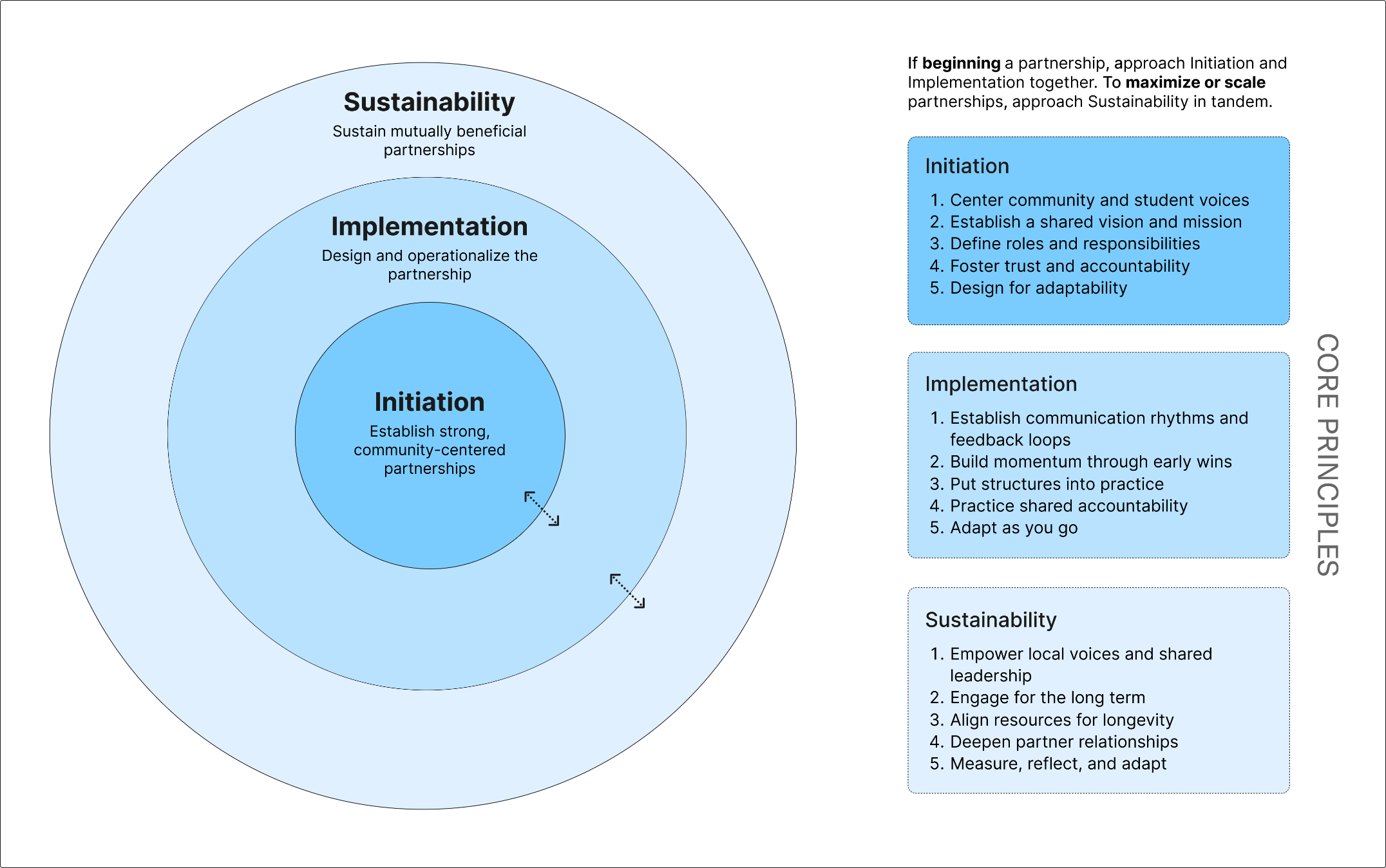
Initiation
Key stakeholders
- Community members and students. Include perspectives of users most impacted by the services or programs being designed.
- Library leadership and institutional administrators. Identify leaders responsible for resourcing, policy alignment, and decision making.
- Frontline staff. Include staff who bring operational insight and direct community knowledge.
- Community-based organizations. Include expertise, training, and existing infrastructure they provide.
- Funders and government partners. Determine whether policy, funding or compliance considerations apply.
- Data, assessment, and evaluation staff. Access the assessment professionals who can support ethical data collection, evaluation, and learning.
Core principles
- Center community and student voices: Engage directly with community members, students, and other local stakeholders such as, advocacy partners, community-based organizations, and frontline service staff to understand community needs.
- How are we already collecting information relevant to community and student needs? How can we design assessment tools from the outset to be inclusive and accessible to all?
- How will we use the information we gather to define initial program priorities, service models, and partnership focus areas?
- What baseline data do we need to ensure leadership buy-in and accountability across each partner?
- Establish a shared vision and mission: Define goals and expectations early, with transparency around resources, differing policies, and capacity.
- What does success look like? What measurable, short-term goals will guide the partnership’s first phase, and how can we establish a regular rhythm for revisiting and refining these goals as the collaboration evolves?
- What joint policies or priorities need to be established to guide day-to-day partnership operations?
- What opportunities for shared funding, pooled resources, or joint grant-seeking to support initial partnership activities already exist?
- Define roles and responsibilities: Discuss and define roles and responsibilities of all partners, stakeholders and who has decision-making authority.
- Who will serve as the designated point person for each partner, and how will we divide roles based on expertise (e.g., IT, outreach, evaluation, communications)?
- What workload expectations are realistic given current staffing and capacity, and how can we scope roles to avoid duplication and prevent burnout? What strategies can balance new partnership responsibilities within current staffing and resource limitations?
- What are the prerequisites for writing an MOU that clearly outlines responsibilities, timelines, and expectations for all partners? What decision-making and escalation frameworks do we need to address disagreements, competing timelines, or changing priorities?
- Foster trust and accountability: Leadership must model commitment, staff must have buy-in, and all partners must be honest about limits while holding each other accountable.
- How will we intentionally include leadership and frontline staff from each institution in planning and decision-making?
- What actions can foster a unified mindset and mutual accountability across all partners? What shared norms or agreements will promote transparency around resources, staff capacity, and institutional constraints?
- What legal, policy, or compliance requirements must we address before launching the partnership? How can we establish a review schedule to revisit funding structures, cost-share ratios, and overall financial alignment?
- Design for adaptability: Build in mechanisms for regular review and evaluation, openness to stop or pivot, and resilience in the face of funding changes or policy shifts over time.
- What data-sharing agreements do we need to ensure consistent and ethical tracking across partners? Who will be responsible for data collection and evaluation, and how will results be shared transparently?
- What early indicators or thresholds will signal when programs should be adjusted, paused, or sunsetted?
- What contingency plans can we develop to address potential funding reductions or misaligned budget cycles?
Implementation
Key stakeholders
- Frontline staff. Bring in staff responsible for service delivery and day-to-day operations
- Community members and students. Include ongoing feedback from users, participants, and advisors, especially those impacted by services and programs being designed and implemented.
- Partnership leaders. Identify a leader from each partner to coordinate activities, timelines, and communication.
- Library leadership and institutional administrators. Include leaders to ensure alignment with institutional priorities and capacity
- Community-based organizations. Bring in partners to support outreach, trust-building, and service integration.
- Data, assessment, and evaluation staff. Access assessment professionals to support data collection, monitoring and reporting.
Core principles
- Establish communication rhythms and feedback loops: Keep every level of the partnership informed, connected, and responsive.
- What cadence of meetings will ensure alignment across partners? What systems (meeting notes, shared folders, dashboards) will ensure transparency in communication and decision-making?
- What practices will encourage the early exchange of ideas and feedback before challenges escalate? Who will serve as a facilitator or mediator to help maintain clarity and resolve conflicts?
- What feedback loops will capture input from frontline staff, students, and community members on an ongoing basis?
- Build momentum through early wins: Start small with visible, achievable steps that show value and impact.
- What short-term outcomes or pilot activities would demonstrate early value to partners and the community?
- How will we identify, celebrate, and communicate early successes to build buy-in across institutions?
- What key metrics and performance indicators will track implementation progress and community impact? How will we document and report outcomes for transparency and accountability?
- Put structures into practice: Move from planning to action by operationalizing agreed-upon structures and commitments.
- How will defined roles be translated into clear, daily practices and workflows? What steps can help ensure every team member understands their role and responsibilities within the partnership?
- How can we leverage the expertise of staff across partner institutions to share resources and build collective capacity?
- Who is the primary bridge to the target community (i.e., frontline staff, advocacy partner, etc.), and how will that role be supported and sustained operationally?
- Practice shared accountability: Maintain clarity on commitments and responsibilities while ensuring transparency in decision-making.
- How will we reinforce shared values and the partnership’s collective mission through regular communication? What spaces or informal opportunities can support trust and relationship-building?
- How can we communicate and monitor our expectations for participation across partners?
- How will we track commitments and hold partners accountable when expectations are not met?
- Adapt as you go: Stay flexible, learn from feedback, and adjust operations as needs, contexts, and capacities evolve.
- How will policy updates remain flexible enough to adapt to changes in staffing, leadership, or resources and be communicated to all partners to maintain alignment and transparency?
- What processes will document and address shifting resource levels (e.g., budget cuts, policy changes)? How will we monitor and adjust capacity (staffing, resources, space) to ensure sustainability?
- What documentation and onboarding tools do we need to help new partners and staff quickly understand and operate within the partnership?
Sustainability
Key stakeholders
- Frontline staff. Engage critical staff to address workload sustainability and maintain institutional memory.
- Community members and students. Incorporate perspectives to ensure ongoing relevance of the partnership.
- Partnership Leadership. Draw on leaders across partners to continue to drive coordination and collaboration.
- Library leadership and institutional administrators. Lead the long-term commitment, policy alignment, and resourcing
- Funders and government partners. Consider partners to shape long-term financial stability, reporting requirements, and future opportunities.
- Data, assessment, evaluation staff. Involve assessment professionals to support evaluation, storytelling, and decision-making.
Core principles
- Empower local voices and shared leadership: Position students, staff, and community members as ongoing collaborators and co-designers in outreach and programming.
- How often should we revisit community needs to ensure outreach remains relevant and responsive?
- How can messaging and outreach reflect the cultural, linguistic, and social diversity of the community? What translation or accessibility supports do we need to reach non-English-speaking or differently abled audiences?
- How can we co-develop programs and materials with community input to ensure cultural resonance?
- Engage for the long term: Design engagement and outreach strategies that are adaptable and aligned with the long-term priorities of both partners.
- How can we maintain and strengthen community relationships beyond individual programs or funding cycles?
- Which existing communication channels (e.g., Friends newsletters, social media, campus platforms) can we use to promote partnership efforts?
- What data or examples best communicate the long-term value of the collaboration? How can storytelling highlight long-term impact, not just short-term success?
- Align resources for longevity: Plan outreach efforts with realistic budgets, shared funding models, and transparent resource agreements to ensure sustainability.
- What structures (e.g., advisory boards, partner councils) do we need to formalize long-term engagement?
- How can partnerships remain flexible to reflect changing local conditions, leadership, and priorities?
- What training or professional development will continuously strengthen staff and partner capacity for community engagement? How can cross-training across institutions expand skill sets and create redundancy for continuity?
- Deepen partner relationships: Build durable connections by prioritizing trust, consistency, and mutual benefit over one-time programs.
- Who are the key connectors or bridge-builders who can sustain ongoing communication and trust?
- How will we examine and balance power, decision-making influence, and benefits across partners over time?
- What systems (shared files, onboarding materials, resource repositories) can preserve partnership memory amid staff turnover?
- Measure, reflect, and adapt: Use ongoing data collection and community feedback to refine outreach, demonstrate impact, and build a compelling case for continued investment.
- What longitudinal indicators demonstrate lasting impact? What processes will ensure ongoing collection of stories, testimonials, and data for advocacy?
- How can evaluation cycles align with funding, reporting, and planning timelines?
- How will we share back results and lessons learned with the community in accessible and meaningful ways?
How can libraries partner to support basic needs?
A key goal of the Maximizing Public-Academic Library Partnerships Project was to better understand how libraries are currently supporting basic needs, and identify opportunities for libraries to support the needs of their shared communities through partnership. These efforts could extend beyond traditional library services, such as shared collections, to include access to technology and internet; financial stability and economic mobility programming; mental health resources, and access to food and housing information and resources. Across our research, we found that when libraries collaborate, they can extend their collective impact, meeting essential needs that influence both academic success and community vibrancy.[6]
To assess how libraries are already supporting student and community basic needs, we completed a qualitative inventory of public and academic library websites.[7] Using a randomized national sample, we analyzed library websites to identify and categorize how libraries publicly communicate and advertise services that meet patrons’ essential needs. Our analysis revealed that technology, financial literacy and assistance, and mental health support were the three most widely advertised forms of basic needs services across both library types. Many libraries also provided resources addressing food and housing insecurity, though these were less consistently promoted online. We also observed that public libraries tended to advertise a wider range of basic needs services while community college libraries primarily focused on services that directly supported student learning and well-being. Overall, these findings underscore that both public and academic libraries are already acting as crucial partners in their communities’ support ecosystems, but that collaboration presents a significant opportunity to strengthen, align, and expand these efforts.
Across our research, we found that when libraries collaborate, they can extend their collective impact, meeting essential needs that influence both academic success and community vibrancy.
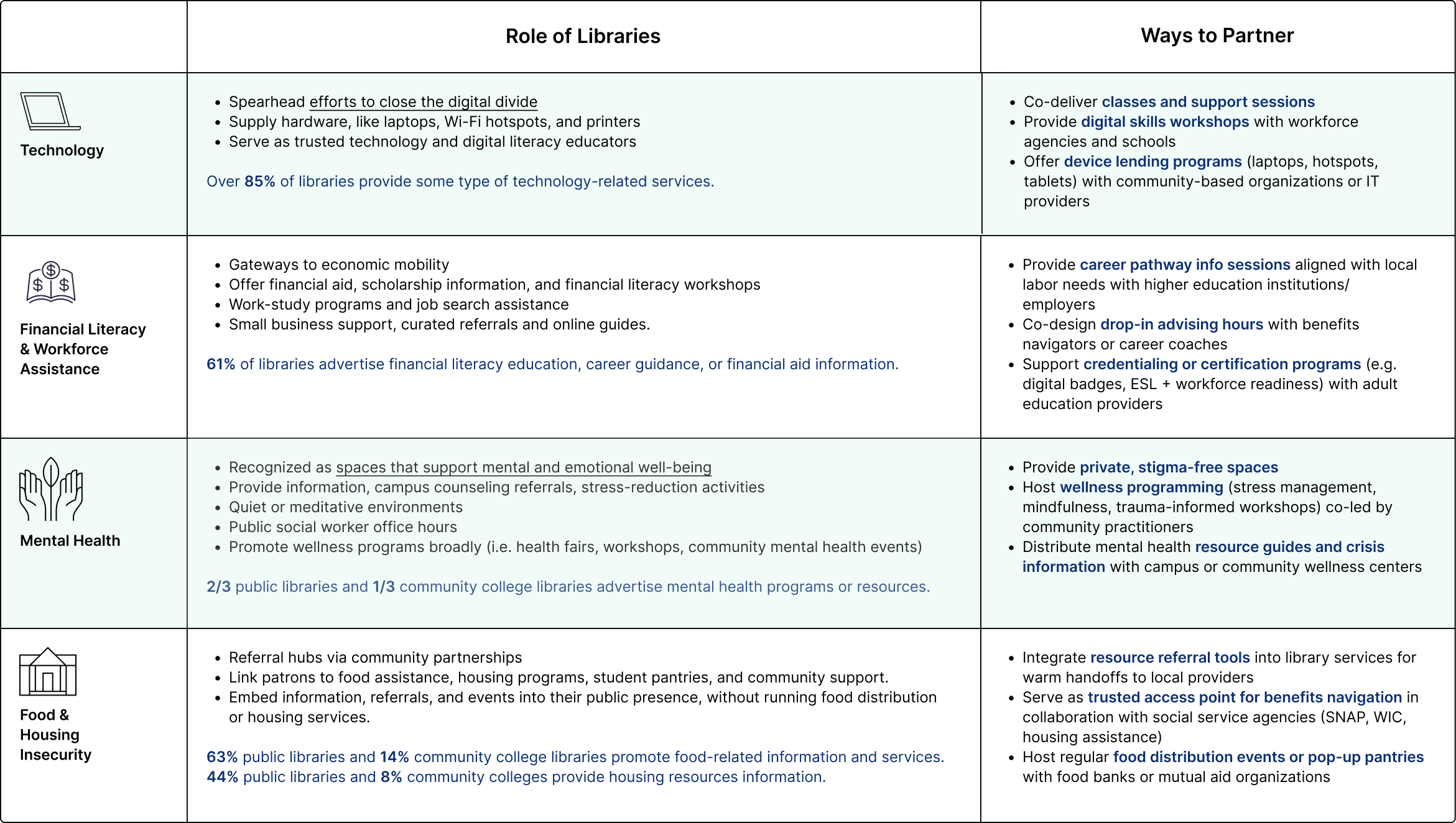
The following table outlines a set of core basic needs that libraries are currently advertising to their community members and students, alongside examples of how public and academic libraries can partner to support these needs, either by leveraging existing functions and capacities or by developing new programs and services collaboratively. Use the following table to spark ideas, conversations, and new opportunities for partnership, exploring ways to better meet the basic needs of students and community members.
Figure 3. Role of Libraries and Ways to Partner Towards Supporting Basic Needs
| Role of Library | Ways to Partner | |

Technology |
Over 85% of libraries provide some type of technology-related services. |
|

Financial Literacy & Workforce Assistance |
61% of libraries advertise financial literacy education, career guidance, or financial aid information. |
|

Mental health |
2/3 public libraries and 1/3 community college libraries advertise mental health programs or resources. |
|

Food and housing insecurity |
63% public libraries and 14% community college libraries promote food-related information and services. 44% public libraries and 8% community colleges provide housing resources information.
|
|
Challenges in developing and sustaining library partnerships
The Institute’s framework co-designed activity also identified a broad set of challenges that illustrate the complexity of developing effective library partnerships. While collaboration continues to be recognized as an essential strategy for expanding access and impact, the realities of organizational structures, staffing, and funding often present barriers to implementation and sustainability. The insights shared highlight that successful partnerships depend on practical alignment across people, processes, and systems.
Relational and operational complexity
Participants consistently emphasized that partnership work is added to already full workloads, making it difficult to dedicate the sustained attention needed to design and coordinate new, multifaceted initiatives. As a result, time constraints, compounded by scheduling conflicts, competing institutional priorities, and staff turnover, were described as one of the greatest barriers to progress. Establishing a central coordinator across partners, as demonstrated by the cross-sector partnership in Illinois, can help with building trust, aligning calendars, and maintaining ongoing engagement.[8]
As many partnerships depend on people, and thus on the relationships, trust, and institutional cultures they bring, human dynamics play a major role in their success or failure. Collaborations driven primarily by personal relationships, without institutional buy-in or accountability, are especially vulnerable during staff transitions. Differences in leadership styles, decision-making approaches, and institutional priorities can create friction and slow progress. Participants surfaced less visible, but deeply influential factors, including burnout, fear of failure, and the emotional labor of collaboration required to sustain collaborative work, which are often overlooked in partnership planning.
Lastly, communication challenges further compound these issues. Unclear internal communication channels or assumptions about who is responsible for outreach can lead to mistakes or duplication of work. Externally, limited marketing expertise may fail to reach key audiences. Participants stressed that sustaining effective communication is not self-sustaining and takes time and intentional planning, particularly during leadership transitions or staff turnover, when institutional memory may be disrupted.
Infrastructure, governance, and sustainability
Participants highlighted that funding and infrastructure constraints fundamentally shape the scope and durability of partnership work. Libraries often operate with already constrained budgets and varying fiscal calendars, making coordination complex. Misunderstandings about budgets or funding rules can unintentionally create inequities across partners and strain relationships. Even when initial funding is secured, participants emphasized that sustaining staffing, programming, and infrastructure beyond a pilot or grant period also remains a major concern.
Policy and governance differences can further complicate collaboration. Each institution brings distinct rules, regulations, and compliance requirements, particularly around finances, privacy, and data sharing. Navigating these differences takes time, expertise, and often legal or administrative support. Misinterpretations of MOUs or informal agreements can create confusion or misalignment, especially when roles and responsibilities are not clearly articulated. Without a shared decision-making framework, questions about authority and accountability can slow implementation and erode trust among partners.
Finally, when planning for sustainability and evaluation, effective partnerships not only plan for growth but also for adaption and closure. Knowing when to pivot, pause, or end a partnership should be intentionally built into its design. Participants emphasized the need for clear metrics, reflective processes, and feedback loops that enable adaptation and adjustment to the partnership over time.
Directions for the future
The insights gathered throughout the Maximizing Public-Academic Library Partnerships (PALP) initiative underscore the complexity of developing, implementing, and sustaining partnerships between libraries, higher education institutions, and community-based organizations. Across our research, a clear theme emerged: libraries are increasingly functioning as connectors and collaborators within larger ecosystems of basic need supports and social services. Despite this pivotal role in their communities, significant questions remain about how to design, integrate, and sustain these partnerships in ways that are both strategic and equitable. The findings also point to the need for deeper understanding of how libraries themselves, through their spaces, services, and values, can be structured to more effectively respond to the evolving needs of students and communities.
Libraries are increasingly functioning as connectors and collaborators within larger ecosystems of basic need supports and social services.
Future directions for research
Future research should focus on how libraries can continue to strengthen their role as institutional and community partners. Many libraries are already working in collaboration with community-based organizations and college or university ecosystems, yet additional evidence is needed to understand what makes these partnerships most effective to their users. Further study of how users are informed about and utilize basic needs resources provided by libraries and their partners could deepen understanding of effective outreach and access models. Additionally, longitudinal studies assessing how these partnerships evolve and their effects on users over time could further illuminate their long-term impact and sustainability.
There is also a need for research that examines how libraries measure effectiveness not only in partnership formation, but in outcomes for the people they serve. Future work could explore how libraries could more intentionally support both community basic needs and student success through programming, resource allocation, and service design. Understanding how basic needs can be more intentionally embedded within library programming and organizational frameworks would help clarify the library’s role as a hub for holistic support. Studies that assess the impact of these efforts on equity, retention, and well-being could inform both policy and practice. By deepening our collective understanding of these dynamics, future work can help libraries not only sustain partnerships, but also lead in advancing access, inclusion, and community vibrancy.
Future directions for libraries
The findings from the PALP initiative also point toward concrete steps libraries can take now. Libraries are already serving as entry points for basic needs support, through welcoming spaces, access to technology, informal referrals, and programs that connect users to community resources. Recognizing this existing work is a critical first step. When approaching new partnerships or considering how to strengthen current ones, libraries can begin by asking not, “How can this partnership benefit us?” but rather, “How can we collectively benefit our users?” This shift in orientation highlights the substantial capacity libraries already devote to supporting their communities and can reveal where collaboration can be most beneficial. By identifying these embedded strengths and low-barrier opportunities, libraries can better understand how to maximize their current efforts. Using data and storytelling to document the impact of existing initiatives also helps articulate their value and demonstrates to partners how collaborative investment could increase that impact.
With clear evidence of impact and a user-centered approach, libraries can enter partnerships as confident, strategic collaborators whose existing contributions make a compelling case for deeper investment.
Building from this foundation, libraries can use the Library Partnership Development Framework action items identified through PALP as a practical guide for amplifying their role within community support ecosystems through collaboration. These steps allow libraries to make the most of the capacity they already have, channeling it more intentionally toward partnership work that advances equity and user well-being. With clear evidence of impact and a user-centered approach, libraries can enter partnerships as confident, strategic collaborators whose existing contributions make a compelling case for deeper investment. In doing so, they position themselves as essential connectors capable of transforming how institutions work together to meet the basic needs of their communities.
Taken together, while this initiative illuminated many of the barriers and opportunities inherent in partnership work, it also pointed toward a broader vision: one in which libraries serve as anchors for collaborative ecosystems that connect people, institutions, and resources in meaningful and lasting ways. Continued research and partnerships in this space will be essential to realizing that vision.
Appendix A: Stakeholder definitions
| Stakeholder | Definition | Examples |
| Community members | Individuals who live, work, study, or receive services within the communities served by the partnership, including those directly impacted by programs or services. | Local residents; library patrons |
| Students | Individuals enrolled in academic programs at participating institutions who may participate in, support, or benefit from partnership activities. | Undergraduate students; graduate students; student employees |
| Frontline staff | Staff who interact directly with community members or students and deliver services or programs on a day-to-day basis. | Public services librarians; reference librarians, outreach librarians; service navigators |
| Partnership leadership | Individuals responsible for coordinating the partnership across organizations, facilitating communication, aligning timelines and goals, and ensuring shared accountability for implementation and outcomes. | Partnership coordinators; cross-institutional leads; designated partnership liaisons; project managers |
| Library leadership | Individuals responsible for strategic direction, decision-making, and resource allocation within libraries. | Library directors; deans; department heads; steering committee |
| Institutional administrators | Senior leaders who influence policy, budgeting, compliance, and institutional priorities beyond the library. | Provosts; academic and student affairs leaders; deans |
| Community-based organizations (CBOs) | Organizations rooted in the community that provide services, advocacy, or support aligned with partnership goals. | Food banks; shelters; health service providers |
| Advocacy partners | Organizations or groups focused on advancing the rights, needs, or interests of specific populations. | Student advocacy groups; housing justice organizations; disability rights groups |
| Funders | Entities that provide financial resources to support partnership activities. | Foundations; government agencies; institutional grant programs |
| Government partners | Public agencies involved through funding, policy, regulation, or service coordination. | Local health departments; municipal agencies; state offices |
| Data, assessment and evaluation staff | Individuals or teams responsible for collecting, analyzing, and reporting information to support learning and accountability. | Assessment librarians; institutional research staff; data analysts |
Appendix B: Key concept definitions
| Term | Definition | Examples |
| Partner | Any library or institution with a formal role in planning, implementing, or sustaining the partnership and shared responsibility for outcomes. | Academic library; public library; library system |
| Stakeholder | Any individual or group with a vested interest in, influence on, or impact from the partnership. | Students; frontline staff; community members |
| Collaborator | Any individual or group that contributes expertise, labor, or resources to specific activities without shared responsibility for overall outcomes. | Volunteers; other institutional departments; marketing team |
| Partnership | A structured relationship among organizations working toward shared goals with defined roles and accountability. | Joint-use; cross-sector; community-based |
| Governance | The structures and processes that define how decisions are made and accountability is maintained. | Steering committee; municipal organizations; institutional administrators |
| Assessment | The collection of information to understand needs, experiences, or performance. | Surveys; focus groups; interviews |
| Data | Quantitative or qualitative information used to support assessment, evaluation, and decision-making. | Attendance counts; survey responses; interview notes |
| Evaluation | A systematic process for examining program effectiveness, outcomes, and impact. | Outcome evaluation; impact study |
| Outcomes | The changes or results that occur as a result of programs or services. | Increased access; improved well-being; reduced barriers |
Endnotes
- For more information on the Maximizing Public-Academic Library Partnerships (PALP) Project, see: https://sr.ithaka.org/blog/supporting-public-academic-library-partnerships/ ↑
- Elmira Jangjou, Sage J. Love, and Melissa Blankstein, “Public and Academic Libraries in Partnership: Advancing Digital Literacy in Illinois,” Ithaka S+R, Last Modified 24 July 2025, https://doi.org/10.18665/sr.323317. ↑
- Elmira Jangjou, Sage J. Love, and Melissa Blankstein, “Maximizing Impact Through Collaboration at Chatham Community Library: A Case Study of a Joint-Use Library Partnership,” Ithaka S+R, Last Modified 18 June 2025, https://doi.org/10.18665/sr.323040. ↑
- Sage Jasper Love, Elmira Jangjou, and Melissa Blankstein, “Shared Space, Shared Mission: How the King Library Expands Access and Strengthens Community Impact,” Ithaka S+R, Last Modified 28 January 2026, https://doi.org/10.18665/sr.324646. ↑
- For more information on joint-use libraries, see: https://libguides.ala.org/Jointuselibraries. ↑
- Achieving the Dream’s Community Vibrancy Framework is “aimed at expanding access to higher education and lowering costs for students, creating greater social and economic mobility for more learners and their families, and helping communities flourish across a broad range of measures. It is designed to move student success work beyond completion and connect institutional transformation efforts with community impact.” For more information see: https://achievingthedream.org/innovation/community-vibrancy/. ↑
- Sindy Lopez, Sage J. Love, and Melissa Blankstein, “Exploring Basic Needs Support Across Public and Community College Libraries: Opportunities for Collaboration,” Ithaka S+R, Last Modified 16 July 2024, https://doi.org/10.18665/sr.321005. ↑
- Elmira Jangjou, Sage J. Love, and Melissa Blankstein, “Public and Academic Libraries in Partnership: Advancing Digital Literacy in Illinois,” Ithaka S+R, Last Modified 24 July 2025, https://doi.org/10.18665/sr.323317. ↑