Use this tool when
Searching for technologies that illuminate for students the most efficient pathway from prior learning to a degree or credential.
What you should leave with
A concrete understanding of the roles of supportive credit mobility technology and key considerations to guide procurement or development of technologies.
Credit mobility technologies have proliferated rapidly in recent years, responding to the evolving information needs of students and institutions as well as emerging advancements in artificial intelligence (AI). As the marketplace grows increasingly crowded, states, systems, and institutions face greater complexity in evaluating and selecting technologies that align with their strategic priorities and operational needs. This complexity is further amplified by the cross-sector nature of credit mobility, which requires coordination among multiple stakeholder groups and depends on large, dynamic datasets that continuously evolve and vary across institutional and state contexts.
Members of the 2025 Holistic Credit Mobility Acceleration Cohort[1] identified technology implementation and improvement as a key priority, while also highlighting significant challenges related to the selection, acquisition, integration, and long-term sustainability of tools and platforms. As part of their cohort projects, several systems and institutions deployed or enhanced a range of technologies, including credential backpacks, Learning and Employment Records (LERs), equivalency databases, transfer websites, and AI-assisted equivalency generation tools.
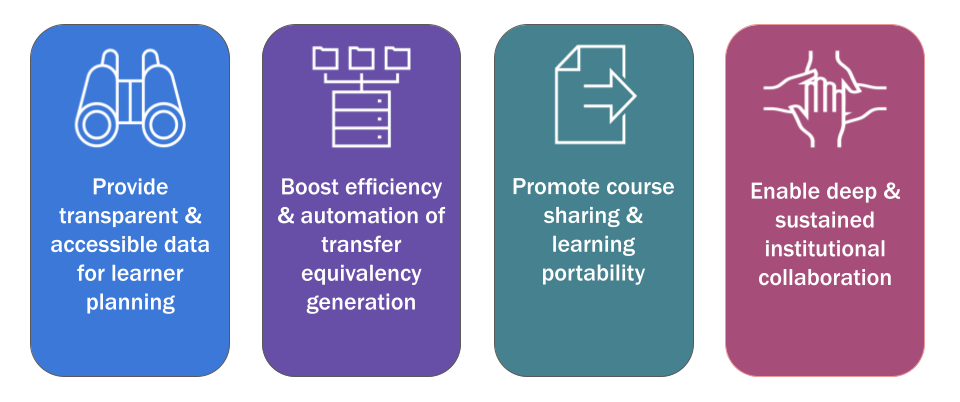
To achieve holistic credit mobility, states, systems, and higher education institutions must leverage modern credit mobility technologies to make these critical data visible and accessible, streamline data processes, and—especially as AI capabilities continue to advance—generate learning equivalencies and pathways from those data. To help make sense of this complex landscape, inform strategy, and ground technology decisions in the core principles of holistic credit mobility, Ithaka S+R has identified four key roles for technology.[2] Technology solutions can serve in one or multiple of these roles. States, systems, and institutions should carefully assess the specific needs technology is intended to address before adopting a new system or tool. Whether designed to support learners directly or to assist advisors and staff, effective credit mobility technologies should illuminate the most efficient pathway from prior learning to a degree or credential.
Roles of Supportive Credit Mobility Technology
Technology Selection Considerations Guide
Selecting a credit mobility technology requires a tailored approach; there is no single project plan or set of guidelines that will apply across all contexts. Instead, the process is shaped by local policies, budgets, institutional needs, procurement guidelines, and stakeholder priorities. Above all, technology decisions should begin with a fundamental question: What outcome are we trying to achieve for learners?—not simply, What technology should we buy?
This guide is divided into three sections: understanding the current landscape and user needs, assessing proposed technology solutions, and sustainability and continuous improvement. Together, the guiding questions support system and institutional leaders in evaluating technology needs, selecting appropriate solutions, and planning the capabilities and infrastructure required to sustain holistic credit mobility.
Understanding the current landscape and user needs
Before entering a technology selection process, system and institution leaders should consider the following questions:
Credit Mobility Processes and Data
- How are learning equivalencies currently created, stored, updated, and retired?
- Who is responsible for maintaining equivalency rules and ensuring accuracy?
- What data inputs are required to support equivalency generation?
- How would business owners rate the quality of current data used for equivalency processes?
- What systems and technologies are used for these processes?
- What regular institutional and system processes would utilize the proposed technology or outputs of the technology (e.g. prospective student services, academic advising, transcript evaluation, etc.)? How would stakeholders like to see these processes improved by the proposed technology?
Policy
- What institution or state/system level policies guide learning equivalency processes? Do stakeholders feel policy additions or revisions would improve the process?
Information Seeking
- Where do students or staff go to find information about learning equivalencies and degree applicability now? Are these sources accurate, up-to-date, easily accessible, and inclusive of multiple types of prior learning?
- Do students and staff trust and utilize the information on learning equivalencies currently available? What do they do if a critical piece of information is not available?
Assessing the proposed technology
When vetting credit mobility technology solutions, system and institution leaders should consider the following questions:
Data ingestion, integration, and presentation
- What is the source of the data displayed or utilized by the technology? (e.g. institution source systems, catalogs, national data sources, etc.)
- How often and how is data refreshed?
- Does the technology unify data from multiple sources of prior learning that can be awarded credit (e.g., military, courses, exams, workforce learning)?
Access and Ease of Use
- How will learners access the technology? Will the technology require login credentials or authentication?
- Does the technology provide options to easily import or enter prior learning experiences?
- Does the technology allow users to investigate not only whether learning transfers, but how it applies to specific degree or program requirements?
- Does the technology allow a student to easily share results or queries with institution staff or advisors?
Interoperability
- Does the technology integrate with existing source systems and CRMs?
- Does the technology utilize or integrate any data standards or common languages (e.g., CTDL, ACE IDs, state codes)?
- How does the technology support the exchange of learning information across institutions, systems, or states?
Strategic and Operational Fit
- What is the underpinning mission of the technology and does it align with institution and system goals for student credit mobility?
- How does the technology monitor and report usage and user success?
- Does the technology offer robust support and training for users and institution staff?
- What is the implementation timeline, costs, staffing needs, and potential risks associated with the technology?
- Is the technology compliant with privacy, accessibility, and IT policies?
- How does the technology continuously improve and develop? Does the technology allow user customization and to what level?
Sustainability and continuous improvement
When implementing a new credit mobility technology, institution and system leaders should plan for sustainability and ongoing assessment of user experience. The following questions should be considered:
Ownership, Accountability, and Resources
- Who will be the business owner of the technology?
- Is there sufficient funding to maintain year-over-year costs for the technology?
- How will the success of the technology be monitored and results shared with system and institutional leadership and key stakeholders?
- Is there adequate staffing to support the technology beyond the initial launch and rollout?
- Is there adequate support from IT to maintain the technology and from marketing and communications to support ongoing promotion (if student-facing)?
User Experience and Adoption (Post-Implementation)
- How are users engaging with the technology to complete credit mobility tasks?
- What barriers are they encountering in navigating the technology to complete these tasks?
- What “off-label” uses of the technology have users discovered and are actively using?
- Do users feel the technology is meeting their functional and/or information needs?
- Do users feel the technology is being widely utilized by their peers? What opportunities are present to improve utilization?
Acknowledgements
This report was made possible through generous support from Ascendium Education Group. The views expressed in this report do not necessarily reflect the positions or policies of the funder. In developing this resource, authors drew on expertise and insights shared by members of the Holistic Credit Mobility Acceleration Cohort, which included: EDWorks of Northeast Tennessee, Eastern Washington University on behalf of a regional group of education and training organizations, Idaho State Board of Education, Louisiana Board of Regents, Minnesota State Colleges & Universities, Missouri Department of Higher Education & Workforce Development, Nevada System of Higher Education, Ohio Department of Higher Education, Pennsylvania State System of Higher Education, South Carolina Commission on Higher Education, Shasta College/North State Together Partnership, and University System of Georgia. The authors are also grateful for excellent copyediting and design from Kimberly Lutz and Juni Ahari and thought partnership from Complete College America.
Endnotes
- Kyle Gray, Betsy Mueller, Emily Tichenor, Elise Miller McNeely, “National Holistic Credit Mobility Acceleration Cohort: Announcing 11 Members,” Ithaka S+R, February 27, 2025, https://sr.ithaka.org/blog/national-holistic-credit-mobility-acceleration-cohort/. ↑
- Betsy Mueller and Emily Tichenor, “Examining the Critical Role of Technology in Holistic Credit Mobility; Notes from the Cohort’s Second Virtual Convening,” Ithaka S+R, June 5, 2025, https://sr.ithaka.org/blog/holistic-credit-mobility-acceleration-cohort-examines-the-critical-role-of-technology/. ↑