Announcing the Library Partnership Development Framework
Across sectors, organizations are increasingly recognizing that no single institution can meet the full range of needs facing students and communities today. Effective partnerships, grounded in shared goals, clear roles, and sustained collaboration, are essential for addressing complex challenges like access to education, workforce development, digital inclusion, and basic needs support. Libraries offer a compelling example of how this work can take shape.
Public and academic libraries often serve the same populations through different institutional structures. In both settings, libraries regularly serve students balancing coursework, jobs, and family responsibilities, as well as community members seeking reliable internet access, workforce resources, or a place to study and connect. These shared audiences and missions create natural opportunities for collaboration across institutions, yet there is limited guidance on how they can work together intentionally and effectively to support their community’s basic needs.
Today we are pleased to announce the publication of the Library Partnership Development Framework, designed to help libraries and other collaborative institutions build, strengthen, and sustain collaborations that support student success and community wellbeing.
The framework is the culmination of research conducted through the Maximizing Public-Academic Library Partnerships (PALP) project. Drawing on case studies, a national inventory of library websites, and an in-person, participatory design institute with librarians, project advisors, and community stakeholders, the project explored how collaborations between public and academic libraries develop and evolve, as well as the challenges and opportunities they encounter along the way.
What is the Library Partnership Development Framework?
While grounded in the context of public and academic libraries, the framework speaks to a broader need: how institutions can work together more effectively across organizational boundaries towards supporting basic needs. Partnership can take on many forms, from deeply integrated joint-use spaces that share facilities and governance, to more flexible arrangements that focus on coordinated programming or collaborations with community organizations. In libraries, these collaborations often address essential needs such as digital access, financial literacy, food security, or mental health support.
Rather than prescribing a single model, the framework recognizes that successful partnerships are shaped by local contexts, institutional priorities, and community needs. Its goal is to provide a flexible structure and helpful context that institutions and libraries alike can adapt to their own partnerships and collaborative styles.
The Library Partnership Development Framework is intended for librarians at all levels, from frontline staff to institutional and administrative leaders, who are exploring new collaborations or looking to strengthen and sustain existing ones. While the framework focuses on partnerships between public and academic libraries, its core principles may also be useful for libraries and other departments working with other campus units, community organizations, or regional networks committed to supporting student success and community wellbeing.
Building effective partnerships
The framework organizes partnership development into three interconnected phases: initiation, implementation, and sustainability. Each phase includes guiding core principles, key stakeholders, and practical questions that partners can use to align their goals, clarify responsibilities, and evaluate progress. Institutions can enter the framework at any point depending on where they are in their partnership, whether they are beginning conversations with potential partners or looking to expand and deepen long-standing relationships.
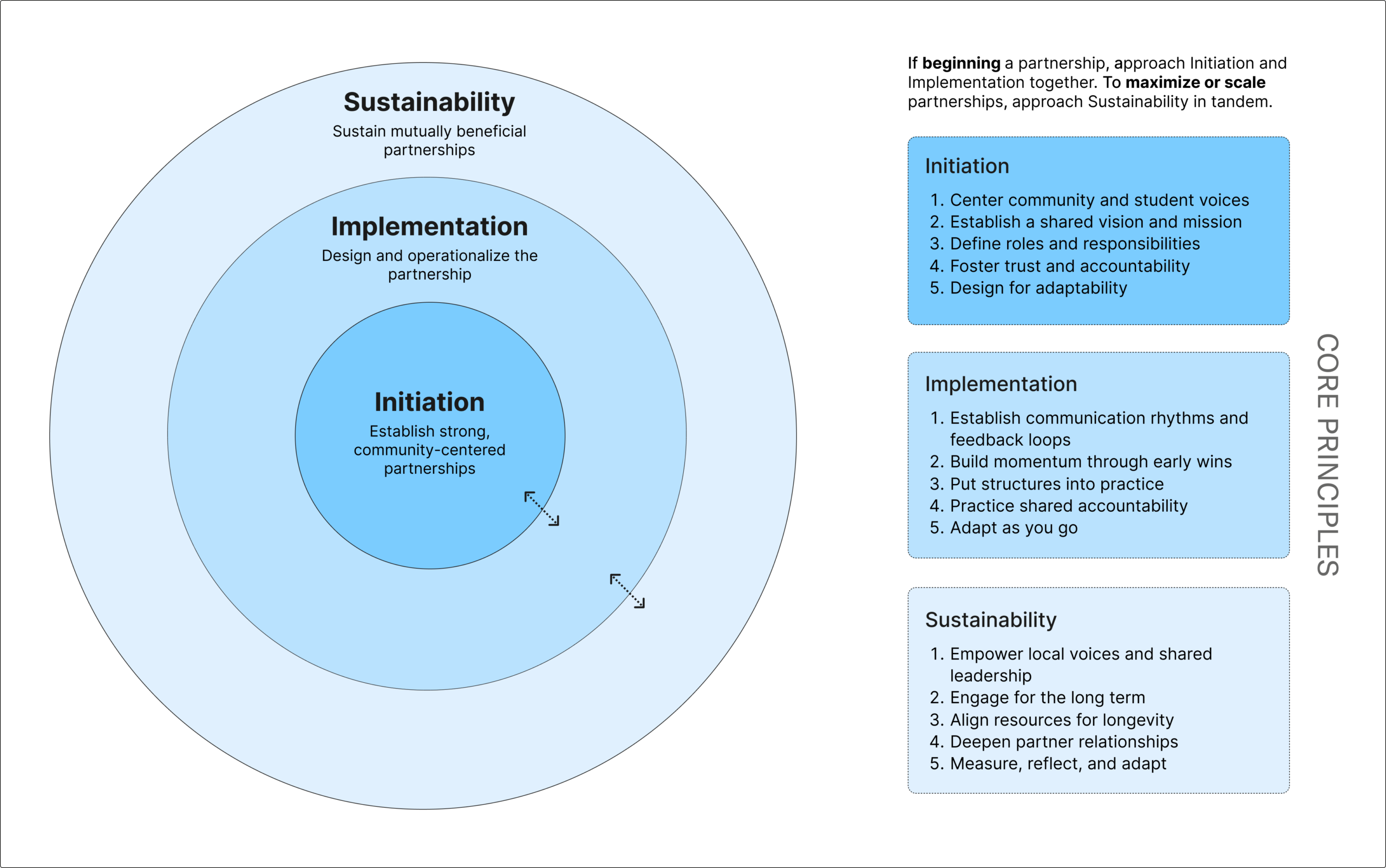
Importantly, the framework is designed to be iterative rather than linear. Partnerships evolve over time, and the framework encourages organizations and libraries to revisit earlier stages, refine their approach, and adapt to changing community needs. This flexibility makes the framework relevant not only for new collaborations, but also for strengthening and expanding existing partnerships.
Across our research, one theme emerged clearly: libraries are increasingly acting as connectors within broader ecosystems of education, basic needs services, and community support. This insight applies more broadly as well. When organizations collaborate across institutional boundaries, they can extend their reach, access new resources, and respond more effectively to the full range of needs their communities face. By collaborating with each other and with partners across sectors, libraries and other institutions can extend their reach, increase funding opportunities, and better address the interconnected needs that shape community success and wellbeing.
We hope this framework helps institutions move from informal collaboration to intentional partnership. By providing shared language, practical guidance, and real-world examples, it aims to support leaders and staff build relationships that are sustainable, responsive, and grounded in the needs of the communities they serve.