Assessing Comprehensive Support for First-Generation Student Success
New Findings and a Dashboard from the Kessler Scholars Program Evaluation
First-generation college students bring remarkable determination and resilience to their pursuit of higher education. Yet they continue to face significant barriers to degree completion, including fewer financial resources, less academic preparation, and less information and guidance about how to navigate the higher education system. A growing evidence base suggests that comprehensive, cohort-based support programs that address these multifaceted barriers can meaningfully improve outcomes for these students.
Today, we published a new issue brief and a public dashboard as part of Ithaka S+R’s ongoing evaluation of the Kessler Scholars Program, which offers new evidence on how the comprehensive cohort-based program is redefining holistic support for first-generation, limited-income students across 16 institutions nationwide.
The Kessler Scholars Collaborative, supported by the Judy and Fred Wilpon Family Foundation and Bloomberg Philanthropies, now serves over 1,000 Kessler Scholars annually through a model that combines financial support with high-touch advising, peer mentoring, cohort-based programming, and structured engagement in high-impact practices. The Collaborative supports its national network of institutional partners in two key ways: guiding program development and implementation, and supporting continuous learning and assessment through its partnership with Ithaka S+R. Ithaka S+R’s findings inform program improvement and generate new insights for the field.
Since Ithaka S+R began its external evaluation of the program in 2022, we have published findings on the Collaborative’s support to partner campuses, the effectiveness of targeted first-year interventions, and the program’s response to COVID-19 disruptions. This latest brief draws on newly available data on program participation, year-to-year persistence, and completion rates to assess the Collaborative’s progress toward its goals of transforming the college experience for first-generation students and closing gaps in their persistence and completion. As part of its evaluation efforts, Ithaka S+R recently launched the Kessler Scholars Student Success Dashboard, which reports key metrics on the backgrounds and experiences of Kessler Scholars and compares their outcomes to those of other first-generation students at their institutions.
Promising completion outcomes for the inaugural cohort
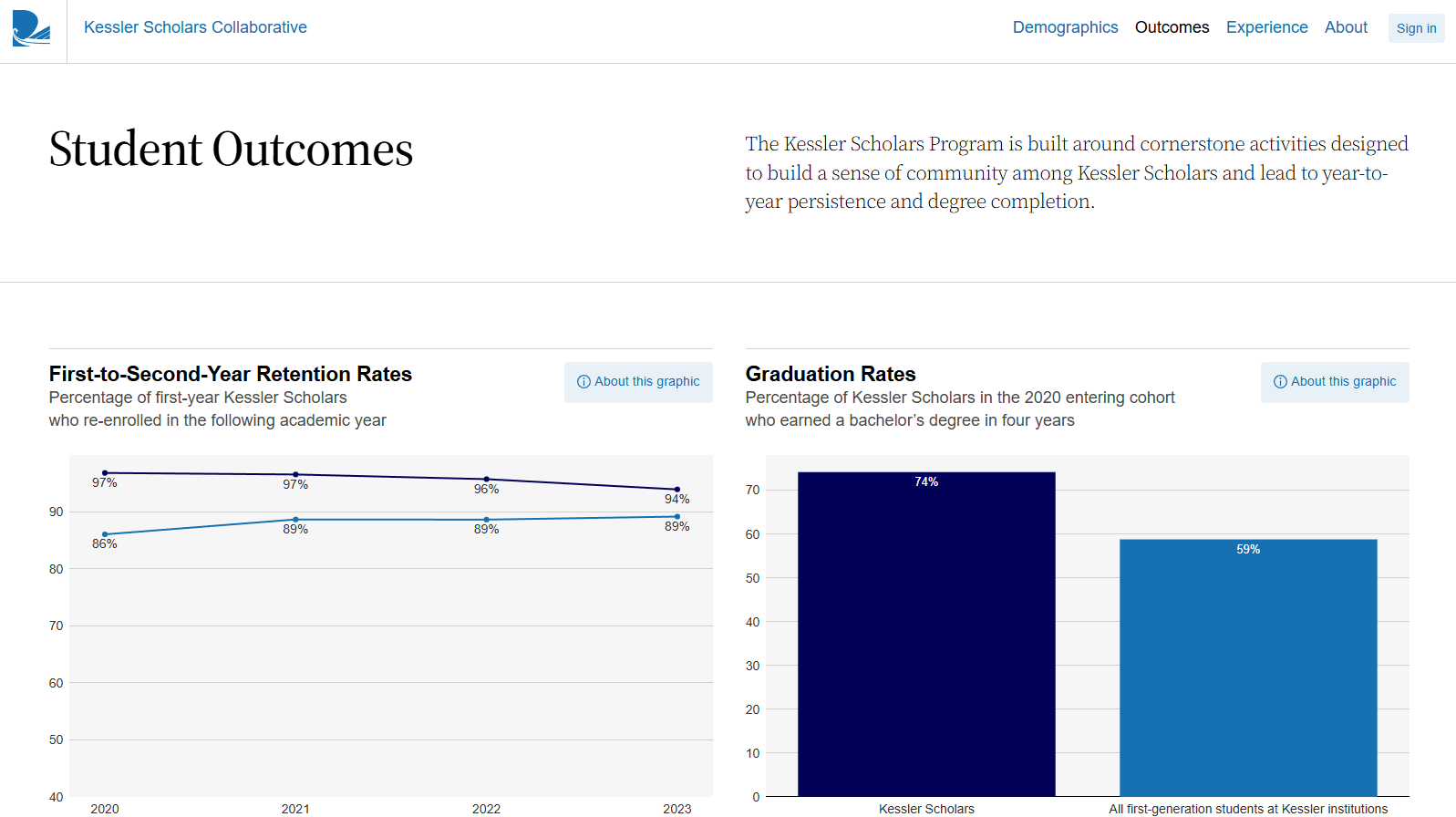
Among the brief’s most noteworthy findings is the four-year graduation rate for the Collaborative’s inaugural cohort. Seventy-four percent of Kessler Scholars who entered in fall 2020 earned bachelor’s degrees within four years, surpassing the Collaborative’s 70 percent goal and exceeding the 59 percent average four-year graduation rate for first-generation students at the same institutions. This completion rate is especially significant given that this cohort navigated the disruptions of the COVID-19 pandemic during their first two years of college. By the end of summer 2025, 84 percent of the cohort had graduated, placing the Collaborative on track to meet its six-year graduation goal of 85 percent. The Collaborative also met its retention benchmark: 94 percent of Kessler Scholars in the fall 2023 entering cohort returned for their second year, compared to 80 to 82 percent of first-generation students nationally.
Kessler Scholars value the program community
Survey data reinforce the value that students derive from the program’s holistic approach to student support. Ninety-four percent of respondents rated their overall program experience as good or excellent. Scholars reported especially strong benefits in areas related to belonging and community: 79 percent said program events strengthened their sense of belonging, and scholars consistently reported higher levels of belonging within the Kessler Scholars community than at their institutions overall. These findings align with a recurring theme across our evaluation: the program’s intentional community-building serves as a distinctive source of validation and support for first-generation students who may otherwise feel marginalized on their campuses.
By the time they graduated, a large majority of senior respondents at the inaugural institutions had completed at least one high-impact practice—study abroad, an internship, or mentored research—and 76 percent had served in a leadership role within the program or their broader campus community.
Areas for growth
The evaluation also identified areas where the program model can be strengthened as the Collaborative scales and matures. As upper-level students took on work commitments, leadership roles, and high-impact experiences, their participation in core program activities, such as one-on-one advising meetings and cohort events, declined. Additionally, scholars and staff also identified career preparation and post-graduation planning, and cross-institutional connections among Kessler Scholars at different programs as areas where programming could be improved. To address these issues, we recommend that the Collaborative consider differentiating program expectations by year of study, strengthening career development and alumni engagement infrastructure, and implementing targeted strategies to increase participation in high-impact practices.
Introducing the Kessler Scholars Collaborative Student Success Dashboard
Tracking students’ experiences and outcomes can help institutions and programs understand where students are thriving, where gaps persist, and which supports are making the biggest difference. Alongside the issue brief, we are launching the Kessler Scholars Student Success Dashboard, a new tool that makes key data about Kessler Scholars publicly accessible for the first time. Built and maintained by Ithaka S+R in tandem with the Collaborative, the dashboard allows users to explore aggregate data on Kessler Scholars’ backgrounds, outcomes, and college experiences across the Collaborative’s 16 partner institutions.
The Kessler Scholars Student Success Dashboard provides visualizations of scholars’ demographics, outcomes, and experiences across 16 partner institutions.
The dashboard covers over 1,200 students from the 2020 through 2024 entering cohorts and is organized around three domains:
Student Demographics describes the first-generation limited-income students supported across the Collaborative’s network of partner institutions in terms of majors, home states, Pell Grant receipt, race, and gender.
Student Outcomes presents data on first-to-second-year retention rates and four-year graduation rates, and offers insights into how Kessler Scholars are performing compared to other first-generation students at the partner institutions of the Collaborative.
Student Experience goes beyond traditional markers of success to capture the holistic experience of Kessler Scholars within the program and at the broader institution. This section includes data on scholars’ overall program satisfaction, sense of belonging, and feelings of mattering within both the program and their institution, and graduates’ participation in high-impact practices such as study abroad, internships, and undergraduate research.
The dashboard draws primarily on data from the annual Kessler Scholars Survey, which has been administered every spring since 2023 with response rates exceeding 85 percent, as well as student-level administrative records submitted by institutional research offices at partner campuses. It will be updated periodically as new data become available, providing a resource for understanding the Collaborative’s reach and impact over time.
The dashboard will serve as a valuable complement to our published evaluation findings, giving a wider audience the ability to engage directly with the data that inform our work. We encourage practitioners, researchers, and institutional leaders to explore the dashboard and consider how these data can inform their own efforts to support first-generation student success.
Looking ahead
The Collaborative recently announced grant renewal awards for its partner institutions, building on early evidence of the role of a comprehensive, cohort-based approach for closing outcome gaps and promoting belonging for first-generation students. As the 10 newer partner institutions graduate their first cohorts of scholars in 2027 and beyond, the evaluation will draw on a more representative evidence base to assess key completion outcomes. Future evaluation activities will also examine variation in program implementation and outcomes across campus partners, investigate leadership development within the program, explore engagement in high-impact practices, and assess the experiences of first-generation transfer students, among other topics.
To learn more, read the full brief and explore the dashboard. If your institution is interested in working with Ithaka S+R to improve student success through research, evaluation, or technical assistance, please contact Ify Oliobi, senior researcher, at ifeatu.oliobi@ithaka.org.