Academic Momentum and Credit Mobility
Examining the Role of CUNY’s Transfer Explorer
Executive summary
Across the United States, many community college students intend to earn a bachelor’s degree, but far fewer do so. A major reason is that transfer processes are often inefficient and opaque. In some cases, students lose credits they have earned, and in others they find that their transfer credits count only as elective credits, rather than helping them make progress towards their major or fulfilling general education requirements. This means transfer students too often need additional courses, time, and money to reach graduation.
The City University of New York (CUNY) created Transfer Explorer (T-REX) to help ameliorate these problems. Launched in 2020, T-REX is a systemwide, public-facing tool that shows how courses transfer across CUNY’s 20 undergraduate colleges and, critically, whether those courses apply to specific degree requirements. By making transfer rules and course degree applicability visible and searchable, T-REX is intended to help students plan course-taking and transfer choices more strategically, and to reduce avoidable “credit drift” after transfer.
T-REX is intended to help students plan course-taking and transfer choices more strategically, and to reduce avoidable “credit drift” after transfer.
This report examines whether using T-REX is associated with improved early transfer outcomes for CUNY students who move from a CUNY community college to a CUNY bachelor’s-degree-granting college. Using administrative data for first-time vertical transfer students initiating transfer between Fall 2020 and Spring 2025, we compare outcomes for students who logged in to T-REX before or during the year they transferred and students who did not. We focus on two outcomes measured at the bachelor’s-degree-granting college (the receiving institution): (1) the total number of courses transferred and (2) the number of transferred courses that count toward non-elective degree requirements (e.g., major, minor, or general education requirements). To assess these outcomes, we constructed a research process that accounts for differences in students’ academic backgrounds and demographics, their programs of study, the timing of their transfer, and the institutions they transferred into.
Three findings stand out:
- Students who logged in to T-REX transferred more courses that counted toward non-elective degree requirements than students who did not. T-REX use did not correlate consistently with students transferring a larger total number of courses to their receiving institutions.
- Where students transfer and what they study matters for applicability. Variation in degree requirements across receiving colleges and majors meaningfully shapes whether transferred coursework can count toward non-elective categories.
In brief, we found that T-REX’s value is less about increasing the volume of transfer credit and more about improving the quality of transfer credit in ways that can support academic momentum. These findings reinforce the importance of implementing tools and policies that help students understand not only whether credit transfers, but how it counts. For systems and states seeking to strengthen transfer pathways, T-REX offers encouraging evidence that transparency-focused infrastructure can improve early indicators of degree progress, particularly for students navigating complex transfer environments.
Introduction
Community colleges are a primary entry point to higher education in the United States, particularly for first-generation or low-income students as well as for students of color.[1] Many community college entrants aim to earn a bachelor’s degree, yet far fewer reach that goal, reflecting persistent barriers embedded in the transfer process.[2]
Students who successfully transfer all their earned credits are far more likely to complete bachelor’s degrees than those who lose credits in the process.
A central barrier is credit loss and credit inefficiency. Students may lose credits outright during transfer, or they may transfer credits that do not apply to specific degree requirements and instead default to elective credit, and even excess elective credit. These outcomes disrupt progress and can reduce the financial advantage of starting at a community college.[3] Students who successfully transfer all their earned credits are far more likely to complete bachelor’s degrees than those who lose credits in the process.[4] Yet only about half of transfer students experience full credit transfer, with differences by race and income.[5]
The information problem behind credit loss
Transfer is not only a policy and administrative challenge. It is also an information challenge. Students must often navigate unclear advising, inconsistent course numbering, and limited transparency about how courses apply to requirements.[6] For many students, successful navigation depends on “social know-how” and familiarity with the hidden curriculum of transfer, which can advantage students with greater access to guidance and insider knowledge.[7] These information gaps can reinforce challenges, especially for students of color and students from low-income backgrounds who rely heavily on the community college pathway.[8]
For many students, successful navigation depends on “social know-how” and familiarity with the hidden curriculum of transfer.
Traditional transfer reforms often focus on policy instruments such as articulation agreements and common course numbering systems. Although these approaches can be helpful, evidence suggests they do not reliably resolve the day-to-day information gaps students face when selecting courses and planning transfer.[9]
What Transfer Explorer is and what it is designed to do
CUNY’s Transfer Explorer (T-REX) is a technology-driven response to the information barriers that shape transfer outcomes. Launched in 2020, T-REX provides a centralized public interface showing how credits transfer across CUNY’s 20 undergraduate institutions and whether those credits apply to degree requirements.[10] The tool is designed for students, advisors, and faculty, and it addresses the fragmentation of transfer information and reliance on informal or inconsistent advising.[11]
In the first three years of its existence, more than 240,000 unique users accessed the site.
In displaying information about how credits transfer, T-REX takes advantage of CUNY’s longstanding policy that guarantees CUNY coursework will transfer across campuses as at least elective credit. More generally, it makes the degree applicability of credits transparent and searchable, including whether a transferred course fulfills major, minor, or general education requirements.[12] In the first three years of its existence, more than 240,000 unique users accessed the site.[13]
How T-REX fits into academic momentum and student decision-making
This study draws on academic momentum as the primary lens for understanding why degree applicability matters. Academic momentum emphasizes that steady progress and the accumulation of degree-relevant credits predict later completion, while interruptions and excess credit accumulation can undermine attainment.[14] T-REX is not designed to change enrollment intensity directly. Instead, it may support momentum by helping students avoid accumulating credits that do not advance degree requirements.
We also situate T-REX in research on student choice and information constraints. Students make decisions within bounded informational and institutional contexts, and unequal access to clear guidance can shape pathways and outcomes.[15] In the transfer context, a tool that clarifies transfer rules and degree applicability can expand the practical options students can see and act on.
The present study
This study examines whether T-REX use is associated with improved early transfer outcomes for students who transfer within CUNY from a community college to a bachelor’s-degree-granting college. We use an observational design with an analytic sample of 29,921 first-time vertical transfer students transferring in a fall or spring term between the start of the 2020-21 academic year and the start of the 2024-25 academic year.
Using a credit transfer archive that records students’ courses before and after transfer, including credit values and degree requirement applicability,[16] we focus on two outcomes: (1) total number of courses transferred and (2) total number of transferred courses applied to non-elective requirement categories. These nonelective categories included courses counting towards a major, minor, or general education requirements. We also obtained data indicating whether a student had logged in to the T-REX platform before or during the same year in which they transferred to a senior college. Finally, we drew student demographic and academic characteristics at the time of transfer from CUNY administrative databases.
To estimate associations between T-REX usage and these outcomes, we fit a series of nested mixed effects models with random effects for students’ attending community colleges. Both outcomes are modeled using negative binomial mixed effects models. Models incrementally add academic variables—major category, receiving institution, and demographic characteristics—while controlling for transfer term and nonlinear time trends.
This report addresses three research questions: (1) whether students who logged in to T-REX differ from those who did not, (2) whether T-REX use is associated with differences in total courses transferred, and (3) whether T-REX use is associated with differences in the number of transferred courses that count toward non-elective degree requirements.
Analytical plan
Statistical analyses consisted of a series of nested mixed effects models with random effects defined by the students’ sending community college. These models examined and tested the robustness of the association between T-REX usage and credit and course transfer outcomes. Whether a student was identified as having logged into the T-REX platform served as the primary independent variable of interest regarding the study research questions. Two outcomes were examined: total courses received at the transfer receiving institution, and total number of courses accepted as non-electives at the receiving institution. Both outcomes were modeled using a negative binomial mixed effects model. Five nested models per outcome were fit and compared. The first model included the T-REX login indicator; the second also included key academic independent variables, such as courses transferred with CUNY course information, courses transferred without CUNY course information (presumably, non-CUNY courses), and cumulative GPA. The third, fourth, and fifth models added variables for students’ major category, receiving institution, and demographic characteristics, respectively. The fifth model thus served as the fully specified model. All five models included control variables for the term in which a student transferred and a centered and squared semester term variable for nonlinear longitudinal trends.
Results
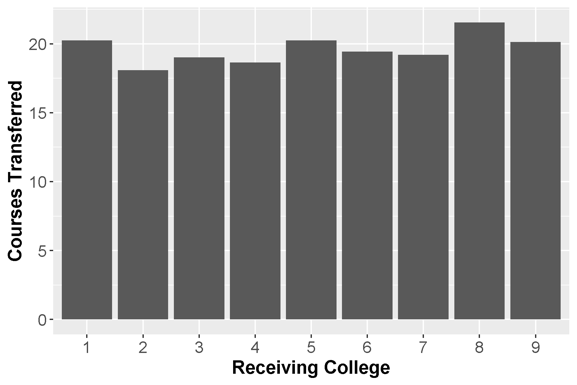
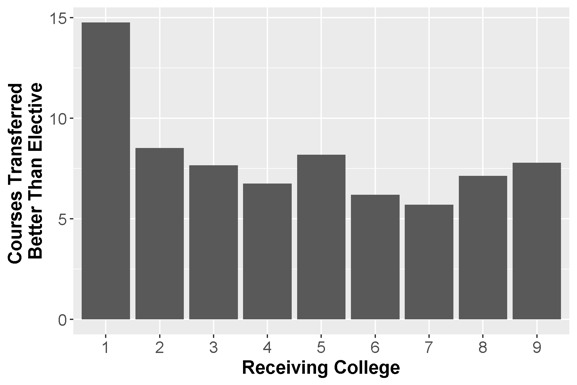
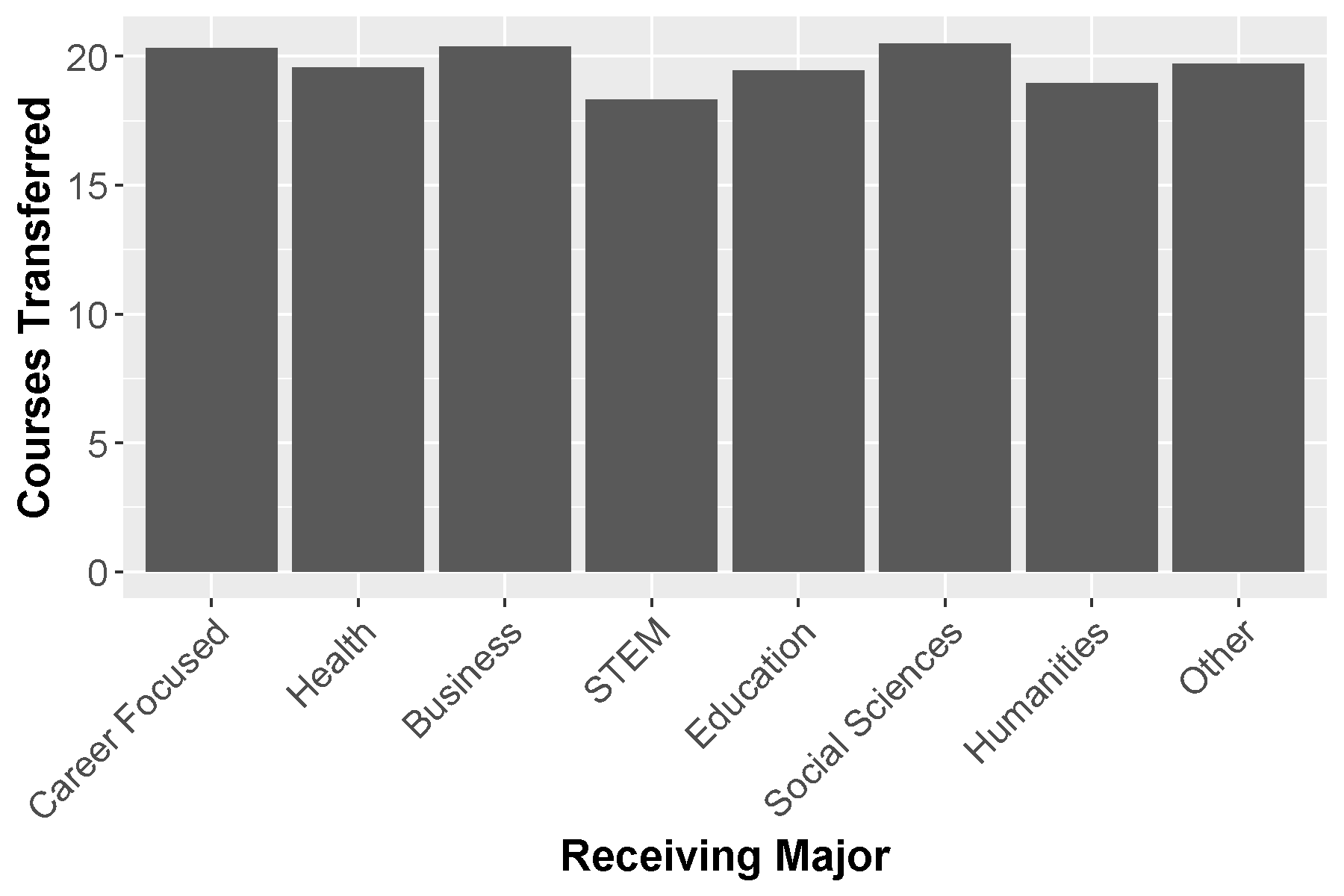
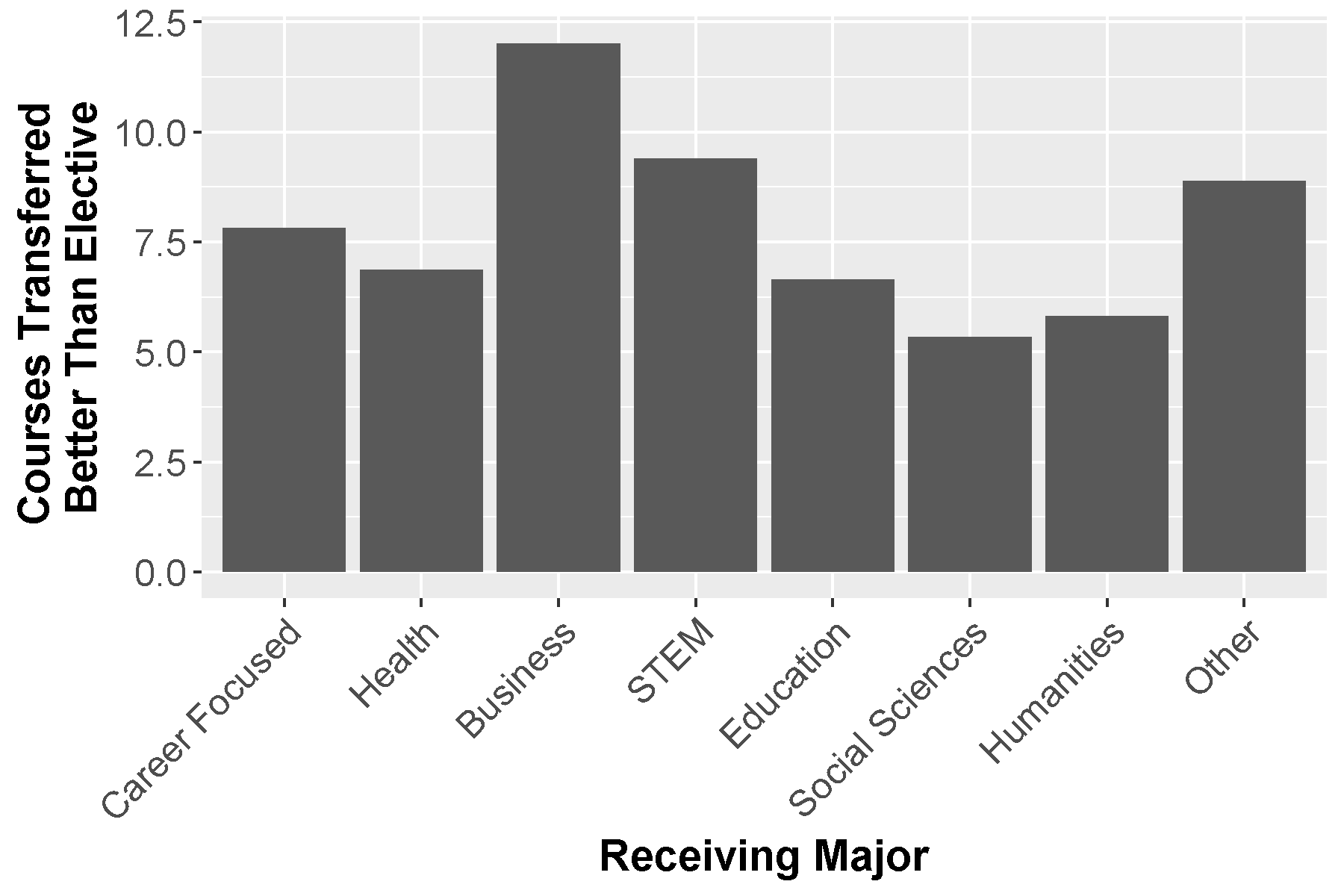
Descriptive statistics and comparisons between T-REX users and nonusers are shown in the first four columns of Table 1. The final three columns of Table 1 compare the mean value for each variable among students who were identified as having logged into T-REX (T-REX Users M) and those who had not (T-REX Nonusers M). The p-value, summarized in terms of correspondence to three threshold levels (p<.05, p<.01, and p<.001), in the final column describes the statistical significance of t-tests or chi-squared tests evaluating differences between the identified T-REX users and nonusers. Most student characteristics were found to have statistically significant differences (p <.05) across T-REX users and nonusers, although differences in mean values or proportions were generally relatively small (e.g. mean cumulative GPA for T-REX users = 3.21, nonusers = 3.07). Regarding the two outcomes, the mean number of courses transferred showed little variation by college or major (18.09-21.56 courses), however the mean number of courses transferred or enrolled in categorized in nonelective categories by college and major had large variation in mean values (5.35-14.77 courses; see Figure 1).
Findings described in Table 2 show that, with a simple mixed effects model including only fixed effects for T-REX use and time variables, T-REX use formed a statistically significant positive relationship with total courses transferred. However, as control variables were added, T-REX use no longer formed a consistent, significant, relationship with the total number of courses transferred. Instead, variables such as total courses transferred with CUNY course information, and cumulative GPA, were found to have statistically significant associations. Demographic characteristics did not improve model fit, measured in terms of the Bayesian information criterion (BIC), when added to models that already included major and receiving institution variables.
In contrast to results relating to the total courses transferred outcome, models for the total number of courses transferred in nonelective categories demonstrated statistically significant positive associations with T-REX use across all five of the nested models (see Table 3). For the fully specified fifth model, the marginal effect of T-REX use was found to be 0.47 courses transferred in nonelective categories. The marginal effect for a one standard deviation increase in a student’s cumulative GPA was 0.15 courses transferred in nonelective categories. Total courses transferred from the sending institution with and without CUNY course information, and cumulative GPA also were found to form significant positive associations with this outcome. In contrast to results for the first outcome, the positive association between cumulative GPA and the count of courses transferred in nonelective categories outcome was proportionally closer in magnitude to the association for the variables for total courses transferred with and without CUNY course information. The addition of control variables to each of these nested models was found to improve model fit relative to less specified model versions. Race or ethnicity, gender, and age all formed statistically significant relationships with the number of courses transferred in nonelective categories. This contrasted with results for the first outcome in which the addition of demographic variables did not improve model fit and only resulted in significant associations between age and total courses transferred.
Discussion
Taken together, the results indicate that vertical transfer students’ use of T-REX is associated with increased transfer of credits and of course applicability toward nonelective requirements. However, these results also illustrate some of the complexities involved in credit transfer policy and suggest some of the particular ways in which T-REX may aid student transfer outcomes. CUNY has a system-wide policy in place meant to facilitate transfer that requires that all CUNY coursework transfer across institutions as at least elective credit. It is therefore not surprising that use of T-REX would not be significantly associated with the first outcome measure (the total number of courses transferred). However, the T-REX platform provides detailed information about how coursework and credits transfer as specific courses at receiving institutions, including listing which courses apply toward specific degree and major requirements. As a result, the information contained in T-REX facilitates specific degree path planning and comparison, informs students of requirements, and helps students choose coursework and transfer more credits that apply to specific degree requirements. The conclusion that T-REX promotes such effects is supported by the results concerning the second outcome variable (total number of courses accepted as nonelective courses in the first term at the receiving institution).
One question is how to explain the larger positive significant coefficient for the association between students’ cumulative GPA and the second outcome variable as compared to the first outcome variable. This finding can be partially explained by the fact that CUNY has many transfer credit rules that assign the type of transfer credit a student receives depending on the grade that the student received in the course. Higher grades are more likely to result in courses transferring as specific course designations, courses that are more likely to fulfill major and general education requirements, as opposed to elective credit. Students with higher cumulative GPAs may also be more proactive regarding fulfilling their degree requirements, leading to an increased association between GPA and transferred courses counting towards nonelective requirements.
Note also that the inclusion of receiving institution and major variables improved model fit, particularly for the second outcome variable. This is not surprising given that majors across institutions have unique and varied degree requirements. A student’s selected college and degree program has a direct impact on whether or how prior coursework and course taking fulfills nonelective degree requirements. In contrast, differences associated with a student’s selected college or degree program do not negate the system-wide policy guaranteeing elective credit for all CUNY coursework.
Conclusion
The present study found that although T-REX users do not differ substantially from nonusers in many respects, and that although T-REX use is not associated with greater total courses transferred, T-REX use is associated with more transferred courses applying toward major, minor, and general education requirements. These results indicate that the T-REX platform’s greatest utility for CUNY students may be in enabling students to plan their course taking, as well as choose their transfer destination colleges and degree programs, so as to maximize their fulfillment of nonelective degree requirements at their destination colleges. These results show encouraging evidence regarding the impact of student facing informational tools that facilitate better credit transfer and course choice. Future research should investigate T-Rex usage on longer-term outcomes such as graduation.
T-REX use is associated with more transferred courses applying toward major, minor, and general education requirements.
T-REX has the potential to meaningfully improve students’ abilities to navigate difficult and complex transfer and degree path environments and may be able to aid students’ academic momentum. Such facilitators to academic momentum create opportunities for associate degree students from a range of backgrounds, increasing bachelor’s degree attainment more broadly.
Acknowledgements
Ithaka S+R has had a role in the development, refinement, and implementation of CUNY (City University of New York) Transfer Explorer, the tool which is the subject of this report. This role has included Ithaka S+R obtaining grant funding to cover Ithaka S+R’s staff contributions and, through subgrants, CUNY’s staff contributions. Additionally, a team at Ithaka S+R is working to build a similar tool, a “universal” Transfer Explorer, for other college systems to help students transfer with minimal credit loss. That team may draw on insights from the current research project as they develop this tool.
Our research and other work would not be possible without the contributions of an extensive group of researchers and practitioners. The authors thank, from Ithaka S+R, Chris Buonocore, Martin Kurzweil, Betsy Mueller, Emily Tichenor, and Madeline Trimble for thoughtful research and contributions to this project, as well as Kimberly Lutz and Juni Ahari for their feedback on this work. From CUNY, the authors thank Colin Chellman, Chris Vickery, Juan Villalona, and additional members of the Office of Applied Research, Evaluation, and Data Analytics for providing invaluable access to quantitative data and astute insights about those data that helped further ground this research. Any errors or omissions remain the fault of the authors.
Lastly, this work could not have been undertaken without the generous support of the Ascendium Education Group. Views expressed here do not necessarily reflect the positions or policies of the funders.
To learn more about CUNY Transfer Explorer, visit https://explorer.cuny.edu/.
Appendix
Table 1. Sample Descriptive Statistics and Tests of Differences Comparing T-REX Users and T-REX Nonusers.
| Complete Sample | T-REX Users | T-REX Nonusers | |||||
| (n=29,921) | (n=2,949) | (n=26,972) | |||||
| M | SD | Min | Max | M | M | pa | |
| Outcome Variables | |||||||
| Courses Transferred | 19.60 | 4.72 | 1.00 | 42.00 | 19.76 | 19.58 | |
| Courses Transferred to Nonelective Category | 7.95 | 5.11 | 0.00 | 30.00 | 9.05 | 7.83 | *** |
| Predictor Variables | |||||||
| T-REX Login | 0.10 | 0.00 | 1.00 | ||||
| Sending Courses From CUNY | 16.52 | 6.68 | 0.00 | 36.00 | 17.29 | 16.43 | *** |
| Sending Courses Not CUNY | 4.58 | 6.72 | 0.00 | 72.00 | 4.22 | 4.62 | *** |
| Cumulative GPA | 3.09 | 0.58 | 0.00 | 4.00 | 3.21 | 3.07 | *** |
| Black or African American | 0.29 | 0.00 | 1.00 | 0.28 | 0.29 | ||
| Hispanic | 0.36 | 0.00 | 1.00 | 0.29 | 0.36 | *** | |
| Asian or Pacific Islander | 0.19 | 0.00 | 1.00 | 0.24 | 0.19 | *** | |
| American Indian | 0.00 | 0.00 | 1.00 | 0.00 | 0.00 | ||
| Female | 0.61 | 0.00 | 1.00 | 0.60 | 0.61 | ||
| Age | 26.35 | 7.18 | 18.00 | 81.00 | 27.16 | 26.26 | *** |
| PELL Recipient | 0.84 | 0.00 | 1.00 | 0.81 | 0.85 | *** | |
| Transfer Term | 4.92 | 2.69 | 0.00 | 9.00 | 8.32 | 4.55 | *** |
Note: aCharacteristics of T-REX users and nonusers are compared using t-tests in the case of continuous variables and using chi-squared tests in the case of categorical variables. *p<.05, **p<.01, ***p<.001.
Table 2. Negative Binomial Mixed Effects Model Marginal Effects (ME) for Nested Models Evaluating Associations Between Student Characteristics Including T-REX Use and Count of Total Courses Transferred.
| Model 1 | Model 2 | Model 3 | Model 4 | Model 5 | |||||||||||
| ME | SE | p | ME | SE | p | ME | SE | p | ME | SE | P | ME | SE | p | |
| T-REX Login | 0.25 | 0.01 | * | 0.07 | 0.01 | 0.10 | 0.01 | 0.13 | 0.01 | 0.13 | 0.01 | ||||
| Sending Courses From CUNY | 6.04 | 0.002 | *** | 6.13 | 0.002 | *** | 6.13 | 0.002 | *** | 6.08 | 0.002 | *** | |||
| Sending Courses Not CUNY | 3.46 | 0.002 | *** | 3.63 | 0.002 | *** | 3.68 | 0.002 | *** | 3.69 | 0.002 | *** | |||
| Cumulative GPA | 0.11 | 0.001 | *** | 0.14 | 0.002 | *** | 0.14 | 0.001 | *** | 0.15 | 0.001 | *** | |||
| Major | X | X | X | X | X | X | X | X | X | ||||||
| Receiving Institutions | X | X | X | X | X | X | |||||||||
| Black or African American | 0.12 | 0.004 | |||||||||||||
| Hispanic | -0.003 | 0.004 | |||||||||||||
| Asian or Pacific Islander | -0.04 | 0.01 | |||||||||||||
| American Indian | 0.18 | 0.02 | |||||||||||||
| Female | 0.09 | 0.003 | |||||||||||||
| Age | -0.14 | 0.001 | *** | ||||||||||||
| PELL Recipient | 0.16 | 0.004 | * | ||||||||||||
| Transfer Term | -0.08 | 0.001 | -0.58 | 0.001 | *** | -0.54 | 0.002 | *** | -0.57 | 0.002 | *** | -0.55 | 0.002 | *** | |
| Transfer Term^2 | 0.06 | 0.003 | 0.44 | 0.002 | *** | 0.40 | 0.002 | *** | 0.38 | 0.002 | *** | 0.38 | 0.002 | *** | |
| BIC | 181,941 | 158,170 | 157,838 | 157,694 | 157,725 | ||||||||||
| N | 29,921 | 29,921 | 29,921 | 29,921 | 29,921 | ||||||||||
Note: Marginal effects were calculated at the mode or referent value for categorical variables and the mean value for continuous variables except transfer term variables for which values were set to the most recent observed term, Spring 2025. aContinuous variables: Sending Courses From CUNY, Sending Courses Not CUNY, Cumulative GPA, and Age were mean centered with standard deviation set to one. Columns with “X” in rows labeled “Major” and “Receiving Institution” indicate inclusion of dummy variables for categories of majors and each individual receiving college in the model. Standard errors refer to model coefficient values. P values refer to model coefficients and standard errors. *p<.05, **p<.01, ***p<.001.
Table 3. Negative Binomial Mixed Effects Model Marginal Effects (ME) for Nested Models Evaluating Associations Between Student Characteristics Including T-REX Use and Count of Courses Transferred as Fulfilling Non-Elective Degree Requirements.
| Model 1 | Model 2 | Model 3 | Model 4 | Model 5 | |||||||||||
| ME | SE | P | ME | SE | p | ME | SE | p | ME | SE | p | ME | SE | p | |
| T-REX Login | 0.86 | 0.02 | *** | 0.69 | 0.02 | *** | 0.40 | 0.01 | *** | 0.47 | 0.01 | ** | 0.47 | 0.01 | ** |
| Sending Courses From CUNY | 0.50 | 0.01 | *** | 0.28 | 0.01 | *** | 0.41 | 0.01 | *** | 0.47 | 0.01 | *** | |||
| Sending Courses Not CUNY | 0.52 | 0.01 | *** | 0.29 | 0.01 | *** | 0.71 | 0.01 | *** | 0.80 | 0.01 | *** | |||
| Cumulative GPA | 0.38 | 0.004 | *** | 0.25 | 0.004 | *** | 0.18 | 0.004 | *** | 0.15 | 0.004 | *** | |||
| Major | X | X | X | X | X | X | X | X | X | ||||||
| Receiving Institutions | X | X | X | X | X | X | |||||||||
| Black or African American | -0.24 | 0.01 | |||||||||||||
| Hispanic | -0.39 | 0.01 | ** | ||||||||||||
| Asian or Pacific Islander | 0.72 | 0.01 | *** | ||||||||||||
| American Indian | 0.18 | 0.06 | |||||||||||||
| Female | -0.34 | 0.01 | *** | ||||||||||||
| Age | -0.24 | 0.004 | *** | ||||||||||||
| PELL Recipient | 0.11 | 0.01 | |||||||||||||
| Transfer Term | 0.44 | 0.01 | *** | 0.41 | 0.01 | *** | 0.31 | 0.01 | *** | 0.40 | 0.01 | *** | 0.42 | 0.01 | *** |
| Transfer Term^2 | -0.29 | 0.01 | *** | -0.24 | 0.01 | *** | -0.17 | 0.01 | ** | -0.29 | 0.01 | *** | -0.28 | 0.01 | *** |
| BIC | 179,548 | 179,238 | 175,767 | 173,450 | 173,393 | ||||||||||
| N | 29,921 | 29,921 | 29,921 | 29,921 | 29,921 | ||||||||||
Note: Marginal effects were calculated at the mode or referent value for categorical variables and the mean value for continuous variables except transfer term variables for which values were set to the most recent observed term, Spring 2025. Continuous variables: Sending Courses From CUNY, Sending Courses Not CUNY, Cumulative GPA, and Age were mean centered with standard deviation set to one. Columns with “X” in rows labeled “Major” and “Receiving Institution” indicate inclusion of dummy variables for categories of majors and each individual receiving college in the model. Standard errors refer to model coefficient values. P values refer to model coefficients and standard errors. *p<.05, **p<.01, ***p<.001.
Figure 1. Bar Graphs Showing Mean Courses Transferred (Left), Courses Transferred or Enrolled in First-Term Post-Transfer Fulfilling Degree Requirements (Right) by Receiving College (Top) and by Receiving Major (Bottom).
Endnotes
- “Helping Community College Students Climb the Transfer Ladder,” Community College Survey of Student Engagement (CCCSE), 2023, https://www.ccsse.org/NR2023/Transfer.pdf. ↑
- Tatiana Velasco et al., “Tracking Transfer: Community College and Four-Year Institutional Effectiveness in Broadening Bachelor’s Degree Attainment,” Community College Research Center, 2024, https://ccrc.tc.columbia.edu/publications/tracking-transfer-community-college-and-four-year-institutional-effectiveness-in-broadening-bachelors-degree-attainment.html; K. Gentsch et al., “The Vertical Transfer Pipeline and Its Leaks: Tracking Students from Associate’s Programs to Bachelor’s Degrees,” Journal of Postsecondary Student Success 3, no. 2 (2024): 18–55, 10.33009/fsop_jpss134267. ↑
- William R. Doyle, “Community College Transfers and College Graduation: Whose Choices Matter Most?” Change: The Magazine of Higher Learning 38, no. 3 (2006): 56–58, https://doi.org/10.3200/CHNG.38.3.56-58; Clive Belfield, John Fink, and Davis Jenkins, “Is It Really Cheaper to Start at a Community College? The Consequences of Inefficient Transfer for Community College Students Seeking Bachelor’s Degrees,” Community College Research Center, 2017, https://ccrc.tc.columbia.edu/publications/really-cheaper-start-at-community-college-consequences-inefficient-transfer.html. ↑
- William R. Doyle, “Community College Transfers and College Graduation,” Change: The Magazine of Higher Learning 38, no. 3 (2006): 56–58. ↑
- Matthew S. Giani, “The Correlates of Credit Loss: How Demographics, Pre-Transfer Academics, and Institutions Relate to the Loss of Credits for Vertical Transfer Students,” Research in Higher Education 60, no. 6 (2019): 841–872, 10.1007/s11162-019-09548-w; Dennis A. Kramer, Michael R. Holcomb, and Robert Kelchen, “The Costs and Consequences of Excess Credit Hours Policies,” Educational Evaluation and Policy Analysis 40, no. 1 (2018): 3–28, https://doi.org/10.3102/0162373717709968. ↑
- Michelle Hodara et al., “Exploring Credit Mobility and Major-Specific Pathways: A Policy Analysis and Student Perspective on Transfer,” Community College Review 45, no. 4 (2017): 331–349, https://doi.org/10.1177/0091552117724197. ↑
- Regina Deil-Amen and James E. Rosenbaum, “The Social Prerequisites of Success: Can College Structure Reduce the Need for Social Know-How?” The Annals of the American Academy of Political and Social Science 586, no. 1 (2003): 120–143, https://doi.org/10.1177/0002716202250216; Lauren Schudde, Huriya Jabbar, and Catherine Hartman, “How Political and Ecological Contexts Shape Community College Transfer,” Sociology of Education 94, no. 1 (2021): 65–83, https://doi.org/10.1177/0038040720954817. ↑
- Lorenzo D. Baber et al., “From Access to Equity: Community Colleges and the Social Justice Imperative,” in Higher Education: Handbook of Theory and Research, vol. 34, ed. Michael B. Paulsen and Laura W. Perna (Springer, 2019), 203–240, https://doi.org/10.1007/978-3-030-03457-3_5; Matthew S. Giani, “Correlates of Credit Loss,” Research in Higher Education 60, no. 6 (2019): 841–872. ↑
- Gregory M. Anderson, Jeffrey C. Sun, and Mariana Alfonso, “Effectiveness of Statewide Articulation Agreements on the Probability of Transfer: A Preliminary Policy Analysis,” Review of Higher Education 29, no. 3 (2006): 261–291, https://ccrc.tc.columbia.edu/publications/statewide-articulation-agreements-transfer.html; Angela Boatman and Adela Soliz, “Statewide Transfer Policies and Community College Student Success,” Education Finance and Policy 13, no. 4 (2018): 449–483, https://eric.ed.gov/?id=EJ1192642; Debra D. Bragg, “Opportunities and Challenges for the New Vocationalism in American Community Colleges,” New Directions for Community Colleges 2001, no. 115 (2001): 5–15, https://doi.org/10.1002/cc.26); Megan M. Chase, “Benchmarking Equity in Transfer Policies for Career and Technical Associate’s Degrees,” Community College Review 39, no. 4 (2011): 376–404, https://doi.org/10.1177/0091552111423966. ↑
- Martin Kurzweil, Cindy Le, and Alexandra W. Logue, “A New Resource to Help CUNY Students Transfer Smarter,” Ithaka S+R, June 5, 2020, https://sr.ithaka.org/blog/a-new-resource-to-help-cuny-students-transfer-smarter/. ↑
- Alexandra W. Logue et al., “Transfer Information Online: Websites and Articulation Agreements at The City University of New York,” Community College Review 51, no. 2 (2023): 266–284, https://doi.org/10.1177/00915521221145309; Patel, Pooja, Madeline Trimble, and Martin Kurzweil, “Transfer Credit Information at Your Fingertips:Preliminary Findings on Use and Implementation of CUNY Transfer Explorer,” Ithaka S+R, 2024, https://sr.ithaka.org/publications/transfer-credit-information-at-your-fingertips/. ↑
- Martin Kurzweil, Cindy Le, and Alexandra W. Logue, “A New Resource to Help CUNY Students Transfer Smarter,” Ithaka S+R, June 5, 2020; Christopher Vickery, “Data Nirvana: Using Great Information to Help Transfer Students,” Inside Higher Ed, March 22, 2023, https://www.insidehighered.com/opinion/columns/beyond-transfer/2023/03/22/data-nirvana. ↑
- Betsy Mueller et al., “Providing Credit Transfer Visibility to Improve Credit Mobility: Ithaka S+R’s ‘Universal Credit Transfer Explorer’ Launching in Three States in 2024,” Ithaka S+R, 2024, https://sr.ithaka.org/blog/providing-credit-transfer-visibility-to-improve-credit-mobility/. ↑
- Clifford Adelman, “The Toolbox Revisited: Paths to Degree Completion from High School through College,” US Department of Education, 2006, https://www.ed.gov/sites/ed/files/rschstat/research/pubs/toolboxrevisit/toolbox.pdf; Paul Attewell, Scott Heil, and Liza Reisel, “What Is Academic Momentum? And Does It Matter?” Educational Evaluation and Policy Analysis 34, no. 1 (2012): 27–44,
https://doi.org/10.3102/0162373711421958; Steven L. DesJardins, Dennis A. Ahlburg, and Brian P. McCall, “The Effects of Interrupted Enrollment on Graduation from College: Racial, Income, and Ability Differences,” Economics of Education Review 25, no. 6 (2006): 575–590, https://doi.org/10.1016/j.econedurev.2005.06.002; William R. Doyle, “Impact of Increased Academic Intensity on Transfer Rates: An Application of Matching Estimators to Student-Unit Record Data,” Research in Higher Education 50 (2009): 52–72, https://link.springer.com/article/10.1007/s11162-008-9107-6. ↑ - Laura W. Perna, “Studying College Access and Choice: A Proposed Conceptual Model,” in Higher Education: Handbook of Theory and Research, 99–157, 10.1007/1-4020-4512-3_3; Angela D. Bell, Heather T. Rowan-Kenyon, and Laura W. Perna, “College Knowledge of 9th and 11th Grade Students: Variation by School and State Context,” The Journal of Higher Education 80, no. 6 (2009): 663–685, 10.1353/jhe.0.0074; Regina Deil-Amen and Tenisha LaShawn Tevis, “Circumscribed Agency: The Relevance of Standardized College Entrance Exams for Low SES High School Students,” The Review of Higher Education 33, no. 2 (2010): 141–175, https://doi.org/10.1353/rhe.0.0125; Rebecca Cox, “Complicating Conditions: Obstacles and Interruptions to Low-Income Students’ College Choices,” The Journal of Higher Education 87, no. 1 (2016): 1–26, https://doi.org/10.1080/00221546.2016.11777392. ↑
- Alexandra W. Logue et al., “Tracking Vertical Transfer Students’ Credits: Changes in Applicability to Degree Requirements,” AERA Open 11 (2025), https://doi.org/10.1177/23328584251355515. ↑