Improving the Share of Adult Learners at Four-Year Institutions
Why High-Graduation-Rate Institutions Should Enroll More Adult Learners
Higher education institutions will face multiple enrollment challenges in the next decade. One prominent challenge is the enrollment cliff, the projected decline in the number of high school graduates after 2025, which means fewer traditional-aged students for institutions to enroll. And, while Gen Z values postsecondary education, they’re concerned about the time investment and cost, leading more prospective students to be open to career options outside of a four-year degree. In addition, executive level actions are having an impact on international student enrollment, which has been a significant source of revenue for institutions.
As they consider how to respond to these challenges, colleges and universities should take a closer look at the population of adult learners, particularly those within their geographic region, to support future enrollment efforts. This is important for all types of institutions, including those with high-graduation-rates (colleges with at least 500 undergraduates and six-year graduation rates consistently at or above 70 percent) which will not be immune to the effects of the declining enrollment in traditional-aged students. Engaging adult learners, whether they are enrolling for the first time or left before completing their credential, is one way that they can reimagine their enrollment pipeline.
High-graduation-rate institutions have the resources and structures to ensure students successfully complete their degrees. By helping adult learners enroll and obtain high-value credentials, these schools not only fulfill broader institutional missions around social and economic mobility, but help their states to meet workforce and economic development priorities. As roles in high-demand industries continue to require a postsecondary credential and economic and workforce development continues to be a top priority for states, four-year schools can benefit from enrolling adult learners who may have a clearer idea of what they want to study and why. And, as higher education institutions look to continue boosting public support, serving a broader swath of society is important.
This blog post explores the data on adult learner enrollment and the challenges that four-year public and private not-for-profit institutions face when these learners enroll, with particular attention to high-graduation-rate institutions. These colleges and universities simultaneously enroll the lowest shares of adult learners and, due to resources and student success practices, are best positioned to equip adult learners with a degree.
Who are adult learners?
Adult learners are usually defined as students who are at least 25 years old at the time of enrollment, whether it’s their first time enrolling or not. They are a diverse group who may have earned credits from different sources, work full or part time, and have children or older parents that they also take care of. According to the 2025 National Student Clearinghouse report Some College No Credential (SCNC), there are currently about 33.7 million working age Americans between 25 and 64 with some college credits and no credential. The number of students with some credits and no credential who re-enrolled increased for the second year in a row, although the national re-enrollment rate increased from 2.6 percent to 2.7 percent in the 2023-24 academic year and the population of students with SCNC who are not enrolled also grew. Their reasons for pursuing a credential or undergraduate degree are numerous and they may have different experiences and program needs.
Where did adult learners enroll in Fall 2023?
Table 1: Snapshot of Adult Learners Enrolled at Four-Year Institutions for Fall 2023[1]
| Number of Institutions | Number of Enrolled Adults | Share of Enrollment who are Adults | |
|---|---|---|---|
| Four-Year Institutions[2] | 1,452 | 1,225,666 | 14.7% |
| Public Four-Year Institutions | 530 | 706,105 | 12.3% |
| Private Four-Year Institutions | 922 | 519,561 | 20.1% |
| High-Graduation-Rate Four-Year Institutions | 356 | 145,965 | 4.7% |
Understanding the share of adult learners at four-year institutions can tell us something about the kinds of institutions they are choosing to enroll in. According to IPEDS data, in Fall 2023, the latest available year of data, the share of adult learners enrolled at four-year public and private not-for-profit institutions (n=1,452) was 14.7 percent in Fall 2023, with shares ranging from less than 1 to 98 percent. A slight majority of adult learners (50.4 percent) enrolled in these institutions part time.[3]
Table 1 shows that at four-year institutions, private not-for-profit institutions (n=922) had a higher average share of enrolled adult learners (20.1 percent) than public institutions (12.3 percent).[4] At public institutions (n=530), 53.1 percent of adult learners enrolled part time compared to 46.9 percent who enrolled full time, while at private not-for-profit institutions, 46.8 percent of adult learners enrolled part time and 53.2 percent enrolled full time.
Compared to the overall group of four-year institutions, the average adult learner share at high-graduation-rate institutions was much lower (4.7 percent). More adult learners at public institutions within this subgroup (n=93) were enrolled full time (54.2 percent) compared to the 45.8 percent enrolled part time. At private not-for-profit colleges within this subgroup (n=263), 50.6 percent of adult learners were enrolled part time compared to the 49.4 percent who were enrolled full time.
Adult learner enrollment trends
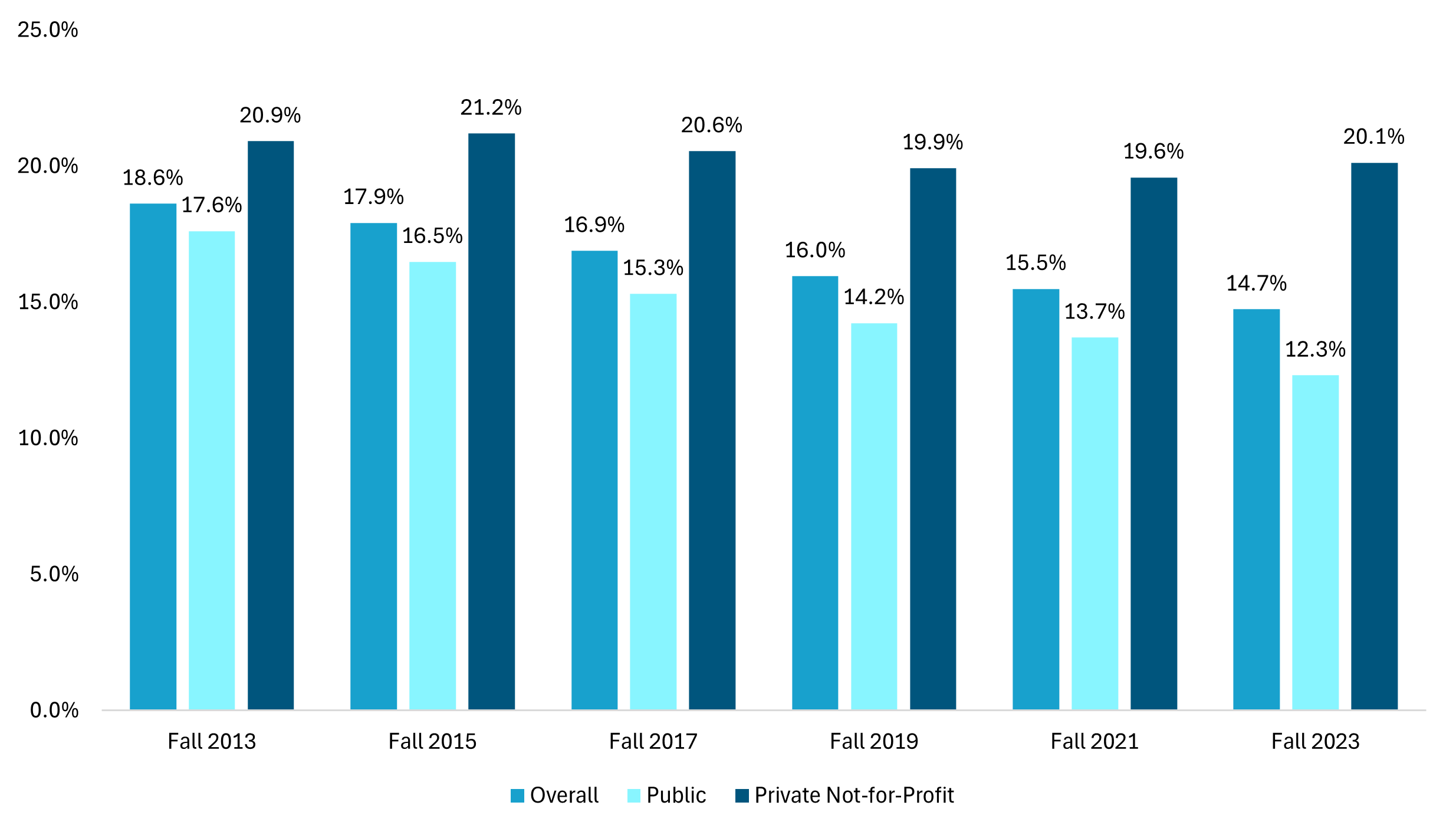
Figure 1 uses IPEDS data to show the composition of enrollment at four-year private, not-for-profit, and public institutions. Adult learners comprise a smaller share of the enrollment at public institutions in Fall 2023 than they did in Fall 2013. In Fall 2023, adults comprised just over 12 percent of enrollment at four-year public institutions, down from almost 18 percent of enrollment in Fall 2013. The trend at public institutions mirrors the overall trend in the share of four-year enrollment comprised by adults. During this same period, adult learner enrollment stayed fairly flat at four-year private, not-for-profit institutions; around 20 percent of undergraduates were adults.
Figure 1: Average Share of Adult Learner Undergraduates at Four-Year Public and Private Not-for-Profit US Institutions
Source: US Department of Education, National Center for Education Statistics, Integrated Postsecondary Education Data System (IPEDS), Fall Enrollment component final data (2014-2022) and Fall Enrollment component provisional data (2024).
Given the trends outlined in Figure 1, it’s not surprising that the number of adult learners overall has slightly declined, while the number of undergraduates enrolled has slightly increased. According to IPEDS, the number of adults enrolled at these four-year schools decreased from around 1.5 million in Fall 2013 to about 1.2 million in Fall 2023. At the same time, the number of all undergraduates enrolled slightly increased: undergraduate enrollment was 8.2 million in Fall 2013 and 8.3 million in Fall 2023, after a peak of 8.5 million in Fall 2017.
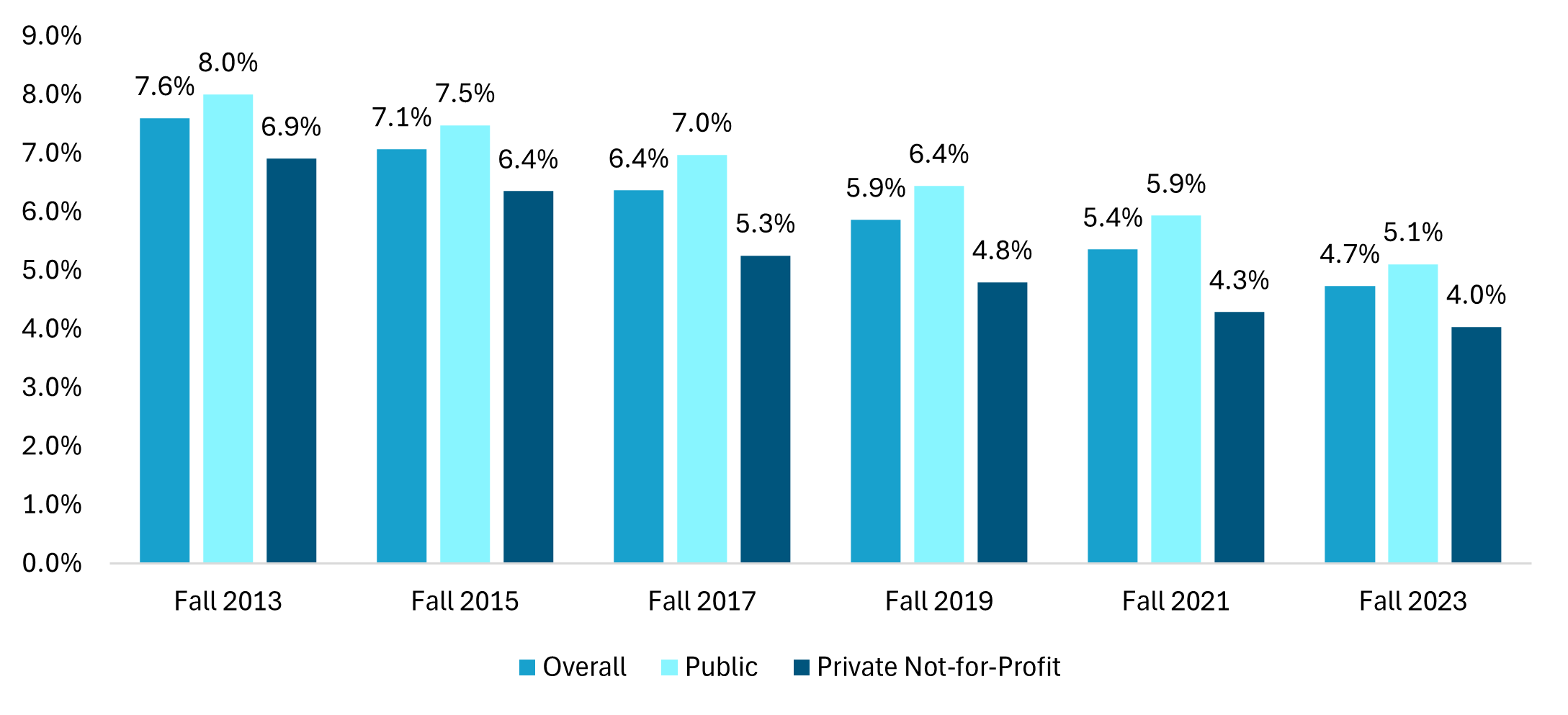
In Figure 2, we show that, compared to the overall group of four-year institutions, high-graduation-rate schools have much lower shares of adult learners. While the share has also declined at high-graduation-rate institutions, public institutions within this group have consistently had slightly higher adult learner enrollment shares than their private not-for-profit peers.
Figure 2: Average Share of Adult Learner Undergraduates at High-Graduation-Rate Four-Year US Institutions
Source: US Department of Education, National Center for Education Statistics, Integrated Postsecondary Education Data System (IPEDS), Fall Enrollment component final data (2014-2022), and provisional data (2024).
Trends in adult learner enrollment by institution type
In addition to the IPEDS data, the NSC Current Term Enrollment Estimates (CCTE) provide another good estimate of enrollment trends for adult learners, including additional insights into the enrollment decisions adults make. According to the NSC data, two-year institutions are the primary destination for adult learners, enrolling 37 percent of them in Fall 2023, down from 41 percent in Fall 2018.[5] These declines are offset by increases in other sectors. For instance, a growing proportion of adult learners are enrolling at four-year private for-profit institutions, from 9.3 percent of adults to 12.3 percent between Fall 2018 to 2023. And, in Fall 2023, 15.5 percent of enrolled adult learners were also at four-year private not-for-profit schools, compared to 14.1 percent in Fall 2018.[6]
What are the challenges to enrolling more adult learners?
Compared to all four-year institutions, adult learner enrollment at high-graduation-rate four-year institutions is comparatively low, and there are many challenges to increasing it. It is important to note that, at the undergraduate level, many of these institutions currently are designed and generally operate with first-time, full-time high-school graduates in mind. Adult learners, with their different motivations for pursuing higher education, life experiences, and needs, require a distinct approach. For these reasons, the challenges institutions face in enrolling more adult learners are in adjusting their current model to better attract and support adult learners while maintaining the traditional education model and experience.
Challenges for institutions
High-graduation-rate institutions may have transfer credit policies and unclear credit for prior learning processes that make it harder for adult students with credits from other institutions and experiences from work or the military to count them towards their intended major and degree.[7] Faculty members often make decisions about credit evaluation within complex institutional environments, where they navigate competing priorities, multiple stakeholders, and their own perceptions of coursework from other colleges. All of this can impact the consistency of credit evaluation practices. Research has shown that the institutions and partnerships with more transfer success were those that shifted away from using only course articulation agreements as the main tool for facilitating transfer and towards models that bring students into contact with transfer pathways—through guaranteed or dual admissions agreements—and four-year major maps early on in their college careers. High-graduation-rate institutions in particular have historically had less developed transfer infrastructure, making this challenge even more pronounced.
Another issue for institutions is capacity. Adult learners may also require more guidance and support throughout the enrollment process to graduation, especially if it has been a long time since they last enrolled. However, institutions do not necessarily have the resources or experienced staff to offer this level of advising and engagement. A national survey found that 60 percent of students who stopped out would return if they had a clearer path to completion. While programs with strong connections to employers or job outcomes can be appealing to adult learners, staff who can make the connection between prior credits, degree programs, and career goals can also help adult learners feel more confident in their decision to enroll. Also, institutions that primarily offer in-person instruction or require students to be on campus may lack flexible learning options that learners with families prefer.[8]
Challenges for students
Prospective adult learners are concerned about the cost and time it will take to finish. Finances, specifically lack of financial aid, are significant upfront challenges as adult learners try to move forward with enrolling. Some may not know if they’ve exhausted their federal aid during previous enrollment periods, which can make them uncertain about their current aid eligibility. Others might be unaware of state or institutional-level aid programs that could support their return. Also, aid and scholarship options that are available to full-time students can exclude adult learners who can only enroll part-time.[9]
Another common challenge is the lack of consistency in how prior learning experiences count towards a degree or credential, particularly for their major requirements. If only a few of a student’s accumulated credits or experiences help them fulfill their major requirements, this can discourage students from enrolling at institutions that may be the better fit for their interests, because they can’t afford to spend more time and money to take more courses. Additional Ithaka S+R research on institutions who have achieved measurable gains in adult learner enrollment and retention demonstrate that there are specific strategies, such as targeted marking and expanding and improving opportunities for credit for prior learning, that offer scalable models to address some of these common challenges.[10]
Compared to a full-time student who enrolled out of high school, many adult learners may also have conflicting priorities, such as full-time jobs and caretaking responsibilities that can impact their ability to continue enrolling and complete their degree. They tend to prefer alternative learning formats, such as hybrid, online, or accelerated programs, but not every institution currently has these options for every degree or credential.
Conclusion
To address enrollment challenges and better serve the public good, colleges should be doing more to enroll adult learners. This is particularly true at high-graduation-rate institutions, where students are most likely to leave with a degree. Part of better engaging adult learners involves understanding the challenges that prevented them from enrolling or completing the first time or the challenges they encounter when trying to enroll now. By reimagining processes, policies, and offices for things like course modalities, credit for prior learning, and points of contact for engagement and advising, four-year institutions can better attract, retain, and support this important subgroup of students.
View the following pages to learn more about our work on adult learner re-engagement, credit mobility, and high-graduation-rate institutions.
Endnotes
- To create the group of four-year public and private not-for-profit institutions, I used IPEDS merged directory data that included information on institutional level, sector, Carnegie Classification, and institutional category. The four-year group of institutions excludes for-profit schools, most schools with Carnegie Classifications for professional schools (e.g. schools of law, management, other health professional schools, etc.) if they aren’t already considered high-graduation-rate schools, and community colleges that are classified as institution levels with “four or more years” in IPEDS. It also excludes institutions with Institutional Categories labeled “Not Applicable” and “Degree-granting, graduate with no undergraduate degrees.” The data used to develop Table 1 and Charts 1 and 2 only looks at schools with adult learner share data in the last six years of IPEDs Fall enrollment surveys that required reporting for age data. This includes the 2014, 2016, 2018, 2020, 2022 and 2024 Fall Enrollment surveys. ↑
- Upon reviewing the data, we decided to exclude two schools that would have been included in the group of four-year institutions due to a potential data error in their count of enrolled students 25 years old and over. ↑
- The adult learner shares throughout this blog that are calculated from IPEDS data (shares for four-year institutions overall, adult learners enrolled part-time and full-time, etc.) are all weighted averages. ↑
- Large, online private non-profit institutions, such as Western Governor’s University, Southern New Hampshire University, and Excelsior College, enrolled the most adult learners, which probably explains why the overall private non-profit’s group’s adult learner share is noticeably higher than the share at public four-year colleges. Excluding these institutions, private non-profit college adult learner share for Fall 2023 is 12.1 percent. ↑
- Collectively, around 39 percent of enrolled adult learners attended public and private non-profit four-year colleges in Fall 2023. ↑
- I used the NSC CTTE Fall 2023 Appendix’s total count of enrolled students aged 25-29 and 30 or older and the total number of students enrolled to calculate the adult learner share at four-year colleges overall (excluding for-profit colleges), public four-year colleges, private non-profit four-year colleges and public two-year colleges. I used the total count of enrolled students aged 25-29 and 30 or older to calculate the proportion of enrolled adult learners in each sector. ↑
- The challenges associated with transfer credit policies are not unique to adult learners. Issues with certain parts of transfer credit policy, like credit for prior learning assessments, may apply more to them because they may have accumulated more work- or military-related experiences that they want to apply towards their degree ↑
- Bethany Lewis, Daniel Rossman, Rafael Pasillas, and Rebecca Klein-Collins, “Latino and Adult Student Success Academy 2022-2024: Diving Deeper on Institutional Change for Measurable Impact,” Council for Adult and Experiential Learning, 2024, https://eric.ed.gov/?id=ED659750. ↑
- The majority of statewide promise programs apply to community and technical colleges. Programs that also include four-year colleges, like the New York State Excelsior Scholarship program may require full-time enrollment. ↑
- Bethany Lewis, Bethany, Daniel Rossman, Rafael Pasillas, and Rebecca Klein-Collins, “Latino and Adult Student Success Academy 2022-2024: Diving Deeper on Institutional Change for Measurable Impact,” Council for Adult and Experiential Learning, 2024, https://eric.ed.gov/?id=ED659750. ↑