Explore Ithaka S+R projects and initiatives focused on credit mobility.
Holistic Credit Mobility

How can higher education recognize validated learning—wherever it occurs—and help students apply it toward meaningful credentials?
Holistic credit mobility offers a new way of answering that question.
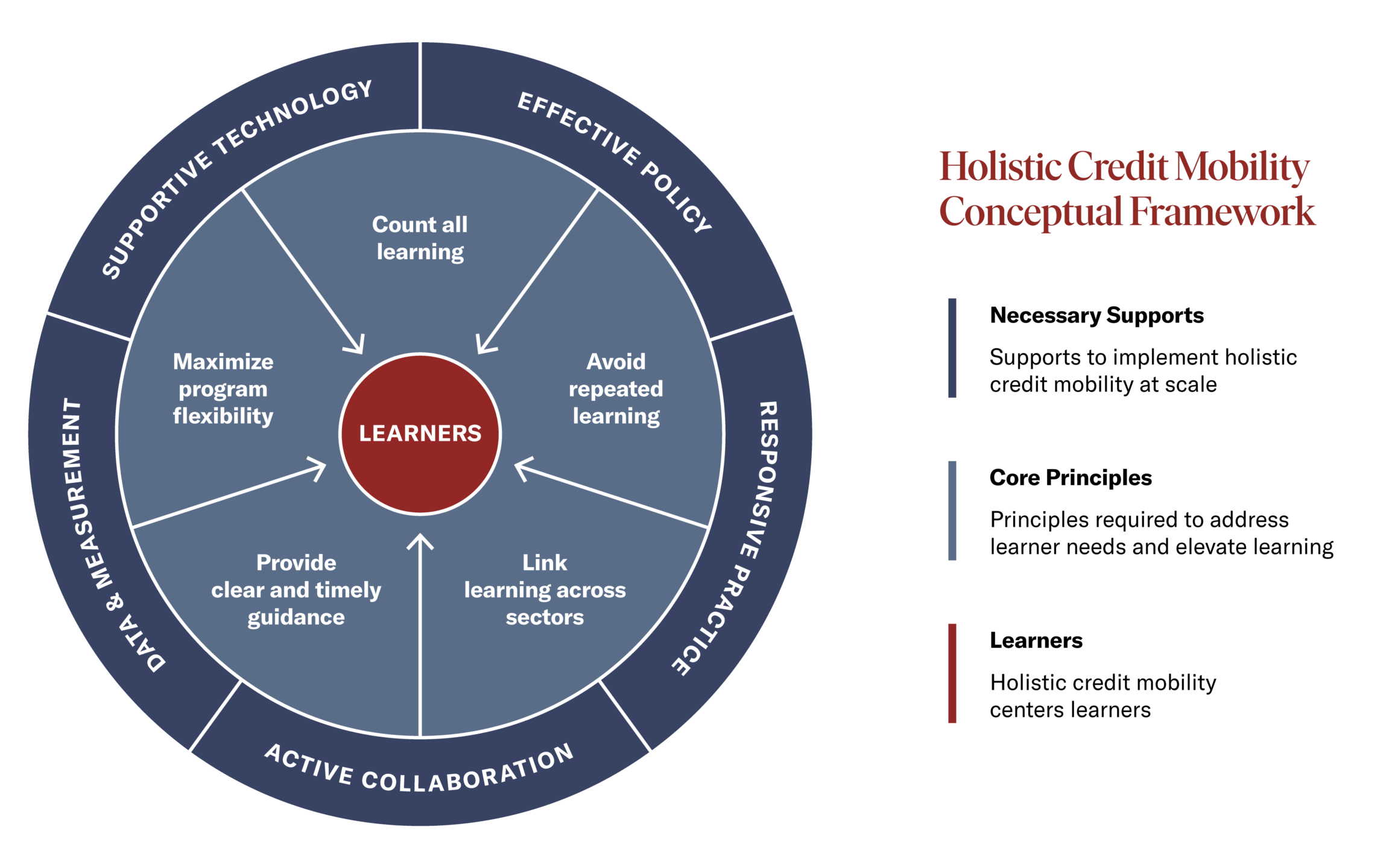
Rather than organizing around individual credit pathways, holistic credit mobility organizes around learning. It begins with a simple proposition: all validated learning should count, and every student should be supported on the shortest, most efficient path from wherever they are to the credential they seek.
We’ve created a series of resources to explain the holistic credit mobility framework and provide practical guidance for states, systems, and institutions working to build more learner-centered approaches to recognizing learning and awarding credit.
We invite you to explore these below.
Explore the Resources
Whether you’re learning about holistic credit mobility for the first time, planning an institutional initiative, or developing state or system policy, these resources are designed to help you move from ideas to action. We’ve grouped these across four common purposes below: understanding the framework, shaping policy, measuring impact, and putting the framework into practice.
 Understand the framework
Report: The Holistic Credit Mobility Framework
Learn the concepts behind holistic credit mobility, explore the five principles, and see how colleges, universities, systems, and states are putting them into practice through illustrative principle spotlights.
Best for: Anyone new to holistic credit mobility, or wanting to engage deeply with the concepts underlying it.
Reference Sheet: Principles at a Glance
A concise overview of the five principles of holistic credit mobility and the supports that help institutions put them into practice.
Best for: Sharing with colleagues and stakeholders.
Reference Sheet: Glossary
Definitions of key concepts and terminology used throughout the framework and resources.
Best for: Readers looking for common definitions.
 Shape Policy
Report: Centering Learners in Credit Mobility Policy and Practice
Practical guidance to assess your credit mobility policy landscape and advance key policy components. Recommendations and examples to help create the policies that support learner-centered credit mobility at scale.
Best for: Those who set or influence policy at the institutional, regional, or state level: state agencies, higher education systems, policymakers, institutional leaders, and advocates.
 Put the Framework into Practice
Tool: Institutional Self-Assessment
Assess your institution’s current approach to holistic credit mobility, identify strengths and gaps, and prioritize opportunities for improvement.
Best for: Institutional leaders and state or system teams assessing member institutions.
Tool: Strategic Collaborations and Partnerships
Define your learner mobility challenge, identify and prioritize partners, set shared outcomes, and plan next steps.
Best for: Teams convening institutional or cross-sector partners.
Tool: Considerations for Choosing a Credit Mobility Technology Solution
Assess your credit mobility technology needs and evaluate options for fit, usability, data integration, and long-term sustainability.
Best for: Teams evaluating or improving technology to support credit evaluation, equivalency management, and student planning.
Tool: Making the Case for Holistic Credit Mobility
Engage in exercises to improve case-making for holistic credit mobility policies and initiatives: align initiatives with strategic priorities, build stakeholder commitment, use data to support alignment, sequence work, and test approaches before scaling.
Best for: Leaders and advocates seeking stakeholder support for credit mobility initiatives.
 Measure Impact
Tool: Key Performance Indicators to Track Learner Success
Reference our “cheat sheet” of high-priority credit mobility metrics to serve as meaningful indicators of mobile learner success, then use our planning worksheet to identify your next steps in data collection and analysis to drive continuous improvement.
Best for: Institutional effectiveness and research professionals alongside the institutional leadership teams who seek to use data for decision-making.
Looking for even more ways to support credit mobility and transfer? Check out the resources below.