Perspectives on Academic Publishers
Evidence from a 2025 Study of Academic Library Professionals
Executive summary
Between August and December 2025, Ithaka S+R undertook a study to understand how library professionals in the United States evaluate academic publishers. The primary aim of the project was to uncover which qualities and practices library professionals consider most and least important when evaluating relationships with academic publishers. In a time when many higher education institutions are facing significant budgetary constraints, it is perhaps not surprising that library professionals cited cost effectiveness as among the most important factors in evaluating whether to begin or renew a publisher contract. They also take alignment with recognized accessibility standards and alignment with library goals under consideration. And while respondents expressed skepticism around publishers’ motivations, libraries recognize that academic publishing organizations are essential to core operations. Library professionals in particular are looking to strengthen relationships with publishers in order to better communicate the return on investment of library resources within their broader institutions.
Key findings
- Ninety-one percent of survey respondents currently face budget or resource constraints that prevent them from acquiring new materials. This strain is felt across higher education, with institutions of all types and sizes reporting financial limitations.
- Library professionals are looking to better understand and communicate the return on investment of their collections and services. As budgetary oversight is increasingly reallocated to higher levels of institutional leadership, library deans and university librarians may increasingly need to justify expenditures to senior administrators.
- Library leaders are seeking greater support from publishers in providing and presenting metrics that demonstrate the value of library resources to administrators and other leaders on campus.
- While there is skepticism around publishers’ practices and motivations, library professionals nevertheless recognize them as essential partners in fulfilling core library functions.
- Respondents cite cost effectiveness, alignment with recognized accessibility standards, and alignment with library goals as the most important factors in evaluating whether to begin or renew a contract with an academic publisher.
- Respondents rate the values publishers place on providing content in accessible formats and supporting efforts to combat misinformation and/or disinformation as extremely important.
- Low usage and insufficient budget or funding cuts are key factors influencing libraries’ decisions to discontinue journal or subscription content. In contrast, staff capacity and publisher relationship management are among the least influential considerations, suggesting that financial constraints, rather than staffing limitations, are the primary pressures shaping collections decisions.
Introduction
Between August and December 2025, Ithaka S+R conducted a national survey and complementary structured interviews with 13 library professionals to examine how library professionals evaluate academic publishers. The project was guided by the primary aim of understanding the qualities and practices library professionals consider most and least important when evaluating relationships with academic publishers. Together, these data provide insight into the values, expectations, and pressures shaping libraries’ relationships with publishers. This issue brief presents key findings across the survey and interviews.
We are grateful to Emerald Publishing for their sponsorship of this research. Ithaka S+R conducts rigorous research in an independent and autonomous capacity.
Methodology
National survey
The survey component of this research was designed to glean information on library professionals’ needs and priorities concerning academic publishers. To support this aim, Ithaka S+R developed the survey instrument through an initial listening session with an advisory working group, followed by targeted feedback from the group on an early draft of the survey instrument. The instrument was subsequently revised and piloted with four survey testers who provided detailed feedback on item relevance and clarity, which Ithaka S+R then incorporated to finalize the survey.
Ithaka S+R fielded the survey between September 30 and November 10, 2025, using an updated contact list of library deans and directors at all nonprofit, four-year colleges and universities across the US. The final contact list included 1,501 individuals. Of these, 100 email invitations bounced or failed to deliver, resulting in a final recruitment pool of 1,401 library deans and directors. From this group, we received 161 completed responses, yielding an overall response rate of 11 percent. It should be noted that survey recipients were asked to forward the invitation to a colleague better positioned to respond to questions about the library’s dealings with publishers, if applicable. Accordingly, some survey responses were submitted by individuals who did not hold dean- or director-level positions within the library (see Table 1).
We employed a range of statistical techniques to analyze the survey data, ranging from frequency counts and other descriptive analyses to inferential techniques such as one-way analyses of variance (ANOVAs) with Tukey post-hoc tests and independent-samples t-tests. The inferential analyses examined differences across several predictor variables, including institutions’ degree type (grouped as doctoral-, master’s-, bachelor’s-granting, or special focus) and enrollment size, both drawn from dimensions of the 2025 Carnegie Classification[1] as well as respondents’ personal demographics. Across analyses, institution type and size yielded the most consistent and meaningful group differences relative to the other tested predictors. Accordingly, we focus our reporting on these institutional characteristics where relevant.
All inferential findings reported met an alpha criterion of p < .05. We implemented listwise deletion when analyzing the data, such that responses with missing data were excluded only from the analyses requiring those variables; as a result, sample sizes exhibit slight variation across analyses. Unless otherwise noted, the reported survey responses are based on the full sample of 161 respondents.
Key sample demographics
Below, we present the respondent demographics most relevant for contextualizing the survey findings. Full sample demographic information is provided in the Appendix.
Of the 161 survey respondents, most held roles at the level of library dean or director (74 percent); see Table 1 for the full range of role categories represented. The sample skewed toward library professionals who had been in their current position for six years or fewer (63 percent) and who had worked in librarianship or a related professional field for 16 years or more (84 percent). Additionally, most respondents identified that they were at least 46 years old (56 percent), women (62 percent), and White (80 percent).
Table 1
Respondent role categories
| Role Category | Count | Percentage |
| Library Dean or Director | 119 | 74% |
| Associate/Assistant Library Dean or Director | 11 | 7% |
| Head of Collections/Collection Strategies | 10 | 6% |
| Head of Electronic Services and Access | 6 | 4% |
| Other | 1 | 1% |
| I prefer not to answer | 14 | 9% |
The institutional characteristics of degree type and enrollment size were used as grouping variables in the analyses. Most institutions in the sample were classified as doctoral-granting (43 percent) and had medium enrollments (40 percent); see Table 2 for the full distributions.
Table 2
Respondent institutional characteristics
| Institution Degree Type | Count | Percentage |
| Baccalaureate | 24 | 15% |
| Master’s | 32 | 20% |
| Doctoral | 70 | 43% |
| Special focus | 34 | 21% |
| Unknown | 1 | 1% |
| Institution Enrollment Size | Count | Percentage |
| Small | 59 | 37% |
| Medium | 64 | 40% |
| Large | 37 | 23% |
| Unknown | 1 | 1% |
Structured interviews
To provide qualitative context for the survey results and surface open-ended insights into library professionals’ perspectives and experiences with academic publishers, Ithaka S+R conducted 13 one-on-one interviews with library professionals in November 2025.
Interviews were held both in person and virtually. Interviewees represented a range of library roles and institutions varying in size, location, and degree types awarded. To protect interviewees’ identities, we do not report their demographic information.
Guided by preliminary analysis of the survey findings, which pointed to growing financial and logistical pressures on libraries alongside even greater anticipated strains facing higher education, we focused the interview questions on three primary areas:
- the types of support or actions library professionals would like to see from academic publishers;
- how libraries’ core values versus content demands influence acquisitions decisions
- the changes library professionals would like to see in how publishers engage with institutions in light of increasing pressures on higher education.
Interview responses were analyzed using a grounded thematic approach to identify recurring themes and patterns. Several cross-cutting themes emerged from these qualitative data, often echoing and enriching the survey results. These themes are highlighted in subsequent sections of this issue brief, where most relevant, to help contextualize the survey findings.
Findings
Acquisitions and decision-making
Frequency of acquisitions
A selection of survey items explored acquisitions and related decision-making processes within respondents’ libraries. Findings revealed substantial variation both across and within institutions in how frequently new journals or subscription content are acquired (see Figure 1). The largest share of respondents reported that their libraries add new materials once per academic year (37 percent), followed by those with no established acquisitions schedule (28 percent). Another 22 percent noted that their libraries acquire new materials multiple times throughout the academic year.
Figure 1
“On average, how often does your library acquire new journal or subscription content?”
Acquisition frequency varied by institution type. This difference was driven by variation among the institutions reporting that they acquire new content multiple times per academic year, such that respondents at doctoral institutions were more likely to report acquiring new content at this frequency (36 percent) than their counterparts at baccalaureate, master’s, and special focus institutions (see Figure 2).
Figure 2
Proportion of institutions by type that acquire new journal or subscription content multiple times per academic year
Note. Results are based on the 35 respondents who indicated that their institution acquires new content multiple times throughout the academic year. An asterisk (*) indicates that institutions of this type selected the response option at a statistically significantly higher rate than their counterparts.
Acquisition frequency also varied by institution size. As with institution type, this difference was driven by the libraries reporting that they acquire new content multiple times per academic year. Specifically, large institutions were more likely to report acquiring new content at this frequency (38 percent) than institutions of other sizes (see Figure 3).
Figure 3
Proportion of institutions by size that acquire new journal or subscription content multiple times per academic year
Note. Results are based on the 35 respondents who indicated that their institution acquires new content multiple times throughout the academic year. An asterisk (*) indicates that institutions of this size selected the response option at a statistically significantly higher rate than their counterparts.
Budget or resource constraints
Despite variation in how frequently institutions acquire new materials, libraries overwhelmingly report making content-related decisions within constrained environments. As shown in Figure 4, 91 percent of respondents are facing budget or resource constraints that prevent them from acquiring new content. These barriers did not differ by institution type or size, suggesting that financial pressures are felt across the higher education landscape.
Figure 4
“Do budget or resource constraints currently prevent your library from acquiring new journal or subscription content?”
Reasons for acquiring or discontinuing content
Respondents indicated the reasons that influence their library’s decision to acquire new journal or subscription content using a predefined, multi-select list of potential drivers. This also included an “Other” response option for those who wished to specify additional reasons not captured in the list. As shown in Figure 5, acquisitions decisions were most often driven by factors related to course/program and user needs. More specifically, the three leading reasons behind acquisitions were supporting curricula or other requests related to student learning (91 percent), supporting a new academic program at the institution (91 percent), and broadening the library’s collection in response to user needs (78 percent).
In contrast, factors related to authors at their institution were among the least frequently selected. Only 18 percent of respondents indicated that providing access to content authored by faculty or researchers at their institution influenced acquisitions decisions, and just 11 percent reported that disseminating such content played a role in their decision-making.
Figure 5
“Which of the following reasons, if any, influence your library’s decision to acquire new journal or subscription content?” (Multi-select)
Acquisitions decisions were generally influenced by similar factors across institution types, with two notable exceptions: supporting a new academic program and disseminating content authored by affiliated faculty or researchers. As shown in Figure 6, respondents at baccalaureate institutions were less likely than those at other institution types to select supporting a new program as a reason for acquiring new materials (75 percent). Respondents at doctoral institutions, meanwhile, were more likely to indicate that disseminating content authored by their institution’s faculty or researchers played a role in their acquisitions decisions (19 percent).
Figure 6
Reasons for acquiring new journal or subscription content that statistically significantly differed by institution type
Note. Results are based on the full sample of 160 respondents whose institutions had a known 2025 Carnegie Classification. An asterisk (*) indicates that institutions of this type selected the response option at a statistically significantly lower/higher rate than their counterparts.
The influence of disseminating content authored by faculty or researchers at the institution also varied by institution size. As seen in Figure 7, respondents at large institutions were more likely than those at less populated institutions to indicate that disseminating content authored by their institution’s faculty or researchers motivated acquisitions decisions (22 percent).
Figure 7
Reasons for acquiring new journal or subscription content that statistically significantly differed by institution size
Note. Results are based on the full sample of 160 respondents whose institutions had a known 2025 Carnegie Classification. An asterisk (*) indicates that institutions of this size selected the response option at a statistically significantly higher rate than their counterparts.
A parallel multi-select question explored reasons libraries discontinue access to journal or subscription content (see Figure 8). Low content usage emerged as the most common factor, selected by nearly all respondents (98 percent), followed by insufficient budget or funding cuts (93 percent) and content redundancy (83 percent). Conversely, reasons related to staff workload and the management of publisher relationships were among the least frequently selected: 11 percent of respondents indicated a desire to consolidate or reduce the number of publisher relationships, and only 4 percent cited insufficient staff capacity to manage multiple collections or subscriptions as drivers of their decision to discontinue content.
Figure 8
“Which of the following reasons, if any, influence your library’s decision to discontinue journal or subscription content?” (Multi-select)
Perceptions of publishers
Traditional publishing factors
One objective of the study was to better understand library leaders’ general perceptions of academic publishers and the foundational considerations that shape decisions around whether to initiate or renew publisher relationships. To address this aim, the survey included a set of items assessing the perceived importance of various technical and structural publisher characteristics in contract decision-making, which we refer to as “traditional” factors.
As shown in Figure 9, cost effectiveness emerged as the most salient consideration, with more than three-quarters of respondents rating it specifically as extremely important (76 percent) when evaluating whether to begin or renew a contract with an academic publisher. This share increases to 98 percent when including respondents who rated cost effectiveness as very important.
Several additional factors were also widely prioritized in the very to extremely important range. Depth of subject coverage was rated at these levels by 83 percent of respondents, followed by reputation in the scholarly community (80 percent), alignment with library goals and values (74 percent), and alignment with recognized accessibility standards (70 percent). These priorities closely align with themes raised in interviews conducted as part of this study, in which respondents emphasized the challenge of meeting campus research needs amid ongoing budget constraints and the growing importance of compliance with accessibility standards (discussed further below).
Other factors frequently rated as very to extremely important included the breadth of subject coverage (66 percent), and transparency of business practices (62 percent). Figure 9 presents the full distribution of responses across all traditional publishing factors examined.
Figure 9
“When evaluating whether to begin or renew a contract with an academic publisher, what level of importance do you assign to each of the following factors?”
Note. Responses were given on a 5-point Likert scale ranging from 1 = Not at all important to 5 = Extremely important.
Two items in this section—depth of subject coverage and demonstrated citation impact of content—showed differences by institution type (see Figure 10). Doctoral institutions rated depth of subject coverage as less important than did baccalaureate and master’s institutions. In contrast, doctoral institutions rated citation impact as more important than their baccalaureate counterparts.
Figure 10
Average perceived importance on traditional factors that statistically significantly differed by institution type
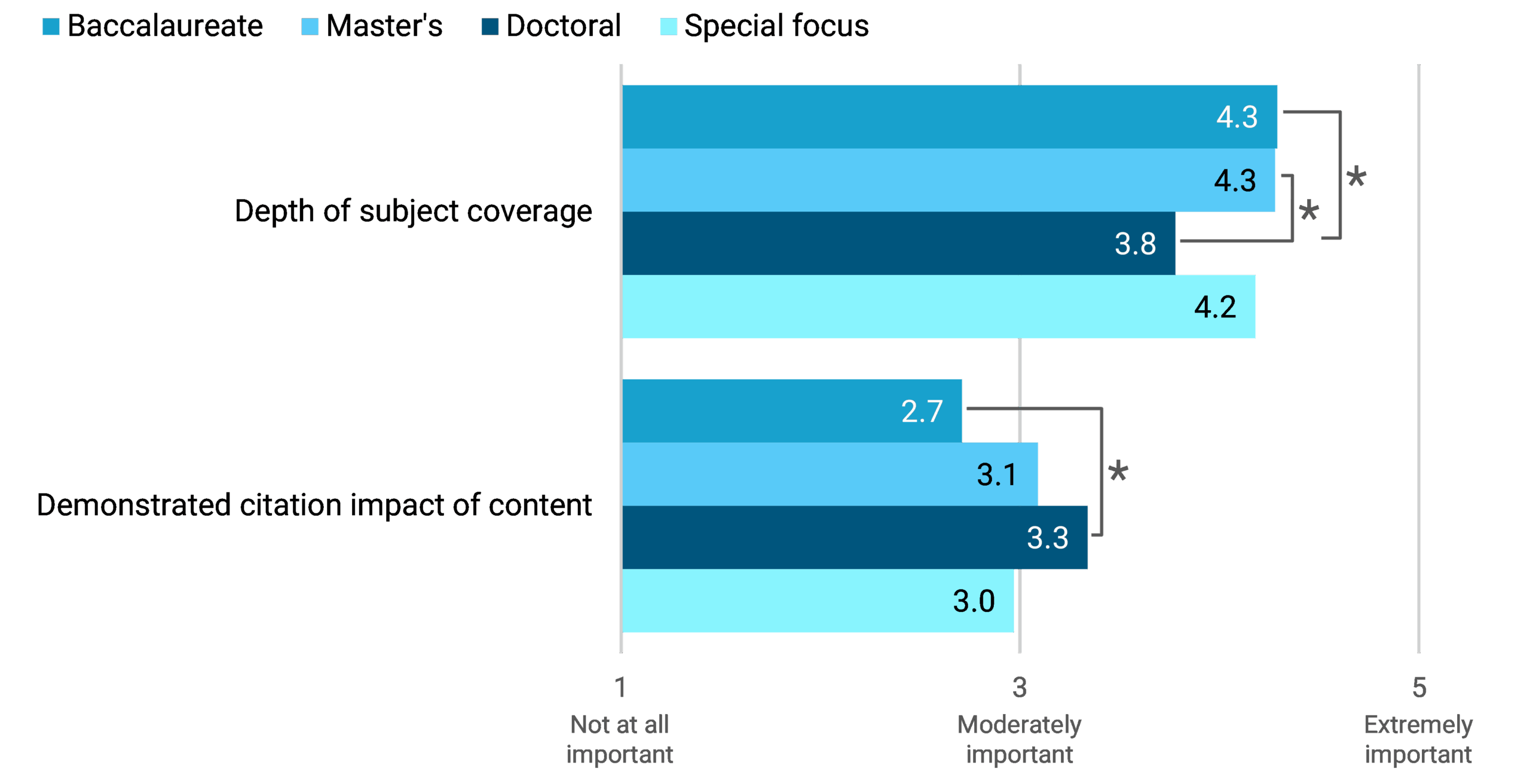
Note. Results are based on the full sample of 160 respondents whose institutions had a known 2025 Carnegie Classification. Values represent the averaged responses of each institution type. Responses were given on a 5-point Likert scale ranging from 1 = Not at all important to 5 = Extremely important. * indicates p < .05.
Three additional items differed by institution size (see Figure 11). Cost effectiveness was rated as less important among respondents at medium-sized institutions compared to those at small and large institutions. Access to content authored by faculty at the institution was more important to respondents at large institutions than those at small institutions. Finally, alignment with recognized accessibility standards was rated as more important by respondents at large institutions relative to respondents at small and medium-sized institutions.
Figure 11
Average perceived importance on traditional factors that statistically significantly differed by institution size
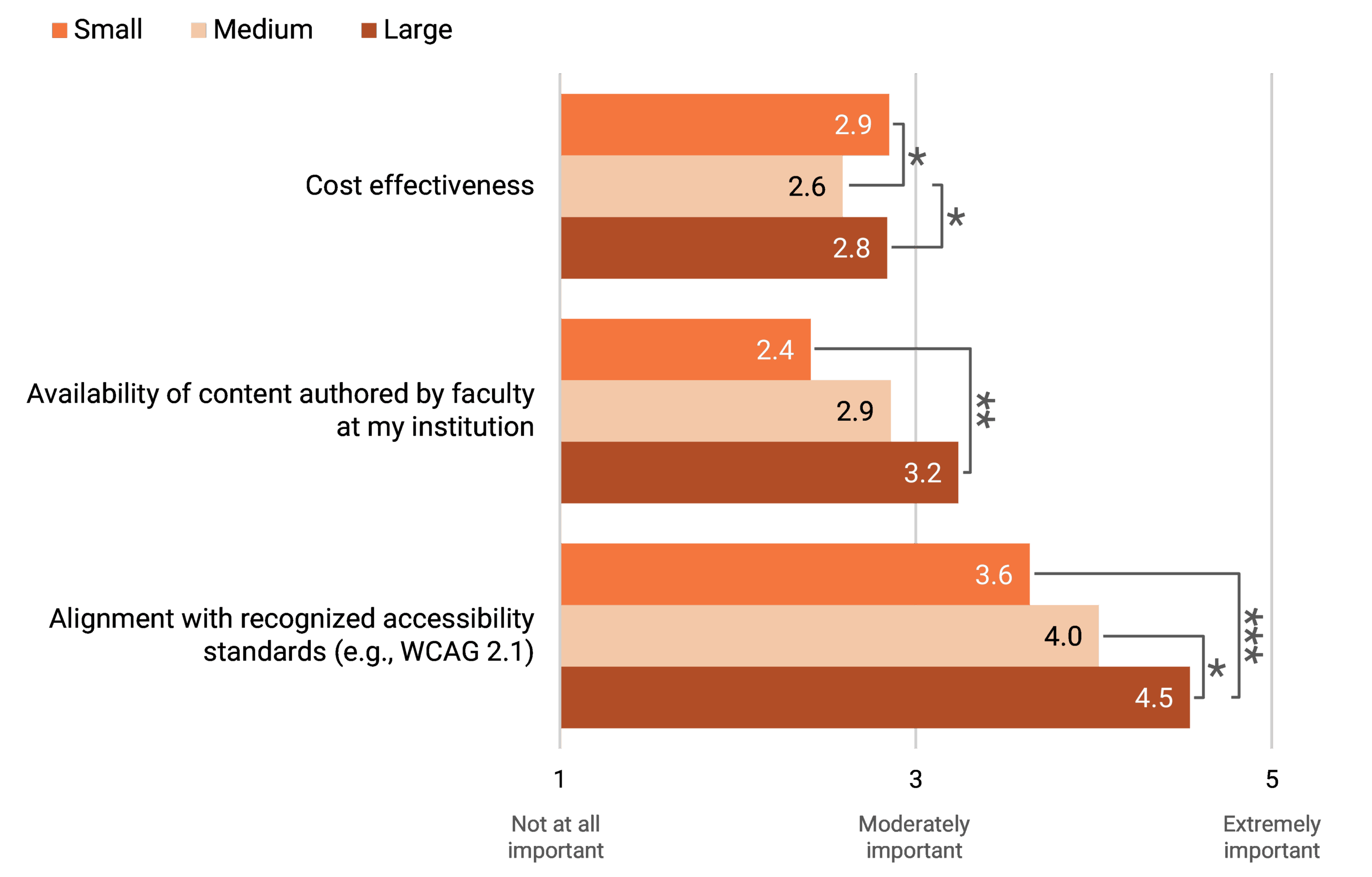 Note. Results are based on the full sample of 160 respondents whose institutions had a known 2025 Carnegie Classification. Values represent the averaged responses of each institution size. Responses were given on a 5-point Likert scale ranging from 1 = Not at all important to 5 = Extremely important. * indicates p < .05. ** indicates p < .01. *** indicates p < .001.
Relevant interview findings
Several interview responses spoke directly to the priorities identified above, often deepening our understanding of the context in which these factors are viewed as important. To leverage the immediate relevance of these insights to the survey findings on traditional factors, we summarize them here.
Libraries’ current financial environments
Not surprisingly, the most common theme across interviews was the current budget challenges faced by libraries in maintaining essential collections. With extensive budget reductions experienced by libraries in 2025 and additional cuts anticipated in 2026, libraries are refocusing their collection management efforts on meeting essential needs while lowering their overall subscription costs. Interviewees stressed that it is difficult to think about new, multi-year contracts with this budget uncertainty looming. Several individuals expressed hope that publishers will be willing to compartmentalize deals to adjust to new, smaller institutional budgets. Libraries have incentives at the moment to break big deals, negotiate post-cancellation access, and investigate other cost saving measures that maintain access to critical content while helping them navigate the current budgetary reality.
New institutional workflows to justify purchases
In addition to decreased budgets, new purchasing workflows at many institutions have altered who at an institution has the final signatory authority on new library contracts or renewals. A university librarian or dean may no longer have the final say on spending and therefore must be able to justify spending within their college or university’s broader institutional context. In these instances, interviewees communicated that they are seeking additional support from publishers with metrics that demonstrate the value of library resources to their provost or other administrative offices. While usage data is often available to individual libraries, several interviewees indicated they would be grateful for support via their representatives or publisher contacts in thinking though how best to use and present this data in the context of communicating value for library resources more broadly on campus. Demonstrating return on investment is increasingly difficult for libraries, and additional support that addresses this need would be welcomed by many institutions.
Sensitivity around artificial intelligence
Interviewees are seeking additional assistance to understand the functionality of artificial intelligence tools that are increasingly integrated with individual publisher platforms. Several discussed their frustration that questions about training models, data privacy, and possible bias mitigation are not answered in routine communications and therefore require lengthy conversations with technical staff. Interviewees also noted their sensitivity to publishers’ increased bundling of artificial intelligence tools into core operations and then increasing costs. Coupled with libraries’ budget shortages and their need to justify expenses, spending additional money on artificial intelligence add-ons, especially in cases where the library cannot articulate the added value of those tools for the institution, may simply not be possible at present.
Additional requests for post-contract support
Interviewees provided mixed comments about how often and by what means they prefer to be contacted by publisher representatives. Staff turnover at many publishing organizations in the past few years has caused some uncertainty about how to contact the appropriate institutional representative, and several interviewees mentioned they appreciate having a direct email address to contact their representative. Several also mentioned they would appreciate routine check-ins throughout the year as opposed to annually. These types of conversations could present additional opportunities to discuss the usage of currently subscribed materials and tools in ways that would benefit the library.
Values-based publishing factors
A parallel survey question examined library professionals’ perceived importance of values-aligned factors when evaluating whether to initiate or renew a contract with an academic publisher (see Figure 12). Across the values presented, respondents placed the greatest emphasis on publishers’ commitments to accessibility, information integrity, and open access.
Providing content in formats accessible to people with different needs or abilities emerged as the most important value overall. More than three-quarters of respondents (76 percent) rated this factor as very or extremely important, and no respondents indicated that it was not at all important. Supporting efforts to combat misinformation or disinformation followed closely, with 77 percent of respondents rating this value as very or extremely important, though a small subset of respondents found this to be of lower importance as well. Democratizing access to knowledge followed a comparable pattern, with 69 percent of respondents indicating such efforts as very or extremely important.
Several additional values were likewise widely prioritized. Advancing open access initiatives was rated as very or extremely important by 68 percent of respondents, while publicly opposing censorship of academic research received similarly strong support (66 percent). The majority of respondents also viewed publicly advocating for policies that support libraries as very or extremely important (63 percent).
Among the values included in this question, providing resources that advance the field of librarianship stood out as the only factor that was more frequently rated as less important. Sixteen percent of respondents rated this value as not at all important, and an additional 30 percent rated it as just slightly important. While still meaningful to some respondents, this value was comparatively deprioritized relative to other values-based considerations. Figure 12 presents the full distribution of responses across all values-based publishing factors examined.
Figure 12
“When evaluating whether to begin or renew a contract with an academic publisher, how important is it to you that the publisher demonstrates each value listed below?”
Note. Responses were given on a 5-point Likert scale ranging from 1 = Not at all important to 5 = Extremely important.
Two items differed by institution size: advancing open access initiatives and providing content in accessible formats (see Figure 13). Publisher support for open access initiatives was rated higher on importance among respondents at large institutions relative to those at small and medium institutions. Likewise, a publisher’s provision of content in formats that are accessible to people with different needs or abilities was more important to respondents at large institutions when compared to respondents at small and medium-sized institutions.
Figure 13
Average perceived importance on values-based factors that statistically significantly differed by institution size
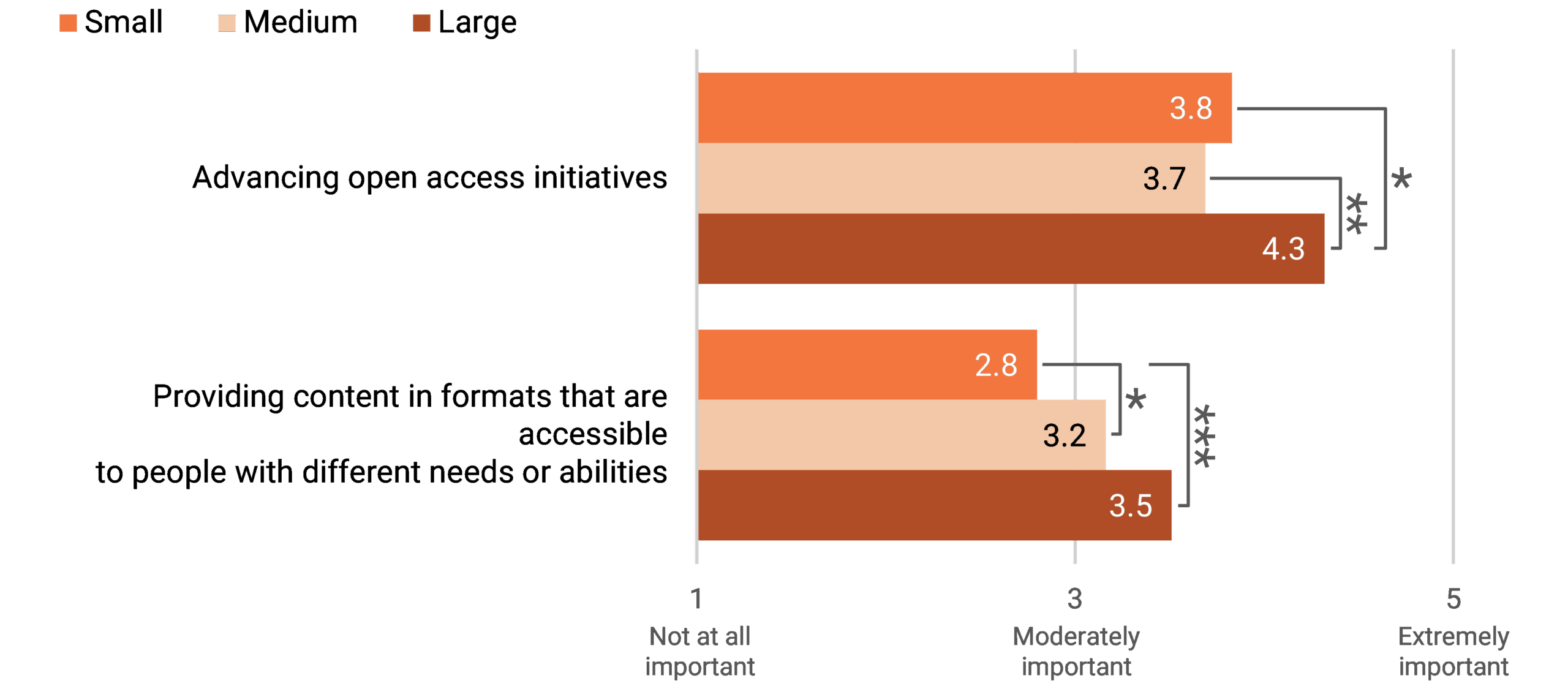
Note. Results are based on the full sample of 160 respondents whose institutions had a known 2025 Carnegie Classification. Values represent the averaged responses of each institution size. Responses were given on a 5-point Likert scale ranging from 1 = Not at all important to 5 = Extremely important. * indicates p < .05. ** indicates p < .01. *** indicates p < .001.
Relevant interview findings
Open access
Echoing the survey data, interviewees voiced their commitment to open access. Interviewee responses indicate that librarians are carefully thinking through the cost/benefit analysis of transformative agreements or flip to open access programs to articulate the value of these models to the campus. Several interviewees mentioned appreciation for publishers who are willing to think about what constitutes the future of open access, including moving past current read-and-publish agreements. With faculty interest around open access increasing, interviewees were eager to engage directly with publishers about future directions and opportunities to expand open access.
Institutional requirements to comply with ADA and other new legislation
With the compliance deadline for the new Americans with Disabilities Act (ADA) Title II regulations approaching in April 2026, access to content and platforms that meet the new requirements is critical for institutions. In speaking about the challenges of compliance, interviewees frequently spoke about ADA as an example of one area of new legislation that requires more complex purchasing considerations than in the past, including whether content packages and terms of use meet evolving institutional guidelines or state legislation. Interviewees noted that it would be helpful if publishers were to start discussions around these considerations, as the library cannot proceed with contract negotiations for content that does not meet their procurement parameters.
Attitudinal perceptions
To assess respondents’ attitudes toward academic publishers, the survey included a series of semantic differential scales in which respondents were presented with opposing descriptors positioned at either end of a continuum. Respondents were asked to indicate where their perceptions of academic publishers fell along each continuum, with selections closer to one descriptor indicating stronger alignment with that characterization and selections closer to the opposite descriptor indicating alignment with the alternative view.
Figure 14 summarizes respondents’ average ratings across these bidirectional measures. Responses were coded such that values closer to 1 correspond to the more negative descriptor and values closer to 7 correspond to the more positive descriptor, with a midpoint value of 4 indicating a neutral perception. Across measures, respondents’ average ratings skewed toward the more negative descriptors. Academic publishers were perceived as more exploitative, adversarial, non-transparent, and one-sided compared to the positive descriptive counterparts. At the same time, however, respondents indicated that academic publishers remain highly central to library operations. Taken together, these findings point to a notable tension in how library professionals view academic publishers: while there is skepticism around publishers’ practices and motivations, publishers are nevertheless recognized as essential partners in fulfilling core library functions.
Figure 14
Average attitudinal perceptions of academic publishers
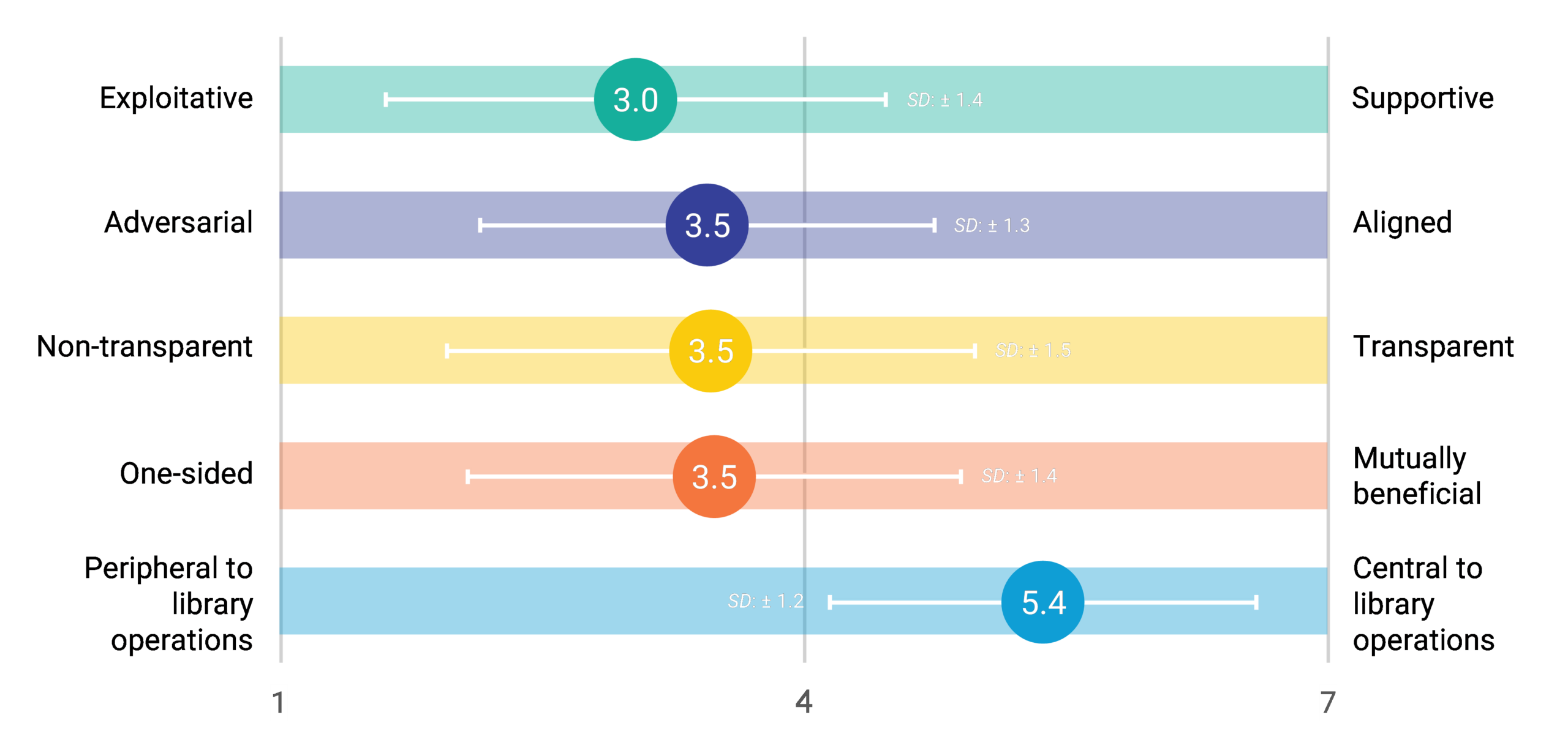 Note. Values represent average responses on each attitudinal continuum. Responses were given on a 7-point Likert scale. White error bars represent the standard deviation (SD).
Conclusion
The present research provides a more holistic understanding of library professionals’ perspectives on and experiences with academic publishers. While tensions between the goals and operating realities of academic libraries and publishers are longstanding, our findings suggest that they are now particularly acute amid the mounting financial and social pressures felt across the higher education sector. Reflecting this strain, library professionals tended to characterize publishers in adversarial terms—more exploitative, opaque, and singularly driven by their own motivations—rather than as collaborative partners working toward the shared goal of sustaining the scholarly record during a period of collective challenge. Yet, more optimistically, the survey and interview findings point to actionable areas in which publishers can better support academic libraries. In particular, respondents highlighted specific efforts publishers could enact to strengthen alignment with libraries’ values, improve transparency, and respond more directly to libraries’ evolving constraints. Addressing these concerns represents an opportunity for publishers to rebuild trust and foster a more constructive and sustainable relationship with their constituency moving forward.
Budget instability has prompted libraries to reassess collection management strategies, with staff time increasingly redirected from building and expanding collections toward strategically reducing expenditures, including ongoing collections subscriptions. Interviewees emphasized particular concern about the unpredictability of future budgets and the difficulty of fiscal planning in such an environment, expressing the need for academic publishers to offer more flexibility when discussing new contracts. With this in mind, library professionals also articulated the importance of aligning acquisitions decisions with institutional values, but that practical considerations (namely cost and resource limitations) play the ultimate decisive role in whether libraries can engage with a publisher. In the current environment of sustained financial pressure, cost and resource effectiveness frequently outweigh values-based considerations in final decision-making.
At the same time, technological and societal shifts are shaping library priorities in new ways. Respondents rated the values publishers place on providing content in accessible formats and supporting efforts to combat misinformation and/or disinformation as extremely important, underscoring the current significance of these issues. Sensitivity around artificial intelligence tools is also heightened at present, and interviewees reported that it can be difficult to obtain prompt and accurate information about embedded artificial intelligence tools within publisher platforms. Library professionals articulated that publishers’ prioritization of these issues in discussions with institutions and consortia, including how libraries can demonstrate their value in an era of considerable upheaval within higher education, is critical at the present time.
Across these domains, a common theme emerges: libraries are operating within a “new normal” of constrained and uncertain resources while facing expanding expectations related to accessibility, information integrity, and technological change. As a result, many are seeking to better understand and communicate the return on investment of their collections to campus stakeholders. Closer collaboration around the factors identified in this study as most important, including cost effectiveness, alignment with recognized accessibility standards, and support for combating misinformation and disinformation, offers a constructive path forward for academic publishers and academic libraries to strengthen their partnerships. By engaging directly and transparently with these priorities, publishers and libraries alike may be better positioned to advance their respective missions while navigating a challenging and rapidly evolving scholarly landscape.
Appendix: Survey sample demographics
Table A1
Respondent personal characteristics
| Age | Count | Percentage |
| 45 years or younger | 21 | 13% |
| 46–55 years | 39 | 24% |
| 56–64 years | 41 | 25% |
| 65 years or older | 10 | 6% |
| I prefer not to answer | 50 | 31% |
| Gender | Count | Percentage |
| Man | 49 | 30% |
| Woman | 100 | 62% |
| I prefer not to answer | 12 | 7% |
| Race | Count | Percentage |
| Asian or Asian American | 4 | 2% |
| Black or African American | 4 | 2% |
| White | 129 | 80% |
| Multiracial and/or multiethnic | 5 | 3% |
| I prefer to self-identify | 2 | 1% |
| I prefer not to answer | 17 | 11% |
| Time in Current Position | Count | Percentage |
| Less than 1 year | 15 | 9% |
| 1–3 years | 38 | 24% |
| 4–6 years | 48 | 30% |
| 7–10 years | 27 | 17% |
| 11–15 years | 13 | 8% |
| 16–20 years | 14 | 9% |
| 21 years or more | 4 | 3% |
| Prior Position | Count | Percentage |
| Associate university/college librarian | 41 | 25% |
| Dean at another institution | 16 | 10% |
| Department head | 29 | 18% |
| Director at another institution | 23 | 14% |
| Interim dean or director | 9 | 6% |
| Other position in higher education | 14 | 9% |
| Other position outside of higher education | 4 | 2% |
| Another position not listed here | 21 | 13% |
| I prefer not to answer | 4 | 2% |
| Direct Supervisor | Count | Percentage |
| Associate College/University Librarian | 9 | 6% |
| Dean or Director of the Library | 19 | 12% |
| Deputy/Assistant/Associate Provost, Deputy/Assistant/Associate Chief Academic Officer, or Deputy/Assistant/Associate Dean of Academic Affairs |
11 | 7% |
| Provost, Chief Academic Officer, or Vice President of Academic Affairs | 112 | 70% |
| Other | 7 | 4% |
| I prefer not to answer | 3 | 2% |
| Time in Profession | Count | Percentage |
| 10 years or less | 8 | 5% |
| 11–15 years | 13 | 8% |
| 16–20 years | 29 | 18% |
| 21–30 years | 66 | 41% |
| 31 years or more | 41 | 25% |
| I prefer not to answer | 4 | 2% |
Table A2
Respondent institutional characteristics
| Number of Full-Time Staff | Count | Percentage |
| 1–3 | 15 | 9% |
| 4–10 | 41 | 25% |
| 11–25 | 43 | 27% |
| 26–50 | 21 | 13% |
| 51–75 | 7 | 4% |
| 76–100 | 9 | 6% |
| 101+ | 21 | 13% |
| I don’t know / I’m unsure | 2 | 1% |
| I prefer not to answer | 2 | 1% |
| Number of Part-Time Staff | Count | Percentage |
| None | 45 | 28% |
| 1–3 | 67 | 42% |
| 4–10 | 23 | 14% |
| 11–25 | 9 | 6% |
| 26+ | 5 | 3% |
| I don’t know / I’m unsure | 10 | 6% |
| I prefer not to answer | 2 | 1% |
| Faculty Eligibility for Librarians | Count | Percentage |
| Yes | 95 | 59% |
| No | 55 | 34% |
| Other | 11 | 7% |
| Tenure Eligibility for Librarians | Count | Percentage |
| Yes | 55 | 34% |
| No | 100 | 62% |
| Other | 6 | 4% |
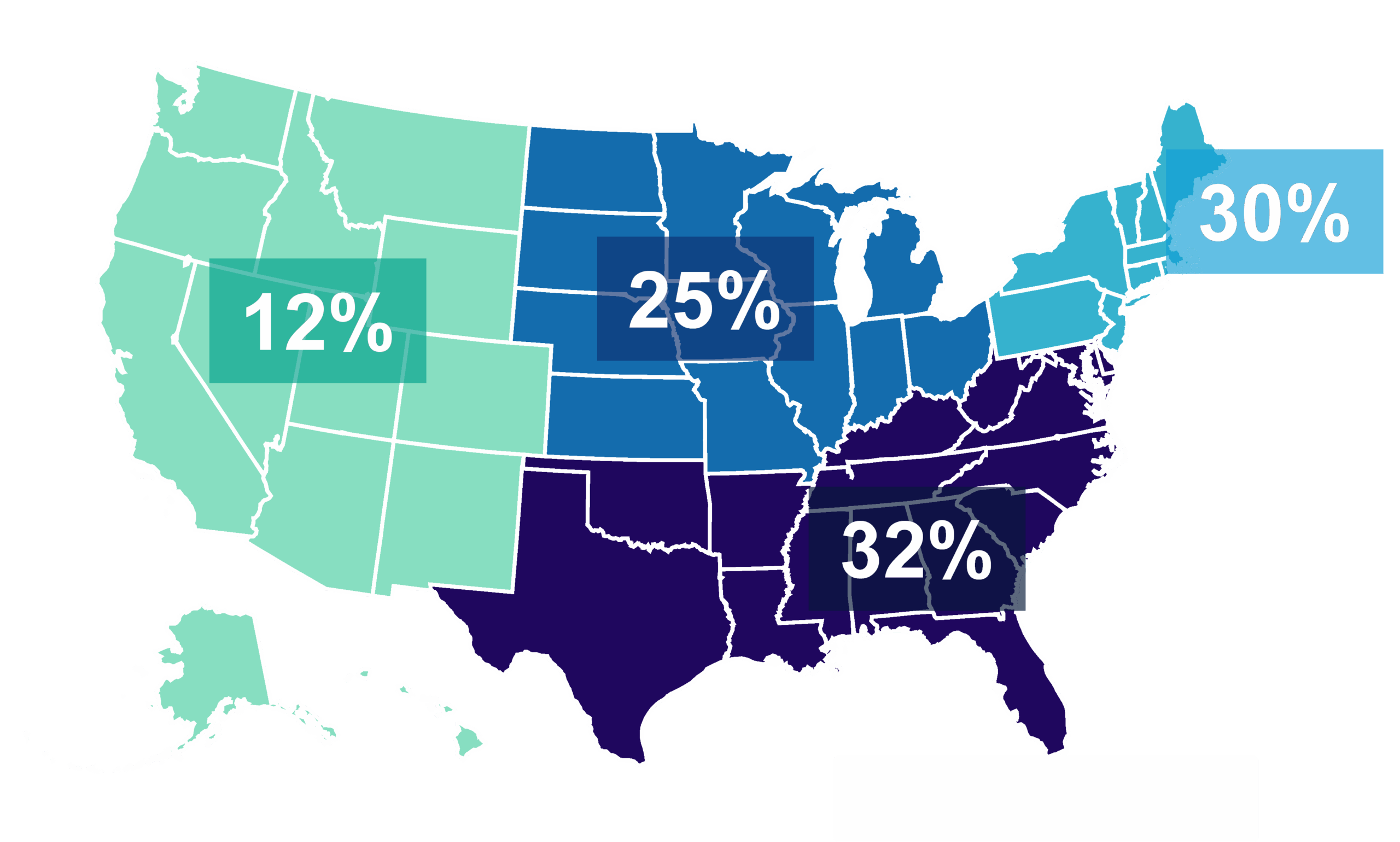
Figure A1
Geographic representation of respondents’ institutions
Endnotes
- American Council on Education, “2025 Institutional Classification,” https://carnegieclassifications.acenet.edu/carnegie-classification/classification-methodology/2025-institutional-classification/. ↑