Evaluating the Promise and Value of 90-Credit Bachelor’s Degrees
Earning a bachelor’s degree is still one of the surest routes to economic mobility. But affordability concerns, changing student needs, and a shifting labor market are raising the pressure on states and colleges to demonstrate that a degree is really worth it. In response, an increasing number of states are authorizing bachelor’s degrees that require as few as 90 credits, rather than the 120 credits or more that most bachelor’s degrees require. Their stated goals are to help students earn their degrees in less time and at a lower cost while at the same time offering programs that respond more directly to what students and employers need.
The promise of these degrees is compelling. But alongside that promise are big questions about quality, design, and outcomes. With support from Arnold Ventures, Ithaka S+R is embarking on what we anticipate will be a multi-year evaluation of the design, implementation, and outcomes of the 90-credit bachelor’s degree. We’re starting in Ohio and Virginia, in collaboration with Jobs for the Future’s Scaling College in 3 initiative, which is supported by Arnold Ventures and Strada Education Foundation. We plan to add additional states to understand how state-specific factors—decisions states make about implementation, their policy environment, the needs of their labor market and the strength of their economy—affect the outcomes that we see.
Most importantly, our evaluation will aim to answer questions for prospective students and their families: How does the quality of a 90-credit degree compare to a traditional one? How will my learning outcomes and experiences be different? How will employers perceive these degrees, and will that affect my future earnings? Will I be able to pay less, finish my degree faster, and enter the workforce sooner? Should I think about graduate school differently? By putting students at the center, our evaluation can also answer questions for states and institutions: how should these programs be designed, what are the right learning outcomes, which set of courses and experiences are essential, which programs should be offered, and which students should consider enrolling in them, among others.
The work is already underway. This fall we’ll release two reports that will underpin our evaluation. The first will identify and evaluate the contextual factors that may influence how states implement these degrees as well as their potential for impact. The second will provide a framework for how states should select the programs to offer 90-credit bachelors.
- A state alignment framework. This report looks at the state-level conditions likely to shape whether 90-credit programs succeed: a state’s higher education and workforce needs, its policy and governance environment, its other efforts to improve completion and credit efficiency, and its capacity to collect the data needed to learn from implementation. The goal is to help leaders understand how 90-credit programs align with state needs and priorities, what might help or get in the way of implementation, and what support they’ll need along the way.
- A program identification framework. This framework helps states figure out which fields of study are actually good candidates for a 90-credit degree. Our emerging approach asks institutions to first define the problem they’re trying to solve, then check whether a program is even feasible given accreditation, licensure, and institutional constraints, and finally weigh where the value to students and employers is strongest. That means looking hard at the evidence—enrollment and access, student learning outcomes, completion and credit efficiency, earnings and economic mobility, labor-market demand—rather than just picking the programs where it’s easiest to cut 30 credits.
The reason we’re taking this work on is to know whether a shorter, more affordable path to a bachelor’s is a choice worth making. Over the next several years, we hope these frameworks will help us follow these programs closely and share what we find, so that states, institutions, and students can weigh these choices with evidence.
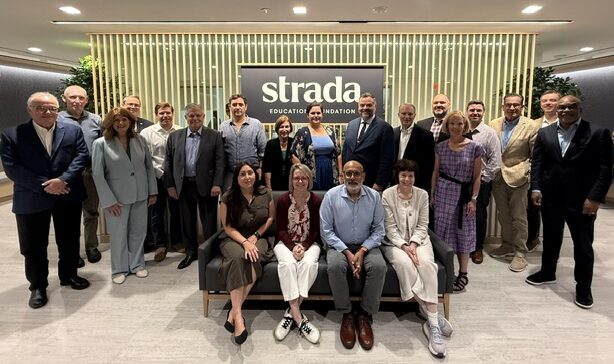
Elizabeth Pisacreta is serving on the national taskforce on Three-Year Degree Pathways, a taskforce co-convened by Arnold Ventures and Strada Education Foundation to inform how 90-credit bachelor’s degree programs scale.