The Holistic Credit Mobility Framework
Recognizing Validated Learning Regardless of Its Source So That Learners Can Chart the Shortest Route to the Credential They Seek
-
Table of Contents
- Introduction
- The Five Core Principles of Holistic Credit Mobility
- Principle I: Count Validated Learning Regardless of Source
- Principle II: Avoid Repeated Learning of the Same Content
- Principle III: Link Learning Across K-12, Higher Education, and Workforce
- Principle IV: Provide Clear Guidance on How Learning Will Count Towards a Specific Degree
- Principle V: Maximize Program Flexibility to Accommodate Diverse Learning Pathways
- Conclusion
- Acknowledgements
- Endnotes
Introduction
Postsecondary students today earn college credit from many sources, including dual enrollment, workforce and military learning, credit for prior learning, and attendance at multiple institutions. Student pathways are increasingly nonlinear, multidirectional, and populated by adult learners returning to higher education.
As sources and types of college-level learning increase and students become more mobile, higher education institutions have struggled to adapt. Too often, policies, technologies, and processes treat different forms of validated learning as separate challenges. This fragmented approach leaves students with little visibility into how their learning will be recognized and applied toward a credential, too often causing them to lose time, money, and momentum.
Traditional transfer pathways remain important and form the backbone of most transfer infrastructure across higher education, yet they are insufficient on their own. Highly structured 2+2 articulation pathways are rarely utilized as designed by mobile students. For example, only 8 percent of vertical transfer students follow a traditional 2+2 bachelor’s degree pathway, according to research conducted by the Community College Research Center.[1] Policies designed around a single expected learning pathway do not fully serve students whose learning histories and transfer paths are more varied.
Organizations across higher education have worked to strengthen transfer pathways, support dual enrollment students, recognize credit for prior learning, evaluate military and workforce learning, and reconnect adults with some college but no credential. Holistic credit mobility brings these efforts together under a common framework centered on a shared purpose: recognizing validated learning regardless of its source so that learners can chart the shortest route to the credential they seek.
What is Holistic Credit Mobility?
Introduced in 2022, holistic credit mobility is a unifying conceptual framework designed to support higher education governing and coordinating boards, systems, and institutions to develop solutions that support mobile students with multisource validated learning.[2] It considers the entire ecosystem of mobile learning, from dual enrollment to returning adult learners, across different modalities and sectors. Holistic credit mobility challenges states, systems, and institutions to move beyond the current siloed and fractured handling of these diverse forms of learning to ensure college-level learning transfers easily across sectors to support degree completion.
Ithaka S+R revised and strengthened this framework over the past two years by conducting case study interviews and through direct engagement with the holistic credit mobility acceleration cohort, a community of practice encompassing 12 state higher education agencies, university systems, and institutional consortia.[3] The framework recognizes that highly choreographed 2+2 pathways between one community college and one university within one region—the cornerstone of traditional articulation—are no longer a sufficient intervention for modern mobile students, pushing systems and states to go deeper and align across sectors to create lasting change.
Holistic credit mobility centers learners by recognizing validated learning regardless of its source so that students can chart the shortest route to the credential they seek.
Holistic credit mobility centers learners and learning. This means shifting away from traditional bureaucratized processes to a more individualized, interrogative approach to understanding the experiences of incoming learners, and how those experiences should count towards a credential. Instead of segmented policies, technologies, and processes that compartmentalize sources of validated learning (such as dual enrollment, credit for prior learning, transfer courses, and the military), holistic credit mobility seeks to benefit all incoming students with all forms of prior learning.
Principles and supports
Holistic credit mobility centers learners through five core principles reinforced by five necessary supports. The core principles focus attention not just on how the work is done, but on why it matters. They represent aspirational goals for states, systems, and institutions:
Principles
- Count validated learning regardless of source
- Avoid repeated learning of the same content
- Link learning across K-12, higher education, and workforce sectors
- Provide clear guidance on how learning will count towards a specific degree
- Maximize program flexibility to accommodate diverse learning pathways
To achieve these principles, we recommend five interconnected supports that collectively enable more integrated, streamlined opportunities to support learners. These supports build upon and act as checks and balances for one another, ensuring that mobile students and their learning are prioritized in system and institutional policy, implemented through responsive practices, made visible and accessible through supportive technology, reinforced through active collaboration across learning and related sectors, and improved through continuous measurement.

Supports
- Effective Policy
- Supportive Technology
- Responsive Practice
- Active Collaboration
- Data & Measurement
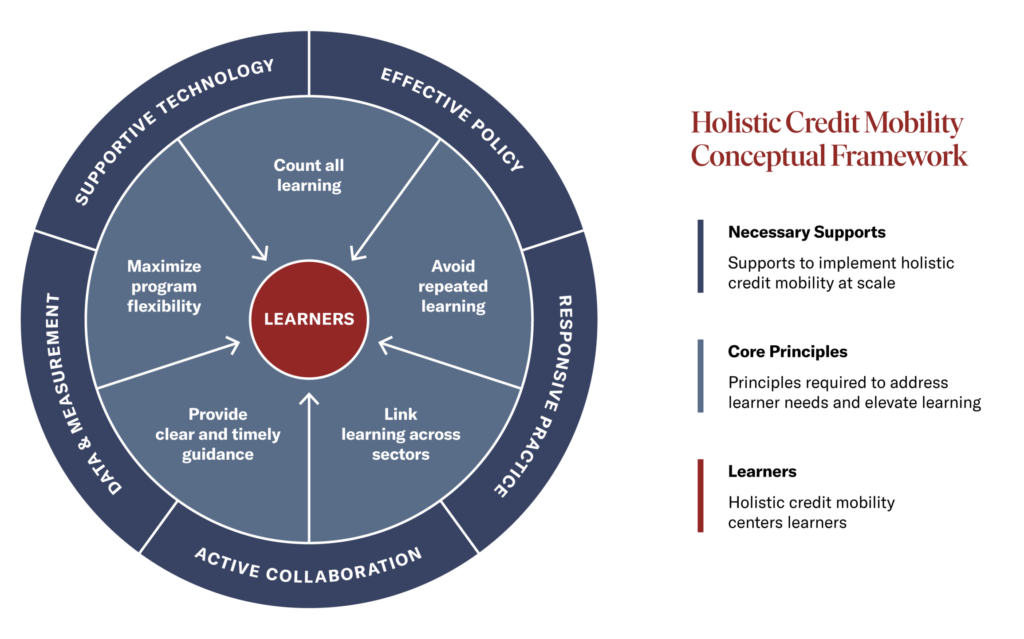 The visualization below summarizes the holistic credit mobility framework, with the five core principles (center circle) made accessible by the necessary supports (outer circle).
This Playbook and Toolkit examines each principle in detail, offering aligned case studies, guiding questions, and practical tools to support institutions and systems in putting these principles into action.
Why Holistic Credit Mobility matters now
Mobile learners are the norm, not the exception. Data from the National Student Clearinghouse shows that 67 percent of bachelor’s degree completers have attended multiple institutions,[4] research in California and New York has found that horizontal or lateral community college transfer is more prevalent than widely assumed,[5] and states and systems increasingly have developed policies to support credit for prior learning.[6] As sources and types of college-level learning increase and students become more mobile, higher education institutions have struggled to adapt. Keeping up with the vast amounts of data related to credit transfer requires significant and ongoing labor and intentionality for institutions. The difficulty that institutions have in efficiently processing these data often leaves students with little visibility into how their credits will be accepted and apply to a degree at a new institution. Credit loss during transfer can lead to loss of time, money, and momentum towards graduation for the student, and long-term loss of enrollment and decreased retention for institutions. Making information about the degree applicability of prior learning accessible and usable to prospective students is already a key strategic goal of many states and systems of higher education institutions; a 2025 survey of the State Higher Education Executive Officers Association (SHEEO) identified student transfer pathways and use of state data to inform decision making as two key state policy priorities and concerns.[7]
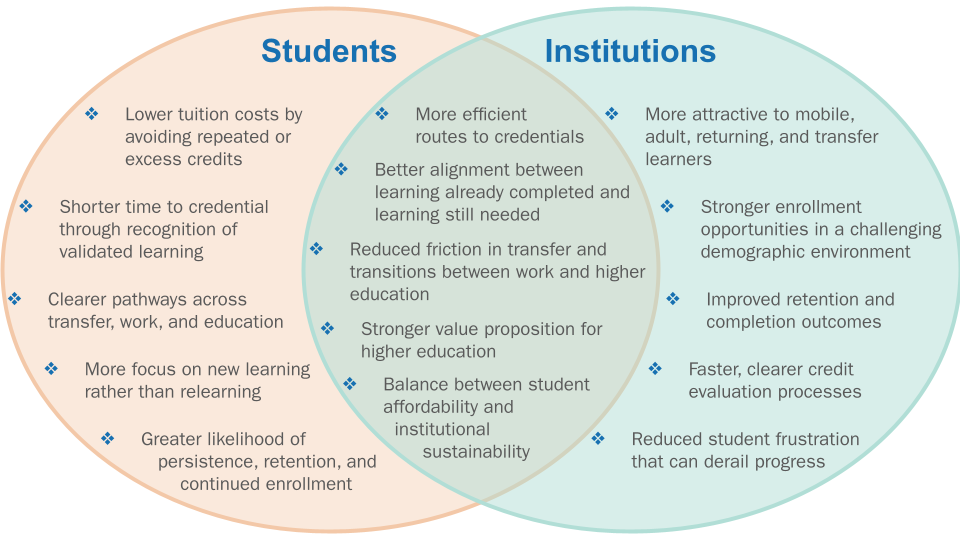
Students benefit from holistic credit mobility strategies in two complementary ways: via cost savings and time savings. Counting validated learning and ensuring students avoid repeated learning helps students lower time and financial costs associated with obtaining a credential or degree. These principles help learners focus on accomplishing new learning, shortening time to their next credential. Avoiding excess and wasted credits also reduces tuition expenditures for students. At the same time, deploying holistic credit mobility strategies helps students beyond cost reduction. Learners who face lower barriers to transfer and transitions between the labor force and higher education may be more likely to enroll in additional courses; research from the Council for Adult and Experiential Learning (CAEL) and Western Interstate Commission for Higher Education (WICHE) has found that students who bring in credit for prior learning have better retention and earn more home-institution credits at their destination institution.[8]
Clearer pathways, faster credit evaluation, and stronger recognition of validated learning can make institutions more attractive to mobile, adult, and returning learners.
Holistic credit mobility also benefits institutions and systems. Clearer pathways, faster credit evaluation, and stronger recognition of validated learning can make institutions more attractive to mobile, adult, and returning learners. They can also support retention and completion by reducing avoidable frustration, repeated learning, and excess credits. At a time of demographic pressure and growing skepticism about the value of higher education, institutions that reduce friction for mobile learners can advance both student success and their own enrollment and completion goals.
Recognizing that “initiative fatigue” can make higher education leaders wary of yet another buzzword, we introduce the holistic credit mobility framework to make sense of the varied existing initiatives that can really be best understood as serving a common purpose together. Other organizations have already done incredible work to provide strategies to strengthen two-year-to-four-year transfer pathways,[9] support dual enrollment students,[10] recognize credit for prior learning,[11] evaluate learning,[12] and reclaim degrees for “some college, no degree” students,[13] among many other specific areas of opportunity to improve the efficiency and success of credit transfer. Holistic credit mobility seeks to connect and align these strategies under a common umbrella: recognizing validated learning regardless of its source so that learners can chart the shortest route to the credential they seek.
The Five Core Principles of Holistic Credit Mobility
In this section, we elaborate each of the five principles in the Holistic Credit Mobility framework. For each principle, we provide a high-level key concept overview, a deep dive into some of the context and considerations around this principle, case studies illustrating best practices for implementing the principle from real postsecondary institutions and systems, callouts to specific supports in action, and guiding questions to consider for readers striving to implement this principle in their own context.
These five principles are distinct but also necessarily intertwined: each is individually important to ensure that credit mobility is holistic. They work together in concert to support learners, but each addresses a distinct failure point in the current credit mobility journey.
Principle I: Count Validated Learning Regardless of Source
Key Concept
When assessing a student’s experiences for academic credit, the learning that took place is more important than where, when, or how it occurred. To support mobile students holistically, institutions should take an expansive view of how students acquire college-level learning and a nuanced approach to evaluating and assessing that prior learning. By prioritizing student learning outcomes and avoiding rigid gatekeeping, institutions can honor students’ unique educational journeys and create clearer, more efficient pathways to a degree or credential.
Deep Dive
Students transitioning between postsecondary institutions, returning to higher education from the military or workforce, or enrolling with college-level learning earned in high-school often encounter barriers in receiving academic credit for their prior learning and skills.[14] Many times these barriers are the result of credit evaluation policies that strictly define what learning rises to the college level. At times, institutions do not accept learning because of deficit-based assumptions about its source, particularly coursework completed at trade, technical, or community colleges. In other cases, they deem learning to have been validated too long ago, particularly for adults returning to higher education who earned credits earlier in their lives or careers. They may also classify the format of instruction—such as online, competency-based, or asynchronous independent study—as unacceptable.[15]
This principle encourages colleges and higher education systems to remove these barriers and create more comprehensive policies and processes that recognize and assess prior learning, validate students’ individual experiences, and support their progress toward earning a degree or credential. While many institutions and systems strive to achieve this principle, roadblocks and resistance are common. Some of this resistance is rooted in appropriate concern around rigor and validation: not all learning is college-level learning, and not all claimed learning can be documented and verified.
Counting validated learning regardless of source thus requires institutions and systems to ask not only where learning occurred, but also who has already validated it and under what conditions. In some cases, another accredited postsecondary institution has validated the learning by awarding transcripted credit. In others, a standardized exam, a military training recommendation, an industry-recognized credential, a faculty-reviewed portfolio, or an employer using agreed-upon standards provides the validation. Institutions retain responsibility for determining whether learning aligns to their own course or program outcomes, but holistic credit mobility asks them to distinguish between legitimate quality assurance and unnecessary revalidation. When learning has already been credibly assessed, institutions should have clear criteria for when to trust that validation, when additional review is warranted, and how to avoid requiring students to repeatedly prove the same learning.
Principle I is about ensuring that learners have legitimate on-ramps into academic pathways from varied starting points. Validated learning should count towards a credential even when it takes place outside a traditional college classroom. In practice, however, a fragmented policy landscape too often determines what counts. At the system level, credit mobility policies may be fragmented across many areas including credit for prior learning, transfer, dual credit, and vocational, short-term or noncredit credentials. This siloed approach to policy reinforces the focus on the inputs of learning type and sector, instead of the output of student learning. In order to achieve holistic credit mobility, systems must strive to create policies that emphasize learning outcomes and competencies across learning formats and sources, as well as the ways in which learning is recognized, applied, and made transferable across institutions within their jurisdictions.
Over the past 15 years, access to credit for prior learning (CPL) has expanded,[16] driven by evolving research in the field and a growing national focus on re-enrolling more than 40 million adults who have some college credit but no credential.[17] As CPL became more accessible, a concerning trend emerged—the awarded credits were often not transferable between institutions. A survey by the American Association of Collegiate Registrars and Admissions Officers (AACRAO) and Council for Adult Experiential Learning (CAEL) found that while 82 percent of institutions offer some form of credit for prior learning for incoming students, 54 percent will not accept CPL awarded by other colleges for transfer credit.[18] For the benefits of CPL to be fully realized, credits must be portable across institutions of higher education, and these institutions should not require students to revalidate previously recognized learning.
Another challenge colleges and universities often have to address is the perceived financial disincentive of counting outside learning towards a degree or credential.[19] Faculty play a crucial role in evaluating prior learning and assessing if it meets the learning outcomes of credit bearing courses. Institutions must embrace policies that prioritize consistent low or no-cost access to credit for prior learning evaluation across multiple learning formats and sources. They must also ensure that policies around residency and the age of prior courses are not creating unnecessary barriers for mobile students. To support these critical changes, states and systems must ensure funding structures incentivize institutions within their jurisdiction to prioritize learning mobility.
In practice, this principle is often achieved incrementally, as systems and institutions begin to more closely interrogate their policies regarding the acceptance of categories of learning ranging from exams, certificates, workforce training, military service, and lived experience. An audit of existing policies and available student and equivalency data can help identify areas where learning from all sources can be more holistically recognized and accepted. Holistic credit mobility policies at the state and system level can enable institutions to reexamine their own policies and open the door for learning to be counted regardless of source.

Principle Spotlight:
Counting Validated Learning at the State Level
Ohio’s Articulation and Transfer Network demonstrates how a state can establish coordinated policies to recognize validated learning from multiple sources. Alongside traditional transfer policies, including the Transfer Assurance Guides (TAGs), for early-major coursework, and Ohio Transfer 36, for general education, Ohio has developed statewide frameworks for career-technical learning (CTAGs), military training and experience (MTAGs), and industry-recognized credentials (ITAGs). Statewide policies also address credit by exam, including AP, IB, and CLEP.
What makes Ohio’s approach especially notable is that it applies a common logic across many forms of learning rather than treating each source as a separate exception. The state uses aligned statewide structures and standards to establish how different types of learning are evaluated and recognized. Faculty play a central role in defining learning outcomes, evaluating equivalencies, and building statewide consensus about what learning should count and how it should apply. That approach helps ensure academic legitimacy while also building the buy-in needed to sustain implementation across institutions. Together, these approaches demonstrate how coordinated policies can expand recognition of validated learning while maintaining consistent academic standards.
Principle Spotlight:
Ensuring the Portability of Credit for Prior Learning Through Policy
Idaho and the Maricopa County Community College District (MCCCD) illustrate two approaches to ensuring that credit for prior learning (CPL) remains portable across institutions. The Idaho State Board of Education policy on Prior Learning includes a provision that “once recorded on a student’s transcript, Prior Learning Assessment (PLA) credit is transferable among Idaho institutions on the same basis as if the credit had been earned as a regular student at the awarding institution.”[20] This provision ensures that CPL awarded at Idaho institutions can follow students as they move between institutions.
In Arizona, MCCCD has made CPL portability a core requirement of its university transfer partnerships.[21] MCCCD has a minimum threshold of requirements that all universities must agree to before entering into a transfer partnership. These requirements include that PLA credit awarded at MCCCD must be accepted in transfer and applied to degree requirements. Universities must agree to accept CPL awarded by MCCCD and apply it toward degree requirements as a condition of entering into a transfer partnership. Both approaches demonstrate how state policy and institutional agreements can help ensure that previously validated learning continues to count as students move between institutions, without requiring them to repeat the process of having that learning recognized.
Principle Spotlight:
Recognizing Military Learning Through a Statewide Military Equivalency System
The University of North Carolina System launched its Military Equivalency System (MES) in 2024 to help current and former service members receive academic credit for learning acquired through military service. The interactive database connects military training courses and occupational experience to equivalent courses across the system’s institutions, drawing on American Council on Education (ACE) credit recommendations. With nearly 25,000 equivalencies at the time of writing, the MES makes a broad range of military learning visible and recognizable within higher education.
By establishing a shared, systemwide resource for evaluating military learning, the University of North Carolina System helps institutions recognize knowledge and skills acquired outside traditional classrooms. The MES also makes institutional equivalency decisions more transparent, creating opportunities for universities to identify gaps and expand their recognition of military learning. The initiative illustrates how intentional coordination and supportive technology can help institutions count validated learning regardless of its source.
Supports in Action: Principle I

Effective Policy
- Develop policies at the state, system, and institution level that prioritize what learning has been demonstrated over where, when, or how it occurred.
- Ensure that credit earned or awarded at one institution, including transcripted CPL, can be accepted for transfer at other institutions within the same state, system, or partnership.

Supportive Technology
- Use centralized equivalency and credential databases to capture validated learning from multiple sources and support consistent evaluation across programs, offices, and institutions.

Responsive Practice
- Use learning outcome-based review practices that evaluate validated learning on its merits rather than screening it out based on source, modality, age, or provider type.

Active Collaboration
- Clearly define roles for faculty, workforce partners, military representatives, credential providers, and partner institutions and engage them in defining standards for validating learning across sources.

Data and Measurement
- Establish key performance indicators at the state, system, and institution levels to measure the volume of learning accepted for credit, disaggregated by source/type of learning.

Key Questions: Principle I
As you consider this principle in your own context, ask:
- What forms of validated learning are we accepting for academic credit, and which forms do we not accept? Why?
- Are we basing credit acceptance decisions on where, when, or how learning occurred rather than what learning was demonstrated?
- Who has the authority to validate different forms of learning in our institution or system and are those roles clearly defined?
- When do we accept the validation of learning validated by a credible external entity and when do we require additional review?
- Do we have clear processes and codified policies for evaluating noncredit, technical, workforce, military, and experiential learning for academic credit?
- Is credit for prior learning that has been transcripted at one institution accepted for transfer at another institution within the same state, system, or partnership without re-evaluation?
- What on ramps to degree programs do we have for students with noncredit and technical college experience
Principle II: Avoid Repeated Learning of the Same Content
Key Concept
Institutions should not obligate students to take courses that repeat learning they have already mastered. Repeatedly learning the same content because of institutional or program-level practices and policies is unnecessary and deeply demotivating for students. Instead, institutions should evaluate prior learning against course and program outcomes, identify reasonable equivalencies even when courses do not match perfectly, and proactively surface opportunities for students to receive credit for learning from multiple sources.
Deep Dive
This holistic credit mobility principle builds on the policy framework outlined in Principle I to count validated learning regardless of the source. Once barriers around what counts as learning are removed, the next step is to ensure that recognized learning meaningfully advances students’ progress toward a degree. The cornerstone of this principle—ensuring that learning is not repeated—requires that institutions identify prior learning, evaluate and document it consistently, and purposefully align prior learning to program-level learning outcomes. Scalable, responsive practices and supportive credit mobility technologies serve both staff and students and are essential for advancing this principle. Principle II is about preventing unnecessary backtracking: students should not have to repeat content they have already covered simply because they learned it at a different institution or through alternative pathways.
Principle II is about preventing unnecessary backtracking: students should not have to repeat content they have already covered simply because they learned it at a different institution or through alternative pathways.
This principle, however, often hits snags because of the labor intensive and often manual nature of learning evaluation.[22] Staff capacity is constrained at many institutions, and adopting processes that center a more individualized approach to learning evaluation may not align with resource availability. Approaches to evaluating different types of learning may be siloed, with military learning handled by one unit and workforce or previous college learning in another. To implement this principle, institutions must actively engage functional teams in admissions, enrollment, advising, and the registrar, as well as, program and discipline faculty in adopting a student learning centered approach.
Admissions, intake, and advising practices must be responsive to the multifaceted prior learning of mobile students. Students may not know that learning from work, military service, industry credentials, exams, dual enrollment, or prior college coursework could apply toward their new credential. Institutions should proactively ask students about these experiences, connect them to appropriate evaluation processes, and ensure that staff are trained to recognize when prior learning may merit credit. This work complements Principle IV’s emphasis on timely guidance: before students can receive useful guidance about what remains, institutions must first identify what learning they may have already completed.
Institutions should also be mindful to record validated learning even if it may not be immediately applicable to a degree. Often, when past learning does not directly contribute to a degree, institutions do not evaluate it or add it to the student’s transcript, sometimes due to concerns that such awards may contribute to excess credits and negatively impact financial aid calculations. However, learning that is not applicable now may become so in the future. Institutions should encourage the use of Learning Employment Records (LERs) and credential wallets to help students capture and preserve all of their learning and ensure it can be reevaluated for degree applicability if they change majors or institutions.
A central challenge to this principle is that no two courses or learning experiences will align perfectly. If institutions require a 100 percent match between external learning and local course outcomes, students may be required to repeat content they have already substantially mastered. AACRAO recommends awarding credit when at least 70 percent of course or program-level learning outcomes are met.[23] This type of threshold preserves attention to academic quality while recognizing that reasonable equivalency does not require perfect sameness. Institutions that adopt outcome-based thresholds can reduce unnecessary repetition while still identifying learning that students may need to complete. Program faculty thus play a critical role in ensuring learning is not repeated.[24] Faculty serve as the primary evaluators of transfer credit and prior learning, making it essential for them to determine whether validated prior learning satisfies course and program learning outcomes. Programs and disciplines should also proactively develop co-curricular opportunities for students who have validated learning that meets the majority, but not all, core learning outcomes for a course. For instance, if a prior accounting course has covered all core content except for a hands-on application component, the student should not be required to retake the entire course; instead, they should have the opportunity to complete the missing learning outcome and demonstrate readiness to continue in the program.
Credit mobility technologies serve many crucial roles in ensuring learning is not repeated.
Credit mobility technologies serve many crucial roles in ensuring learning is not repeated: delivering transparent, accessible data to support learner planning; improving the efficiency and automation of transfer equivalency processes; promoting course sharing and the portability of learning; and, enabling deep, sustained institutional collaboration.[25] Technologies that enable transcript and data exchange, track learning equivalency decisions, and utilize AI to generate equivalency suggestions have the potential to ease staff capacity constraints at institutions. However, these tools can themselves become siloed and burdensome if they are not integrated with institutional, state, and system-level technologies and workflows.[26]

Principle Spotlight:
Integrating Prior Learning Evaluation into Academic Planning
Charter Oak State College integrates prior learning evaluation into its admissions and advising processes to help students avoid repeating learning they have already acquired. During admissions, students submit documentation of prior learning, including college coursework, standardized exams, military training, and professional licenses or certifications. This information feeds into a largely automated evaluation process that draws on internal equivalency databases in the student information system to determine how students’ prior learning can count toward their degrees.
Following admission, academic advisors use these evaluations to guide course registration and identify opportunities for students to satisfy remaining requirements efficiently. For example, advisors may recommend CLEP exams to fulfill prerequisites rather than requiring students to enroll in courses covering material they have already mastered. By connecting early credit evaluation with individualized academic advising, Charter Oak helps students build on their existing learning rather than unnecessarily repeating it.
Principle Spotlight:
Using Supportive Technology to Prevent Repeated Learning
Students do not always know that learning from work, military service, training, credentials, or other life experiences may be eligible for academic credit. As a result, if institutions wait for students to self-identify prior learning, they may miss opportunities to prevent students from repeating coursework. One practical approach is to build prior learning prompts directly into admissions, onboarding, advising, or degree planning processes. Supportive technology tools like CAEL’s Credit Predictor Pro or the Education Assessment System can support this work by helping students identify experiences that may align with credit for prior learning opportunities based on an institution’s policies.
The key is to identify prior learning through an early intake function, not through a specialized process students discover only after they have enrolled. Even a lightweight screening process can help advisors ask better questions, route students to the right documentation or faculty review process, and flag possible credit before students register for courses covering material they may already know.
Principle Spotlight:
Evaluating Transfer Credit Before Course Registration
Florida International University (FIU) uses automated credit evaluation and coordinated advising to help transfer students avoid repeating coursework they have already completed. Through its PeopleSoft infrastructure, FIU automatically processes established course equivalencies, particularly those covered by Florida’s statewide course numbering system, while directing more complex cases to staff and faculty for review. Newly approved equivalencies are added to the database for future use, reducing the need for repeated manual evaluations, and also made available on FIU’s public Transfer Equivalency Database (TED).
Importantly, FIU aims to evaluate transfer coursework before students’ advising and registration appointments. Following admission, its Transfer and Transition Services team proactively reviews courses without established equivalencies that may satisfy general education requirements. Incoming transfer students also meet with academic advisors before registering, providing an opportunity to review how their prior coursework applies and plan their remaining courses accordingly. By connecting timely evaluation with pre-registration advising, FIU has designed its processes to reduce the risk that students enroll in courses covering learning they have already completed.
Supports in Action: Principle II

Effective Policy
- Establish outcome-based guidelines for evaluating prior learning consistently across programs and disciplines, including standards for reasonable equivalency when learning substantially aligns, and co-curricular or test-based gap-filling when curricular differences are more significant.

Supportive Technology
- Employ credit mobility technologies to improve learning evaluation workflows by assessing the compatibility of learning outcomes at scale and to enable co-curricular catch-up such as through the use of adaptive courseware.

Responsive Practice
- Create onboarding and advising processes that proactively ask students about prior college-level learning before they register for courses.
- Create co-curricular opportunities to support students who have achieved the majority, but not all, of learning outcomes for a course.

Active Collaboration
- Work with cross-sector and institutional partners to proactively generate learning equivalencies for commonly transferred courses and learning experiences.

Data and Measurement
- Closely monitor learning equivalency data to identify gaps in equivalency coverage and opportunities to improve the quality of equivalencies (e.g., elective credit vs. direct course equivalency).
- Track repeated coursework, excess credits, credits accepted but not applied, and time to degree for students bringing validated learning.

Key Questions: Principle II
- Do admissions, onboarding, and advising processes proactively ask students about all sources of prior college-level learning before they register for courses?
- Are advisors and other key contacts evaluating prior learning consistently and early enough to prevent students from enrolling in courses that duplicate learning they have already demonstrated?
- Do our academic policies and faculty review processes define reasonable standards for learning outcome alignment when awarding credit or establishing equivalencies?
- When prior learning meets most, but not all, course or program outcomes, do students have options to complete only the missing learning rather than retake the full course?
- Do academic policies establish clear guidelines for consistent faculty learning evaluation practices and ensure that program and course learning outcomes are transparent and regularly updated?
- How are we using technology to identify prior learning, generate or improve equivalencies, and make existing equivalencies transparent and accessible, and how could that technology be used more effectively?
Principle III: Link Learning Across K-12, Higher Education, and Workforce
Key Concept
Students acquire college-level learning across many settings, including high school, postsecondary institutions, workplaces, military service, and community-based training. Holistic credit mobility requires institutions and systems to connect these learning experiences into coherent pathways so learners can move across sectors without losing momentum. This principle calls for aligned goals, policies, practices, technologies, and advising across K–12, higher education, and employers so students can understand how learning earned in one context can apply in another and how it can lead to credentials of value.
Deep Dive
Students bring college-level learning from many settings—high school, postsecondary institutions, work, military service, noncredit programs, and beyond. Principle III asks institutions and systems to connect these learning experiences into coherent pathways so students can keep moving toward credentials of value rather than encountering dead ends at sector boundaries. Active collaboration is necessary to achieve this principle by aligning goals, policies, practices, technologies, and advising so that learning gained in one sector can be understood, recognized, and built upon in another.
Strong vertical transfer partnerships remain an essential part of holistic credit mobility. Well-designed community college to university pathways can serve large numbers of students when they are intentionally built and well maintained. The second edition of the Transfer Playbook, developed by the Community College Research Center and the Aspen Institute, highlights that strong transfer outcomes depend on more than articulation agreements alone.[27] Based on research with community colleges and universities in transfer partnerships with strong outcomes, their Transfer Playbook identifies three broad strategies: prioritizing transfer at the executive level, aligning program pathways and high-quality instruction to promote timely bachelor’s completion within a major, and tailoring transfer advising and nonacademic supports to foster trust and engagement. These findings underscore that successful transfer dyads achieve alignment through shared leadership commitment, program-level coordination, clear advising, and sustained attention to whether students are actually progressing toward bachelor’s completion.
Holistic credit mobility builds from these strong transfer partnerships toward a broader connected network. Many learners move through vertical transfer pathways, but others enter with college-level learning from high school, workforce training, military experience, noncredit education, or employment. The same lessons from strong transfer partnerships—shared goals, aligned expectations, clear advising, and attention to student outcomes—can also connect learning across K–12, higher education, and workforce sectors.
Holistic credit mobility asks K–12 and higher education partners to ensure that students understand not only that college-level learning is possible before college entry, but how that learning can lead to a credential.
One important starting point is the connection between K–12 and higher education. Students are increasingly acquiring college-level learning before they graduate from high school through dual enrollment, AP and IB coursework, early college, career and technical education, and other accelerated learning opportunities, with dual enrollment alone nearly doubling from 2013 to 2023.[28] Yet students may not know whether these experiences will be accepted, how they will apply toward general education or major requirements, or how their choices will affect future transfer and degree options. Without clear guidance and intentional alignment, early college credit can create momentum for some students while leaving others with credits that do not efficiently apply toward their intended credential. Holistic credit mobility asks K–12 and higher education partners to ensure that students understand not only that college-level learning is possible before college entry, but how that learning can lead to a credential.
Workforce and noncredit learning create another set of important pathways. Many learners acquire college-level knowledge and skills through employer training, apprenticeships, industry-recognized credentials, military service, noncredit education, or other work-based experiences. These experiences may be highly relevant to degree programs, but they often sit outside traditional academic structures and may not be documented in ways that institutions can easily evaluate. Linking learning across workforce and higher education requires shared language around competencies, clear processes for translating noncredit or experiential learning into academic credit, and intentional on-ramps that allow learners to build from workforce learning into certificates, associate degrees, bachelor’s degrees, or additional credentials. When these connections are weak, students may be required to start over even when they have already demonstrated substantial learning.
Principle III extends to what happens to students in their careers during or after exiting college. The national conversation about credentials of value underscores that students are rarely pursuing credentials as an end in themselves; they are seeking education that supports their goals for work, family, community, and economic mobility. Higher education institutions therefore need strong connections with workforce agencies, employers, and community partners to ensure that programs reflect relevant knowledge and skills and that students can document what they have learned in ways that are meaningful beyond the institution. Learning and Employment Records, digital credentials, and other emerging tools may help make learning more portable across education and employment contexts, but they are most effective when grounded in shared expectations about what skills and competencies matter.
Mapping potential partners and assessing the health of existing partnerships are useful first steps for system and institutional stakeholders to prioritize partnerships to strengthen.
Building these robust cross-sector pathways requires active collaboration to ideate, develop, and maintain, but existing relationships between sectoral stakeholders vary in their maturity and strength. However, successful holistic credit mobility collaborations have to start somewhere. Mapping potential partners and assessing the health of existing partnerships (see the Strategic Collaboration and Partnerships tool for practical guidance) are useful first steps for system and institutional stakeholders to prioritize partnerships to strengthen. Additionally, piloting small is a proven tactic for growing initiatives at scale. One member of the Holistic Credit Mobility Acceleration Cohort commented that “systemness is local work done at scale.” Many of the most robust and expansive applications of holistic credit mobility within states and systems began with attempts between a small number of partners working to address local needs, then scaled. Some successful dyad relationships, such as that between Florida International University and Miami Dade Community College in Miami, Florida or that between York Technical College and Winthrop University in York County, South Carolina, established key relationships between personnel and leveraged them to grow programs that now serve as exemplars for the field. The initial focus can be high-demand pathways for learners, which requires understanding local and regional needs and student populations. Over time, additional programs or pathways can be added to expand the pipeline, meet the needs of additional industries, and serve learners who are following less common educational and career trajectories. While the focus may vary in response to local, regional, and state contexts, the process of starting small, iterating, and expanding is universally applicable.
“When do you need this by?” How to Align with Business and Industry
Higher education typically moves at its own (often slow) pace. This can present a challenge when forging industry partnerships. The vast majority of businesses maintain shorter time horizons than postsecondary institutions; the latter often think in years and the former in quarters. Businesses willing to partner may have immediate needs for specific programs or pathways, seeking to keep upfront costs low and move quickly.
To be responsive, higher education institutions might want to start by lifting lighter weights. Instead of forging a multi-year credit pathway aligning to local workforce needs as a first step, which likely requires lengthy approval processes under shared governance, pilot a non-credit pathway first. Over time, with continued championing, this can evolve into a for-credit pathway, bolstered by the momentum of the earlier program. Other options that can get off the ground more quickly include externships or career days. Overcoming constraints to work with industry increases exposure for institutions and learners, nurturing connections that can lay the groundwork for more extensive initiatives over time.

Principle Spotlight:
Connecting Learning Across Sectors Through Digital Records
Learning and Employment Records (LERs) offer a way to document skills, competencies, and credentials in portable digital formats that learners can share across educational institutions and employment settings. Eastern Washington University (EWU), in partnership with iQ4, a digital Talent Infrastructure Platform, piloted digital achievement wallets that allowed learners to access and share verified records of their learning. The 2025 pilot with therapeutic recreation students enabled students to document their competencies in digital wallets that could be shared beyond the university. Following this initial work, EWU conducted a six-month pilot of Parchment digital badges and is now implementing this technology across its programs. Parchment is also used by most other public postsecondary institutions in Washington, creating opportunities for greater consistency and portability of digital credentials across the state.
Unlike traditional academic transcripts, LERs can document a broader range of learning experiences and competencies, potentially making learning acquired in one setting more visible and understandable in another. Their value depends on whether receiving institutions and employers recognize and use these records, but EWU’s initiative illustrates how emerging technologies can help bridge boundaries between higher education and the workforce, supporting more connected pathways for learners.
Principle Spotlight:
Bringing Together Sectors Through Consortia
Cross-sector consortia can help institutions connect learning across K–12, higher education, and workforce systems, even when participating organizations have different missions, governance structures, and priorities. The following examples illustrate three approaches to building the relationships and shared infrastructure needed to advance holistic credit mobility.
North State Together/Shasta College:
Coordinating Across a Rural Region
North State Together connects ten county-level collective impact networks across a large rural region of Northern California, bringing together educational institutions, workforce organizations, and community partners.[29]
Through its participation in the Holistic Credit Mobility Acceleration Cohort, Shasta College leveraged these regional relationships to strengthen credit for prior learning policies and practices, improve transcript evaluation and data sharing, and coordinate with other institutions and statewide initiatives. Its experience illustrates how regional partnerships can help rural-serving institutions pool expertise, address shared challenges, and connect local credit mobility efforts to broader statewide strategies.
EDWorks of Northeast Tennessee:
Building Alignment Without Formal Authority
EDWorks brings together eight postsecondary institutions alongside K–12 and industry partners to strengthen educational and workforce pathways across Northeast Tennessee.[30]
Without governing authority over its member institutions, the consortium has focused on building shared understanding and consensus. Through stakeholder listening sessions, policy analysis, and the iterative development of common guiding principles, EDWorks has laid the groundwork for aligning credit mobility practices across institutions with different missions and priorities. Its approach demonstrates how voluntary collaboration can advance shared goals across institutional and sector boundaries.
Tulsa Higher Education Consortium:
Connecting Education and Community Supports
The Tulsa Higher Education (THE) Consortium brings together nine higher education institutions alongside regional employers, community organizations, and public-sector partners to address challenges that extend beyond any single institution.[31]
Through regular convenings and communities of practice, THE Consortium’s members coordinate cross-campus efforts related to student transfer, career services, and student support. THE Consortium also connects college students to housing assistance through dedicated Housing Navigators, recognizing that unmet needs can adversely impact a student’s ability to navigate educational transitions and persist. Tulsa illustrates how cross-sector partnerships can connect academic pathways with the broader community resources that learners need to succeed.
Principle Spotlight:
Connecting College-Level Learning Across K-12 and Higher Education
The City University of New York’s (CUNY) Transfer Explorer High School to CUNY tool helps students understand how college-level learning completed during high school can apply toward future college degrees.[32] Developed through a partnership between CUNY Transfer Explorer and CUNY Central, the High School to CUNY tool connects learning completed before college matriculation with degree requirements across CUNY institutions.[33]
Students and counselors can select a high school, identify any of CUNY’s dual enrollment courses, AP exams, or other college-level learning completed during high school, and explore how that learning would transfer and apply toward requirements at different CUNY colleges, including toward general education requirements. By linking high school learning opportunities with postsecondary degree requirements, the tool helps bridge the K–12 and higher education sectors so that students’ college-level learning can contribute to coherent pathways toward credentials.
Supports in Action: Principle III

Effective Policy
- Codify cross-sector partnerships in strategic plans, articulation agreements, memoranda of understanding, or state/system policy, with regular review processes.

Supportive Technology
- Use shared tools or interoperable systems that enable partners to access student transcript data, as well as current pathway, equivalency, credential, and applicability information.

Responsive Practice
- Develop joint or collaborative advising practices across sectors, such as embedded advisors at high school campuses, partner colleges, workforce agencies, or employer sites.
- Offer internships, externships, and project-based learning collaboratively designed by faculty and workforce partners.

Active Collaboration
- Establish cross-sector and cross-segment partnerships to design, maintain, and improve connected pathways for mobile learners across K-12, higher education, and workforce contexts.

Data and Measurement
- Establish data-sharing practices that allow partners to track pathway success, including whether credits transferred across institutions are accepted and applied to degree requirements.

Key Questions: Principle III
- Where do learners in our region acquire college-level learning before, between, or beyond enrollment at our institution?
- Which K–12, postsecondary, workforce, employer, military, or community partners are essential to helping learners carry that learning forward?
- Where do learners currently encounter dead ends or unclear handoffs between sectors, such as dual enrollment that does not apply, noncredit learning that does not stack, or workforce credentials that are not recognized?
- How do we ensure that credentials and pathways connect to students’ goals after completion, including employment, advancement, transfer, or additional education?
- Do our most common cross-sector pathways include aligned advising, shared expectations for learning outcomes, and clear information about how learning applies to credentials?
- What shared data, governance structures, or communication routines are needed to maintain connected pathways over time?
Principle IV: Provide Clear Guidance on How Learning Will Count Towards a Specific Degree
Key Concept
Learners need clear, consistent, and easily accessible guidance about how their prior and planned learning applies to their desired credential and how to complete it. That guidance must be available not only at or near the point of admission, but well before transfer or reenrollment so students can proactively choose coursework and experiences that maximize alignment and credit efficiency. Holistic credit mobility depends on both transparent tools and knowledgeable advising: public-facing resources and technology can make options visible at scale, while advisors and other institutional staff help learners interpret those options, plan next steps, and navigate complex pathways with confidence. When these resources are aligned, they improve transparency and efficiency for learners and institutions alike, supporting student recruitment and retention while strengthening course sharing, learning portability, and institutional collaboration.
Deep Dive
Students charting their pathway to a desired credential benefit from tools they can reference and proactive advising. Learners do not all begin from the same starting point: some arrive with credits from prior college coursework, dual enrollment, military or workforce training, or credit for prior learning, while others are still planning the learning experiences that will move them toward a credential. Public-facing tools, transfer guides, and degree maps can help learners understand which routes are available from where they are, while advisors and other institutional staff provide point-of-need guidance when students face key decisions, changes in direction, or unexpected detours.
Effective guidance should answer practical questions in language students can use. Which credits will transfer? Which will apply to general education, major, or elective requirements? What requirements remain? How would the answer change if the student chooses a different major or destination institution? What should the student take next? These questions are especially important because students often make course-taking and enrollment decisions before they receive an official credit evaluation.
Commonly, institutions prepare public-facing webpages or downloadable guides that show transfer equivalencies or common pathways for learners. These guides can provide actionable insights at-a-glance for learners, helping point them to sources for more detailed information. Transfer technology platforms, which allow students to search equivalencies, are another common source of information. They often encourage students to upload transcripts or enter prior learning to provide personalized guidance on how that learning aligns to a new credential of value. The strongest platforms convey detailed guidance on accepted learning and courses that need to be completed for a given credential and are automatically updated, providing value to both learners and practitioners. By making credit equivalencies readily available, technological tools speed up processes for staff and can create healthy competition between institutions to assess their own equivalencies in response to their peers, yielding growth and development favorable to mobile learners. This transparency is essential, as it plays an important role in reducing repeated learning by enabling students and advisors to better plan their coursetaking and increase the applicability of their prior learning. For example, students who logged into the City University of New York’s credit mobility website Transfer Explorer transferred more courses that counted toward non-elective degree requirements than students who did not, bringing them closer to their next degree.[34] Transparency is essential for mobile students to navigate the most efficient path to a degree or credential and avoid repeated learning and excess credit accumulation.
While public-facing tools can make information visible at scale, advising makes that information actionable. Advisors, transfer coaches, admissions staff, faculty, and other practitioners help students interpret what tools show, weigh tradeoffs across possible routes, and connect credit information to academic and career goals. A tool may show that the same course applies differently across programs; an advisor can help a student decide whether to adjust their course plan, submit prior learning for evaluation, or choose a destination program that better fits their goals. Prior research emphasizes that students benefit from proactive advising and from academic and nonacademic supports that are integrated rather than fragmented.[35] Strong transfer partnerships often extend advising across institutional boundaries; for example, bridge advising models like those used by Miami Dade College and Florida International University place guidance closer to students before transfer.[36] In this way, tools and advising serve complementary functions: tools increase visibility and consistency, while advising adds context, personalization, and action.
The timing of that guidance also matters. Students benefit from timely notification of equivalencies at or before admission as well as from guidance that is available well before transfer or reenrollment and continues throughout the learner journey. A student in their first semester at a community college may need information about likely transfer pathways long before an official transcript evaluation occurs. Similarly, a stopped-out student considering returning may need guidance about which previously earned credits will count, how their work and other life experiences since leaving college might be able to apply, and what the most efficient route back might be. Institutions that wait until the point of transfer to provide detailed information may miss critical opportunities to recruit and help students proactively choose coursework and experiences that maximize credit efficiency.
To implement this principle well, institutions must build and maintain reliable equivalency data, communicate updates consistently, and ensure that information provided through tools, advisors, and partner institutions remains aligned over time.
Common barriers to successful guidance include inadequate data infrastructure, lack of standardization across different types of learning, resistance from faculty or leadership, resource and staff constraints, and limited student awareness of options. To implement this principle well, institutions must build and maintain reliable equivalency data, communicate updates consistently, and ensure that information provided through tools, advisors, and partner institutions remains aligned over time. Developing formal procedures, such as establishing a credit equivalency review cycle and designating oversight over data maintenance as a formal job responsibility for a delegated staff member, can help ensure data and information do not become outdated. Keeping information in public-facing tools up-to-date is critical: many students look first to websites, peers, or informal networks for guidance, and not to advisors, as many institutions assume. Advisors themselves may also consult these same resources. Ohio’s Academic Advisor Training Toolkit provides one best practice to consider at the state or system level by centralizing information advisors need about statewide transfer policies and credit mobility resources.[37] Higher education leaders should therefore create tiered guidance systems that combine accessible public resources with clear referral points to advising and other personalized supports, helping both students exploring options and students ready to apply their learning.
Overall, Principle IV is not simply about notifying students what credits have been accepted. It is about creating a guidance ecosystem that helps learners understand the pathways they can take to where they are starting from, what routes are available, and what learning remains to reach their destination. When institutions combine transparent tools with proactive advising and provide that guidance early enough to shape decision-making, they enable students to navigate mobility with confidence and efficiency.

Principle Spotlight:
Providing Transfer Guidance Before Students Transfer
DirectConnect to UCF, a partnership between the University of Central Florida (UCF) and seven Florida state colleges, helps students plan their transfer pathways while they are still enrolled at their sending institutions. Success coaches and advisors from UCF and its partner colleges provide coordinated support to help students understand how their coursework will apply toward their intended bachelor’s degree, identify remaining requirements, and make informed course-taking decisions before transferring. Students can access this guidance through advising appointments, classroom visits, workshops, and other outreach activities.
The partnership emphasizes both major readiness and transfer readiness, helping students select appropriate academic pathways, complete prerequisites, and prepare for a successful transition to UCF. Advisors also draw on resources such as Stay on Track Checklists, Degree Mapping Guides, and the Transfer Equivalency Portal to provide consistent information about academic requirements. By bringing receiving-institution guidance to students before they transfer, DirectConnect helps learners plan their coursework with a clearer understanding of what they have already accomplished and what remains to complete their desired credential.
Principle Spotlight:
Using Technology to Make Credit Applicability Visible Earlier in the Learner Journey
Transfer Explorer is a free, publicly accessible platform that helps students and advisors understand how prior and planned coursework may transfer and apply toward degree requirements at participating colleges and universities. Users can enter courses, select a destination institution and academic program, and explore which requirements their credits would satisfy and what learning remains to complete their intended credential. Drawing directly from participating institutions’ course equivalency and degree requirement data, the platform makes information that is often difficult to access available before students make enrollment, transfer, or course-taking decisions.
Early implementation research suggests that institutions particularly value Transfer Explorer’s ability to show how credits apply toward specific degrees, rather than simply whether they transfer.[38] Advisors at participating institutions have used the tool to help students select courses at their current colleges that will satisfy requirements at their intended destinations. By making credit applicability information accessible across institutional and state boundaries, Transfer Explorer helps students and their advisors make more informed decisions about their educational pathways.
Supports in Action: Principle IV

Effective Policy
- Require public-facing tools and resources on credit equivalency and applicability to inform prospective and current students as well as institutional personnel.

Supportive Technology
- Deploy transfer-technology platforms that allow students to search equivalencies and enter accomplished learning to see how it applies to a degree or program pathway.

Responsive Practice
- Tailor advising to help students understand how coursework or other forms of validated learning, such as exams, can be leveraged to complete a desired credential.

Active Collaboration
- Align messages across advising, admissions, registrar, faculty, and partner institutions so students receive consistent, reinforcing answers.
- Embed advising staff on partner campuses, in high schools, or with workforce partners to reach prospective students before they reach the receiving institution.

Data and Measurement
- Formally designate oversight over data maintenance to build and maintain reliable, up-to-date equivalency data, including regular review cycles.

Key Questions: Principle IV
- What publicly-available resources are currently available for prospective students to understand how their prior and planned learning applies to a program at our institution?
- How clearly do our resources distinguish between learning accepted, learning applied to program requirements, and requirements that remain?
- How early can students access this guidance—before application, before enrollment, during advising at a sending institution, or only after admission or matriculation?
- Who is responsible for ensuring course equivalency data are accurate, up-to-date, and reviewed on a regular cycle?
- How well do advising, admissions, registrar, and technology functions coordinate to provide consistent guidance?
- Can partner institutions, high school counselors, workforce partners, or other student-supporting organizations access enough information to guide students before they reach us?
Principle V: Maximize Program Flexibility to Accommodate Diverse Learning Pathways
Key Concept
Maximizing program flexibility means designing credentials that can meaningfully incorporate validated learning from diverse sources and pathways and recognizing that not all students enter the program with a common starting point. Accepting credit is not enough if rigid program requirements, restrictive residency policies, or overprescribed curricula prevent that learning from applying toward a credential. Holistic credit mobility requires structured pathways that provide clarity and momentum for students, while also embedding enough flexibility to accommodate transfer students, returning adults, major changers, and learners with prior learning credit. At its core, this principle asks not only whether learning is accepted, but whether program design enables students to use that learning to chart the shortest route to the credential they seek.
Deep Dive
Efforts to improve credit mobility often focus on whether institutions accept transfer credit or credit for prior learning. While acceptance is essential, it does not guarantee that credit will meaningfully apply toward a student’s intended credential. Students may see credits posted to their transcript but categorized as electives that do not satisfy major or general education requirements. They may encounter restrictive upper-division or residency requirements that limit how much prior learning can count. Or they may find that tightly sequenced or overprescribed programs leave little room to integrate previously earned credits without extending time to degree. In these cases, credit mobility exists in name but not in practice.
Maximizing program flexibility addresses this structural gap. Well-designed academic pathways provide clarity and coherence, particularly for students entering college for the first time. Research on guided pathways has demonstrated the importance of structured default routes that reduce confusion and excess credit accumulation.[39] Yet a system designed only for first-time, full-time, non-mobile students will inevitably disadvantage learners whose educational journeys are nonlinear. Holistic credit mobility therefore calls for structured flexibility: degree architectures that maintain clear pathways while preserving enough adaptability to incorporate validated learning from other institutions, workforce training, military experience, dual enrollment, and prior learning assessment.
Structural rigidity appears in several common forms. Historically, Associate of Arts and Associate of Science degrees were designed for transfer, while Associate of Applied Science degrees were designed for direct workforce entry. However, many students who complete applied associate programs later seek bachelor’s degrees and encounter barriers when upper-division programs reject technical coursework or enforce strict residency requirements. Similarly, students who change majors within the same institution may lose ground when program requirements are tightly prescribed and offer little elective space. Over time, programs can accumulate additional requirements resulting in curricular “bloat” that limits flexibility for both transfer and non-transfer students alike.
Elective space is often treated as less important than major or general education requirements, but it can be crucial for mobility. Programs with little or no elective space leave students few places to apply credits that do not map exactly to prescribed requirements. Thoughtfully preserved elective space can function as a mobility buffer, allowing students to explore, change direction, or bring in validated learning without automatically extending time to degree. Conversely, if program requirements gradually increase over time, students may lose the flexibility needed to recover from a change in major, a transfer decision, or a nonlinear pathway.
Program flexibility also matters when students change direction within an institution. Students may switch majors to better reflect their interests, strengths, and goals, but these transitions can also create costs when credits from the original program do not apply to the new one. Research on community college students found that switching majors was associated with higher certificate completion but modestly lower bachelor’s degree completion among students who began with a declared major; the authors argue that institutions should design programs so students can revise their goals without losing substantial time, credits, or tuition dollars.[40] Flexible lower-level requirements, shared introductory courses across related fields, and elective space can help students explore or change direction without turning earlier learning into excess credit.
Flexibility is especially important for learners whose goals change over time. Returning adults with some college but no credential may come back years after first enrolling, only to find that program requirements have changed and previously earned credits no longer fit neatly into a current degree plan. Adult learner reengagement strategies therefore often begin by helping institutions identify returning students, review their academic records, remove administrative barriers, and provide clear paths to completion.[41] The Institute for Higher Education Policy’s Degree Reclamation Playbook underscores the importance of degree audits that consider which catalog year should apply, whether students should be audited against multiple degree options, and whether substitutions, exceptions, or modifications to common requirements could affect degree eligibility.[42] Similar challenges arise for students who earn Associate of Applied Science degrees and later seek a bachelor’s degree. Applied associate degrees were traditionally designed for direct workforce entry rather than transfer, yet, for example, a 2025 Belk Center brief found that AAS earners consistently make up almost 20 percent of North Carolina community college transfers to UNC institutions, and AAS transfer students lost nearly 28 credits on average upon transfer—more than two semesters of coursework.[43] Institutions that create flexible AAS-to-bachelor’s pathways, preserve room for applied credits, and evaluate technical coursework against program outcomes can help these learners continue forward instead of restarting on a traditional transfer route.
By attending to the architecture of degrees, rather than merely the mechanics of credit evaluation, institutions move closer to realizing a truly learner-centered approach to credential completion.
Designing for flexibility does not mean lowering standards or eliminating structure. Rather, it requires institutions to critically examine whether degree requirements are aligned to essential learning outcomes and whether policies unintentionally impede progress for mobile learners. This may include building meta-majors that allow exploration within guardrails, creating intentional bachelor’s pathways for applied associate graduates, reviewing residency and upper-division requirements, embedding elective space within programs, and ensuring that students can change direction without substantially delaying completion. By attending to the architecture of degrees, rather than merely the mechanics of credit evaluation, institutions move closer to realizing a truly learner-centered approach to credential completion.

Principle Spotlight:
Centering Major Flexibility in Transfer Partnerships
The meta-majors framework implemented by York Technical College and Winthrop University demonstrates how institutions can intentionally design program structures that accommodate diverse learning pathways while preserving clarity and coherence.[44] Recognizing that many students begin their postsecondary journeys at a community college with the intent to transfer, the two institutions collaborated on a series of initiatives to reduce friction among students transferring between them. Rather than requiring students to select a highly specific major at the outset, the meta-major framework groups related academic programs together and aligns coursework within those clusters. Students can earn an associate degree in a meta-major at York before transferring to one of several related bachelor’s degree programs or concentrations at Winthrop, preserving flexibility as they refine their academic interests.
The institutions are also working to alleviate structural barriers between Associate of Applied Science (AAS) degrees and bachelor’s pathways. York and Winthrop have begun developing intentional pathways to support AAS-to-bachelor’s transitions, examining upper-division requirements, technical coursework alignment, and program design to minimize unnecessary repetition. This work signals a shift from viewing applied degrees as terminal credentials to designing them as potential on-ramps to further education. Together, these efforts illustrate how intentional program design and cross-institutional alignment can accommodate diverse learner pathways while preserving coherent routes toward credentials.
Principle Spotlight:
Embedding Flexibility in Transfer Pathways
The Louisiana Universal Transfer Pathways are designed to maximize flexibility and efficiency in credit transfer for students seeking bachelor’s degrees across 24 high-demand degree programs.[45] These 60-credit pathways include both program-specific courses and elective options, guaranteed to transfer and apply toward degree requirements at any of Louisiana’s public four-year institutions that offer the corresponding program.[46]
The pathways allow for students to apply learning obtained through dual enrollment or examinations such as AP, IB, and CLEP toward their pathway credits. The pathways are also designed to satisfy graduation requirements for an associate degree, allowing students to earn that credential along the way. Further, learners who complete the 60-credit pathway prior to transferring cannot be required to complete more than the total credits required for their bachelor’s degree (including the 60 credits they have already earned). Louisiana’s example shows that statewide structure can enable flexibility when it reduces unnecessary variation in lower-division requirements and gives students multiple receiving institutions where their coursework will apply.
Principle Spotlight:
Aligning Requirements to Reduce Excess Credits
In 2018, New Jersey enacted legislation establishing statewide standards of 60 credits for associate degrees and 120 credits for bachelor’s degrees. Previously, some associate degree programs exceeded 60 credits, potentially requiring transfer students to accumulate excess credits on their way to a bachelor’s degree. Even when credits were accepted, students could encounter difficulties applying all coursework efficiently toward degree requirements at the receiving institution. The legislation prompted community colleges to review and revise programs that exceeded the cap, helping align degree structures across sending and receiving institutions.
New Jersey further addressed curricular misalignment in 2022 when the Office of the Secretary of Higher Education revised licensure rules to reduce the minimum general education requirement for Associate of Arts degrees from 45 to 33 credits. In its response to public comments about the change, the Office noted that the previous minimum exceeded general education requirements at the state’s four-year institutions, causing some transfer students to complete three to 13 credits beyond what their receiving institutions required. Rather than mandating a uniform reduction to 33 credits, the revised rule gave community colleges greater flexibility to align their requirements with bachelor’s degree programs. These reforms illustrate how recalibrating degree and general education requirements through available policy mechanisms can create more efficient pathways to completion.
Supports in Action: Principle V

Effective Policy
- Review residency, upper-division, and program requirements to ensure they serve essential learning outcomes rather than unnecessarily limiting validated learning.

Supportive Technology
- Use degree audit and transfer planning tools to show how prior learning applies to specific program requirements and where flexibility may be needed.
Responsive Practice
- Use degree audits, substitutions, exceptions, and catalog-year reviews to help returning adults and mobile students apply prior learning efficiently.

Active Collaboration
- Engage faculty across related programs and partner institutions to identify shared lower-division requirements, meta-majors, and flexible pathways for common transfer or major-change patterns.

Data and Measurement
- Track not only credits accepted, but credits applied toward major, general education, and elective requirements.

Key Questions: Principle V
- Does our program design enable students to use accepted validated learning to chart the shortest route to the credential they seek?
- Where do degree requirements, residency rules, upper-division requirements, or tightly sequenced curricula prevent accepted learning from applying efficiently?
- Do programs preserve enough elective space or flexible lower-division requirements to accommodate transfer students, returning adults, major changers, and learners with prior learning credit?
- What pathways exist for Associate of Applied Science graduates or other applied/technical learners to continue into bachelor’s programs without starting over?
- Who do we currently design programs for and around? Who should we design programs for and around?
- How can guided pathways and meta-majors provide structure while still preserving flexibility for students whose routes are nonlinear?
- How do catalog-year policies, course substitutions and exceptions, or exploratory degree audits help returning adults use previously earned credits toward completion?
Conclusion
As with any infrastructure project, holistic credit mobility requires constant maintenance and new construction. New learning modalities, technologies, processes, and policies all require continued improvement to maximize impact for learners. The five principles in this Playbook offer a framework for that work: count validated learning regardless of source, avoid repeated learning, link learning across sectors, provide clear guidance, and design programs flexible enough to accommodate varied pathways. Together, these principles ask institutions and systems to move beyond isolated transfer fixes toward a more learner-centered approach to mobility that helps students carry forward what they have already learned and chart the shortest route to the credential they seek.
Together, these principles ask institutions and systems to move beyond isolated transfer fixes toward a more learner-centered approach to mobility.
The tools and resources included in this Playbook and Toolkit offer actionable activities to help leaders put this framework into practice. They can be used to assess current conditions, identify gaps, guide critical conversations, measure progress, and build buy-in for change. Readers need not tackle every element at once. We encourage continued engagement with these materials as initiatives develop, iterate, and scale. Holistic credit mobility can be built, improved, and expanded over time, but it requires intentional design, shared responsibility, regular maintenance, and sustained attention to whether learners can actually reach their objectives.
Acknowledgements
This report was made possible through generous support from Ascendium Education Group. The views expressed in this report do not necessarily reflect the positions or policies of the funder. In developing this resource, authors drew on expertise and insights shared by members of the Holistic Credit Mobility Acceleration Cohort, which included: EDWorks of Northeast Tennessee, Eastern Washington University on behalf of a regional group of education and training organizations, Idaho State Board of Education, Louisiana Board of Regents, Minnesota State Colleges & Universities, Missouri Department of Higher Education & Workforce Development, Nevada System of Higher Education, Ohio Department of Higher Education, Pennsylvania State System of Higher Education, South Carolina Commission on Higher Education, Shasta College/North State Together Partnership, and University System of Georgia. The authors are also grateful for excellent copyediting and design from Kimberly Lutz and Juni Ahari and thought partnership from Complete College America.
Endnotes
- John Fink, “Visualizing the Many Routes to a Bachelor’s Degree,” Community College Research Center, 2026, https://ccrc.tc.columbia.edu/easyblog/visualizing-many-routes-bachelors-degree.html. ↑
- Martin Kurzweil, “Holistic Credit Mobility,” Ithaka S+R, 2022, https://sr.ithaka.org/publications/holistic-credit-mobility. ↑
- See Kyle Gray, Betsy Mueller, Emily Tichenor, and Madeline Joy Trimble, “Holistic Credit Mobility Strategies in Action,” Ithaka S+R, 2025, https://sr.ithaka.org/publications/holistic-credit-mobility-strategies-in-action; and Kyle Gray, Betsy Mueller, Emily Tichenor, and Elise Miller McNeely, “National Holistic Credit Mobility Acceleration Cohort,” Ithaka S+R, 2025, https://sr.ithaka.org/blog/national-holistic-credit-mobility-acceleration-cohort ↑
- Doug Shapiro, Afet Dundar, Phoebe Khasiala Wakhungu, Xin Yuan, Angel Nathan, and Youngsik Hwang, “Time to Degree: A National View of the Time Enrolled and Elapsed for Associate and Bachelor’s Degree Earners,” National Student Clearinghouse, 2016. ↑
- See Peter Riley Bahr, “College Hopping: Exploring the Occurrence, Frequency, and Consequences of Lateral Transfer,” Community College Review 36, no. 4 (2009): 271-298; and Pooja Patel, Madeline J. Trimble, and Martin Kurzweil, “Transfer Credit Information at Your Fingertips: Preliminary Findings on Use and Implementation of CUNY Transfer Explorer,” Ithaka S+R, 10 September 2024, https://doi.org/10.18665/sr.321284. ↑
- Maria Claudia Soler, Rebecca Klein-Collins, Erica Swirsky, Kara Seidel, and Rachel Hirsch, “The National Landscape of Credit for Prior Learning,” American Council on Education and CAEL, 2024, https://www.acenet.edu/Documents/National-Landscape-CPL-2024.pdf. ↑
- Tom Harnisch, Sean Baser, Rachel Burns, Kelsey Heckert, Carrie Klein, Kelsey Kunkle, and Dustin Weeden, “State Priorities for Higher Education in 2025,” State Higher Education Executive Officers Association, 2025, https://sheeo.org/wp-content/uploads/2025/01/Policy-Issue-Survey.2025.pdf. ↑
- Rebecca Klein-Collins, Jason Taylor, Carianne Bishop, Peace Bransberger, Patrick Lane, and Sarah Leibrandt, “The PLA Boost: Results from a 72-Institution Targeted Study of Prior Learning Assessment and Adult Student Outcomes,” CAEL and WICHE, October 2020, https://cael.org/hubfs/PLA Boost Report CAEL WICHE – October 2020.pdf. ↑
- “The Transfer Playbook,” Aspen Institute and Community College Research Center, 2025, https://thetransferplaybook.org/. ↑
- “The Dual Enrollment Playbook: A Guide to Equitable Acceleration for Students,” Community College Research Center, 2025, https://ccrc.tc.columbia.edu/publications/dual-enrollment-playbook-equitable-acceleration.html. ↑
- Maria Claudia Soler, Rebecca Klein-Collins, Erica Swirsky, Kara Seidel, and Rachel Hirsch, “The National Landscape of Credit for Prior Learning: Effective State and System Policies for Success and Equity,” American Council on Education, 2024, https://acenet.edu/Documents/National-Landscape-CPL-2024.pdf. ↑
- Learning Evaluation and Recognition for the Next Generation (LEARN) Commission, “Learning Evaluation for the 21st Century: Recommendations to Transform Policy and Practice to Meet Changing Needs,” AACRAO and Sova, December 2025, https://www.aacrao.org/programs-initiatives/learning-mobility/credit-mobility-transfer/learn-commission/. ↑
- Leanne Davis, Jennifer Pocai, and Janiel Santos, “The Degree Reclamation Playbook,” Institute for Higher Education Policy, 2022, https://ihep.org/publication/degree-reclamation-playbook. ↑
- “Findings (Beyond Transfer),” Public Agenda, 2025, https://publicagenda.org/resource/beyond-transfer/findings. ↑
- Wendy Kilgore, Steven C. Taylor, and Karina Pineda, “A National Snapshot: How Students Experience and Perceive Transferring Earned Credit,” American Council on Education, 2020, https://acenet.edu/Documents/National-Snapshot-Transferring-Earned-Credit.pdf. ↑
- Maria Claudia Soler, Rebecca Klein-Collins, Erica Swirsky, Kara Seidel, and Rachel Hirsch, “The National Landscape of Credit for Prior Learning: Effective State and System Policies for Success and Equity,” American Council on Education, 2026, https://www.acenet.edu/Documents/National-Landscape-CPL-2024.pdf. ↑
- “Some College, No Credential,” National Student Clearinghouse Research Center, 2025, https://nscresearchcenter.org/some-college-no-credential. ↑
- “Enhancing Accessibility and Inclusion: The 2024 Landscape of Credit for Prior Learning in U.S. and Canadian Higher Education,” AACRAO and CAEL, 22 May 2024, https://www.acenet.edu/Pages/CPL-Inventory.aspx. ↑
- “Unpacking Financial Disincentives in Credit Acceptance,” SOVA, 2023, https://sova.org/wp-content/uploads/2023/02/Beyond-Transfer-Unpacking-Financial-Disincentives-Feb-2023.pdf. ↑
- “III.L. – Prior Learning,” Idaho State Board of Education, 2026, https://boardofed.idaho.gov/board-of-education/policies-rules/board-policies/section-iii-postsecondary-affairs/iii-l-prior-learning/. ↑
- Rose Rojas, “Strategic Approach to Mobility, Transfer, Academic Partnership,” Inside Higher Ed, 2025, https://insidehighered.com/opinion/columns/beyond-transfer/2025/09/26/strategic-approach-mobility-transfer-academic. ↑
- “Launch of the Learning Evaluation and Recognition for the Next Generation (LEARN) Commission,” AACRAO, June 2024, https://www.aacrao.org/our-work/learning-mobility/learn-commission. ↑
- “Learning Evaluation for the 21st Century: Recommendations to Transform Policy and Practice to Meet Changing Needs,” AACRAO and SOVA, 2025, https://www.aacrao.org/wp-content/uploads/legacy/signature-initiative-docs/learning-mobility/learn-commission/learn-commission-final-report.pdf. ↑
- Sophia Sutcliffe, Marjorie Dorimé-Williams, Gianna Perri, Cyrette Saunier, and Jordan Ozley, “How Faculty Members Influence Credit Transfer at Four-Year Institutions: Building Knowledge to Improve Transfer Student Outcomes,” MDRC, June 2025, https://www.mdrc.org/work/publications/how-faculty-members-influence-credit-transfer-four-year-institutions. ↑
- Betsy Mueller and Emily Tichenor, “Examining the Critical Role of Technology in Holistic Credit Mobility,” Ithaka S+R, 2025, https://sr.ithaka.org/blog/holistic-credit-mobility-acceleration-cohort-examines-the-critical-role-of-technology. ↑
- Wendy Kilgore, “Transforming Traditional-Credit Evaluation: Developing a Learner-Centric Approach,” AACRAO, 2024, https://aacrao.org/docs/default-source/signature-initiative-docs/learning-mobility/learn-commission/traditional-credit-eval-green-paper-final-8-21-2024.pdf. ↑
- Tania LaViolet, Kathryn Masterson, Alex Anacki, Joshua Wyner, John Fink, Aurely Garcia Tulloch, Jessica Steiger, and Davis Jenkins, “The Transfer Playbook (Second Edition): A Practical Guide for Achieving Excellence in Transfer and Bachelor’s Attainment for Community College Students,” Community College Research Center and Aspen Institute College Excellence Program, March 2025, https://ccrc.tc.columbia.edu/publications/transfer-playbook-second-edition.html ↑
- “Understanding Dual Enrollment,” Community College Research Center, February 2026, https://ccrc.tc.columbia.edu/wp-content/uploads/2026/02/Dual-Enrollment-Fact-Sheet.pdf. ↑
- “North State Together,” North State Together, 2026, https://northstatetogether.org/ ↑
- “EDWorks Northeast Tennessee,” East Tennessee State University, 2026, https://etsu.edu/edworks ↑
- Tulsa Higher Education Consortium,” Tulsa Higher Education Consortium, 2026, https://tulsahighered.com/ ↑
- “High School to CUNY,” City University of New York, 2026, https://explorer.cuny.edu/highschool. ↑
- Pooja Patel and Sandrine Fermino, “Empowering Students and Simplifying Credit Mobility,” Inside Higher Ed, 2024, https://insidehighered.com/opinion/columns/beyond-transfer/2024/11/14/transfer-explorer-site-helps-students-move-high-school. ↑
- Alex Monday, David Wutchiett, and Alexandra W. Logue, “Academic Momentum and Credit Mobility,” Ithaka S+R, 2025, https://sr.ithaka.org/publications/academic-momentum-and-credit-mobility. ↑
- “Advising and Student Supports at Community Colleges,” Community College Research Center, 2021, https://ccrc.tc.columbia.edu/wp-content/uploads/2021/07/advising-student-supports-community-colleges.pdf. ↑
- Kyle Gray, Betsy Mueller, Emily Tichenor, and Madeline Joy Trimble, “Holistic Credit Mobility Strategies in Action,” Ithaka S+R, 2025, https://sr.ithaka.org/publications/holistic-credit-mobility-strategies-in-action. ↑
- “Academic Advisor Training Toolkit,” Transfer Credit Ohio, 2026, https://transfercredit.ohio.gov/educational-partners/educational-partner-resources/training-toolkit. ↑
- Transfer Explorer is a service provided by ITHAKA. Ithaka S+R is part of ITHAKA. ↑
- Thomas R. Bailey, Shanna Smith Jaggars, and Davis Jenkins, Redesigning America’s Community Colleges: A Clearer Path to Student Success, (Cambridge, Massachusetts: Harvard University Press, 2015) https://jstor.org/stable/j.ctvjf9w9d ↑
- Vivian Liu, Soumya Mishra, and Elizabeth M. Kopko, “Major Decision: The Impact of Major Switching on Academic Outcomes in Community Colleges,” Research in Higher Education 62 (September 2021): 498-527, https://doi.org/10.1007/s11162-020-09608-6. ↑
- Joanna Dressel, Toni-Anne Richards, Elizabeth Looker, and Elena Crosley, “Re-Engaging Adult Learners with Some College but No Credential in Pennsylvania,” Ithaka S+R, 2025, https://sr.ithaka.org/publications/reengaging-adult-learners-with-some-college-but-no-credential-in-pennsylvania. ↑
- Vivian Liu, Soumya Mishra, and Elizabeth M. Kopko, “Degree Reclamation Playbook,” Institute for Higher Education Policy, 2025, https://ihep.org/publication/degree-reclamation-playbook. ↑
- Holley Nichols and Sarah Deal, “Applied Associate of Science Degrees: Pathways for Workforce and Transfer,” Belk Center for Community College Leadership and Research, 2025, https://files.eric.ed.gov/fulltext/ED675061.pdf ↑
- “Meta-Majors and Guided Pathways,” Winthrop University, https://www.winthrop.edu/admissions/transfer/york-technical-college.aspx ↑
- Universal Transfer Pathways,” Louisiana Board of Regents, 2023, https://laregents.edu/divisions/academicaffairs/utp ↑
- Louisiana Board of Regents, “Universal Transfer Pathways,” Academic Affairs Policy 2.25, approved January 9, 2023, https://www.laregents.edu/wp-content/uploads/2023/01/AA-2.25-Universal-Transfer-Pathways-For-Website.pdf ↑